

For gay men, choosing the best fertility clinics for same-sex couples means looking beyond IVF to the full family-building pathway, including egg donation and gestational surrogacy. Lesbian couples may consider donor sperm and reciprocal IVF. Both reciprocal IVF and gestational surrogacy involve legal planning to protect the intended parents’ parental rights before delivery.
It’s understandable to want a clinic that recognizes your relationship and explains medical steps with care. The right fit depends on your family-building goals and the support you need, not simply the clinic’s name.
This guide explains what to consider when comparing fertility care, how egg donation and gestational surrogacy can work for gay couples, and what to prepare for a clinic appointment. You’ll also find practical ways to think through your next steps with greater clarity and confidence.
Key Takeaways
- Understand how egg donation and gestational surrogacy can fit together in a family-building plan for gay men.
- Compare fertility pathways by considering whose eggs, sperm, and role in pregnancy align with your family’s goals.
- Prepare questions before a fertility appointment and take notes during the visit, as VCU Health advises.
- For reciprocal IVF and gestational surrogacy, legal contracts protect both intended parents’ parental rights before delivery.
Egg donation and gestational surrogacy for gay couples
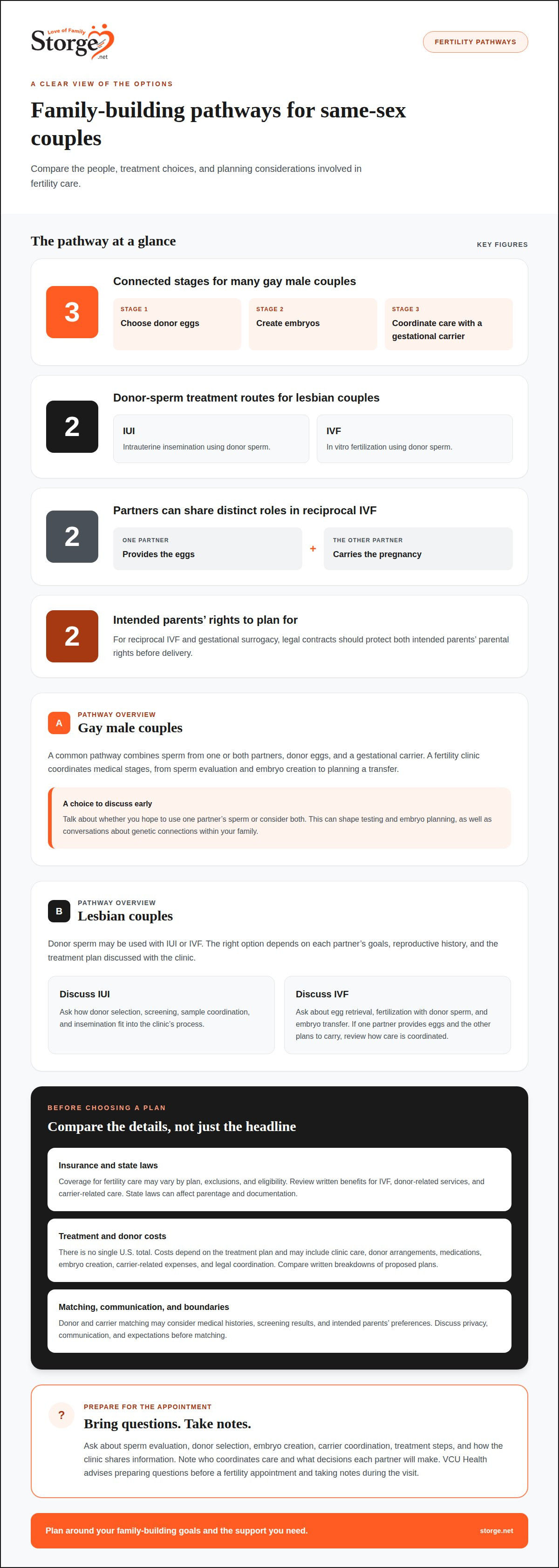
For gay men, egg donation and gestational surrogacy can form a family-building pathway. The process involves choosing donor eggs, creating embryos, and coordinating care with a gestational carrier.
Insurance Coverage and State Laws
Some employer-sponsored and individual insurance plans may cover parts of fertility care, but exclusions and eligibility terms vary. Review your plan’s written benefits for IVF, donor-related services, and carrier-related care. State laws can affect parentage and documentation, so identify the states connected to the intended parents and carrier. Legal planning should address both intended parents’ parental rights before delivery.
Treatment and Donor Costs
There is no single U.S. total for fertility treatment, donor sperm, egg donation, or gestational surrogacy. Costs depend on the treatment plan and may include clinic care, donor arrangements, medications, embryo creation, carrier-related expenses, and legal coordination. Compare the components in each proposed plan instead of relying on a headline figure. A written breakdown can help you see which steps contribute to the overall expense.
Donor and carrier matching typically considers medical histories, screening results, and intended parents’ preferences. Discuss which characteristics matter to your family and how the matching process takes them into account. For surrogacy, clinics coordinate medical care with donor selection, embryo creation, and carrier preparation. The sequence and timeline depend on completing these steps and coordinating appointments. Reciprocal IVF is a different pathway: one partner provides eggs, and the other carries the pregnancy.
Medical, Legal, and Emotional Risks
Before treatment, discuss the procedures involved, decisions each partner may need to make, and how information will be shared. Egg donation and carrier arrangements also bring distinct relationships and expectations into the process. Talk about privacy, communication, and boundaries before matching, so everyone understands the intended arrangement. For surrogacy, legal contracts should protect both intended parents’ parental rights before delivery. Storge offers attorney referrals to help families find legal support for this planning.
Fertility care for gay men
For gay men, a common pathway combines sperm from one or both partners, donor eggs, and a gestational carrier. A fertility clinic coordinates the medical stages, from sperm evaluation and embryo creation to planning a transfer. At an initial appointment, discuss whether you hope to use one partner’s sperm or consider both. That choice can shape testing and embryo planning, as well as how you talk about genetic connections within your family.
Clinics can support lesbian couples, gay male couples, and transgender patients by discussing family-building goals, relevant reproductive health, and treatment pathways. Ask for intake forms and communication that reflect your name, pronouns, and relationship. For example, a transgender patient may want a private conversation about which medical history is relevant to care. Clear communication helps the clinical team plan appointments and discuss options respectfully.
A practical first step is to bring questions about sperm evaluation, egg donor selection, embryo creation, and carrier coordination. VCU Health advises patients to prepare questions before a fertility appointment and take notes during the visit. Write down how the clinic explains each stage, who coordinates information, and what decisions you and your partner will make. Those notes make it easier to compare care plans and revisit details together.
Look for signs that a clinic’s environment acknowledges LGBTQ+ families, while considering how its care process fits your needs. Duke University Hospital, Duke Regional Hospital, and Duke Raleigh Hospital are recognized as LGBTQ+ Healthcare Equality Leaders by the Human Rights Campaign Foundation. Recognition can offer one point of context, alongside the clinic’s communication and the care pathway discussed at your appointment. For help exploring next steps, review fertility planning resources.
Fertility care for lesbian women
Lesbian couples may consider donor sperm with intrauterine insemination (IUI) or in vitro fertilization (IVF). The choice depends on each partner’s goals, reproductive history, and the treatment plan discussed with the clinic. At an appointment, describe who hopes to carry, whether both partners want a role, and any previous fertility care. These details help the team discuss relevant options instead of treating every couple’s plan as identical.
For IUI, discuss how donor sperm selection and insemination fit into the clinic’s process. Ask about donor information, screening, and how samples are coordinated with treatment appointments. If you have preferences about a donor’s background or available profile details, raise them early. Clear priorities can focus the selection process and help both partners understand the choices involved.
IVF may be considered when your goals or medical circumstances point toward that treatment. Ask the clinic to explain the stages, including egg retrieval, fertilization with donor sperm, and embryo transfer. If one partner provides eggs and the other plans to carry, discuss how the clinic coordinates each person’s care. Review the proposed sequence together so each partner understands the appointments and decisions connected to their role.
Before choosing a pathway, prepare questions about testing, treatment steps, and how the clinic communicates results. Ask how the care team records each partner’s role and includes both in discussions. For example, agree in advance who will attend appointments and how updates should be shared. These conversations can clarify expectations while keeping the process centered on your shared family-building goals.
Use the consultation to compare how the clinic explains IUI and IVF, donor choices, and care coordination. Take notes on the options discussed and identify anything you want to revisit as a couple. A thoughtful plan should connect your preferred roles with the treatment approach, rather than assume one pathway fits every family.
What fertility treatments do clinics offer same-sex couples, including IVF, IUI, reciprocal IVF, and donor sperm?
Clinics discuss treatment pathways based on who hopes to provide eggs or sperm, or carry a pregnancy. A lesbian couple, for example, may consider donor sperm with IUI or IVF. A gay male couple may explore IVF using donor eggs and a gestational carrier. Start by explaining your family-building goals and asking which options may fit.
Intrauterine insemination, or IUI, places donor sperm in the uterus during a treatment cycle. Ask how the clinic coordinates donor selection, sample handling, and appointment timing. If you want to compare donor profiles before choosing, clarify what information is available and how selection fits the care plan. This helps you understand the practical steps before beginning.
In vitro fertilization, or IVF, involves fertilizing eggs with sperm and transferring an embryo. Donor sperm may be used when neither partner is providing sperm. Gay male couples may use donor eggs and embryos created with one or both partners’ sperm, then coordinate care with a gestational carrier. Ask the clinic to explain the stages and how each person participates.
Reciprocal IVF gives both partners a direct role: one provides eggs, while the other carries the pregnancy. At a consultation, discuss how the clinic plans each partner’s care and coordinates the embryo transfer. A euploid embryo has 23 pairs of chromosomes, according to Virginia Center for Reproductive Medicine. Ask what embryo information the clinic uses to guide treatment discussions.
Donor sperm selection is a separate decision from choosing IUI or IVF. Consider which donor information matters to you, then ask how the clinic incorporates your preferences into its process. Compare the options by the roles each partner wants, the treatment steps involved, and how care is coordinated. For help exploring donor options, search for donor sperm resources.
For reciprocal IVF, the clinic plans care for the partner providing eggs and the partner carrying the pregnancy, then coordinates embryo transfer. For a gestational-carrier pathway, the clinic can discuss using donor eggs and embryos created with one or both partners’ sperm, and coordinate with the carrier. Ask how long each stage is expected to take.
Storge: Storge PLUS Membership
Storge PLUS Membership can be a next step when you’re ready to organize family-building support around your goals. Storge connects LGBTQ+ individuals and couples with fertility resources, including fertility clinic referrals and donor egg or sperm searches. For gay couples considering gestational surrogacy, Storge also offers gestational carrier searches and attorney referrals.
These resources can help you move from understanding treatment pathways to exploring support that fits your plans. Clinic referrals can help you identify a care pathway, while donor and carrier searches relate to the choices involved in building your family. Attorney referrals connect with the legal planning discussed earlier. Contact Storge to explore a next step that feels right for you.
Choose a next step that feels manageable
Your next move can be a conversation about what matters most to your family. Consider who hopes to take part in treatment, what support would help you feel prepared, and which decisions you want to explore first. These priorities can help you approach the search for the best fertility clinics for same-sex couples with a clearer sense of fit, without feeling pressure to settle every detail at once.
Storge can help you take that next step through Storge PLUS Membership, fertility clinic referrals, and attorney referrals. These resources offer a starting point for organizing your clinic search and finding support with the legal questions connected to family-building.
Explore your options with Storge and move forward at a pace that feels right for you. Your family’s path can begin with one thoughtful decision.
Frequently Asked Questions
Which U.S. fertility clinics are highly rated by same-sex couples?
The information here does not provide a verified ranking of the best fertility clinics for same-sex couples based specifically on patient ratings. Duke University Hospital, Duke Regional Hospital, and Duke Raleigh Hospital are recognized as LGBTQ+ Healthcare Equality Leaders by the Human Rights Campaign Foundation. That recognition relates to LGBTQ+ healthcare equality, not patient ratings or fertility outcomes. Treat it as one point of context, not a substitute for information about a clinic’s care and patient experience.
What should same-sex couples compare when choosing a fertility clinic?
Choosing the best fertility clinics for same-sex couples means comparing how clearly clinics explain treatment options, coordinate appointments, and include both partners in communication. Consider practical details such as travel requirements, scheduling, record-sharing, and whether care pathways align with your family-building plans. If partners have different treatment roles, note how responsibilities and updates will be coordinated. A written comparison can help you identify which clinic is the most workable fit for your circumstances.
How can patients verify a clinic’s success rates, LGBTQ+ expertise, and patient reviews?
Review published outcome information alongside patient feedback, and check what each source measures. Success rates can differ by treatment type and patient circumstances, so compare like with like rather than relying on a single headline figure. Look for specific descriptions of LGBTQ+ patient experiences, inclusive communication, and care coordination. Recent, detailed reviews can provide useful context, but individual reviews don’t establish a clinic’s overall outcomes.
What are the steps and timelines for reciprocal IVF or surrogacy at a fertility clinic?
In reciprocal IVF, one partner provides eggs and the other carries the pregnancy; the clinic coordinates both partners’ care and embryo transfer. Surrogacy involves selecting donor eggs, creating embryos, and coordinating carrier preparation. The sequence and timeline depend on completing these steps and coordinating appointments.


