

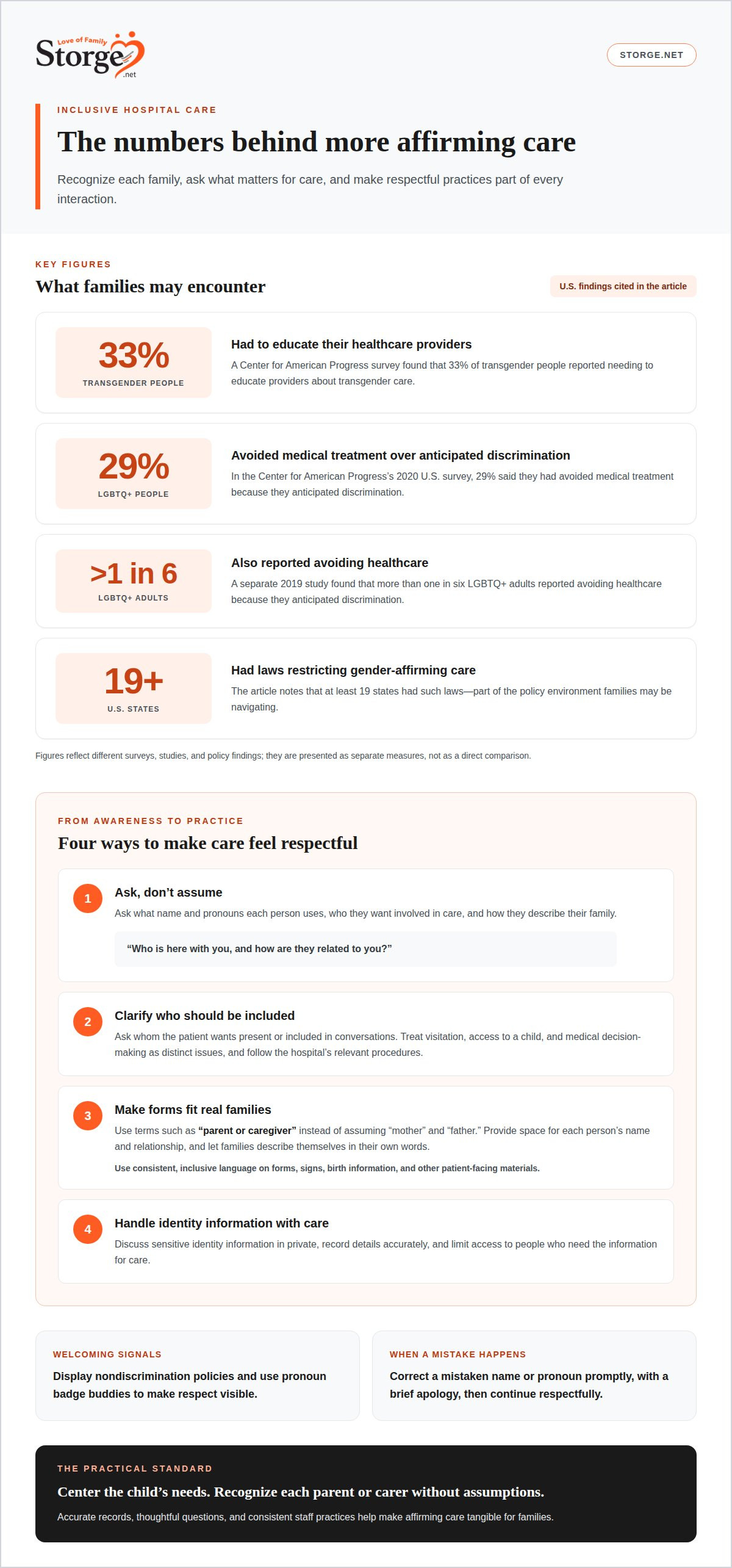
In a nationally representative survey, 33% of transgender people reported needing to educate their healthcare providers about transgender care, according to the Center for American Progress. Inclusive hospital care for LGBTQ parents starts with practitioners taking responsibility for respectful, informed support. Ask each person what name and pronouns they use, who they want involved in care, and how they describe their family.
For parents and carers, the way a hospital asks questions and records information can shape whether they feel safe, recognized, and able to focus on their family’s needs. Small, thoughtful changes can make everyday interactions more affirming.
This article explains practical ways practitioners can support LGBTQ+ parents and carers, from inclusive conversations to patient information, forms, and the careful collection of identity data.
You’ll learn how to recognize family relationships without assumptions, make written materials more welcoming, and handle sensitive information with privacy and respect.
Key Takeaways
- Build trust through staff awareness, welcoming signals, and calm, respectful responses when mistakes happen.
- Keep questions focused on care, and recognize each parent or carer’s role without assumptions.
- Review forms and patient information for language and imagery that reflect different family structures.
- Collect identity information sensitively, discuss it in private, and limit access to those who need it for care.
1. How can practitioners provide inclusive care for LGBTQ+ parents and carers?
Inclusive hospital care for LGBTQ parents means treating each family with dignity and centering the child’s needs. Practitioners can ask parents what name and pronouns they use, identify who should participate in care, and record those details accurately. Family-centered support also recognizes that a child may have two mothers, two fathers, transgender parents, or carers who are not biological relatives.
Which U.S. hospital accreditation programs or standards assess LGBTQ-inclusive care? Accreditation reviews can be considered alongside hospital policies and quality processes, including staff training, respectful communication, documentation, and family participation. A program’s name alone does not show how consistently these practices shape a family’s clinical experience.
Staff preparation matters. According to the Center for American Progress, 33% of transgender people reported needing to educate their healthcare providers about transgender care. Hospitals can use training and inclusive-care resources to build staff awareness of gender diversity, sexual orientation, LGBTQ+ family structures, and how discrimination can affect wellbeing. That preparation helps providers respond to the person in front of them, rather than relying on assumptions.
What does LGBTQ-inclusive hospital care for parents include? It means asking respectful questions, keeping accurate records, and creating a clinical environment where families can identify their relationships and care preferences without being challenged. For example, staff can display nondiscrimination policies, use pronoun badge buddies, and promptly correct a mistaken name or pronoun with a brief apology.
Inclusive care also means recognizing the policy environment families may face. At least 19 U.S. states had laws restricting gender-affirming care. Providers can explain relevant care processes clearly and handle each family’s needs with sensitivity. A welcoming setting, consistent staff practices, and patient-centered communication help make affirming care tangible for parents and children.
Inclusive questions about family and relationships
Start with questions that support care, not curiosity. A provider can ask, “Who is here with you, and how are they related to you?” Then ask whether each person should join conversations or support the child. This gives parents room to describe a spouse, partner, co-parent, chosen family member, or other caregiver in their own words.
Visitation, access to a child, and medical decision-making are distinct issues. Staff should ask whom the patient wants present and included, then follow the hospital’s relevant procedures for access and decision-making. A partner’s relationship to the child should not be assumed from appearance, gender identity, or who gave birth.
Discrimination can shape whether families seek support. In the Center for American Progress’s 2020 U.S. survey, 29% of LGBTQ+ people reported avoiding medical treatment because they anticipated discrimination. A separate 2019 study found that more than one in six LGBTQ+ adults reported avoiding healthcare for that reason. Respectful language and clear explanations can help reduce avoidable strain during a visit.
Practitioner awareness also means recognizing that lesbian, gay, bisexual, transgender, and other LGBTQ+ parents may face different barriers. A non-birthing parent, for example, may be overlooked, while a transgender parent may be misgendered. Ask each person how they describe their role and gender identity, and avoid making them repeatedly correct the record. Because discrimination can affect mental health, offer a private opportunity to discuss concerns and support needs.
Useful resources include a hospital’s patient relations team, social work support, and LGBTQ-inclusive care materials for staff and families. These can help address communication concerns and connect families with affirming care. Families considering where to seek care can explore a hospital search as one way to identify a setting that fits their needs.
3. Heteronormative forms and patient information
Patient forms can welcome LGBTQ+ families or make them explain themselves repeatedly. An intake form that asks for “mother” and “father” may not fit two mothers, two fathers, or a transgender parent. Use terms such as “parent or caregiver,” provide space for each person’s name and relationship, and let patients describe their family in their own words. Use the same language on signs, birth information, and other patient-facing materials.
What hospital policies protect LGBTQ parents and recognize both parents as legal guardians? Hospital nondiscrimination, visitation, and patient-identification policies can explain how staff treat families and document parent roles. Policies should distinguish a person’s relationship to the child from assumptions based on gender or who gave birth, while following applicable decision-making procedures.
Access remains a concern: at least seven U.S. states allowed doctors to turn away LGBTQ+ patients, as described in the episode. Patient navigation and advocacy can help families understand hospital processes, raise concerns through patient relations, and request respectful communication. Clear complaint procedures also help organizations identify gaps in staff practices and patient information.
What practical steps can LGBTQ parents take to prepare for a hospital stay or birth? Before admission, share preferred names, pronouns, contact details, and who should receive updates. Ask staff to record each parent or caregiver’s relationship accurately, and bring relevant decision-making documents if applicable. These details give the care team practical guidance without requiring families to explain their relationships at every interaction.
Patient-centered communication makes forms useful in real clinical encounters. Staff can confirm how patients want to be addressed, explain why information is requested, and promptly correct inaccurate entries. For example, a registration worker can replace an assumed “mother” label with the patient’s chosen parent title. Consistent language helps patients feel recognized and supports respectful care across departments.
4. Collecting sexual orientation and gender identity information
Ask about sexual orientation and gender identity during registration or a first visit as part of routine patient information. Explain why each question is asked, use clear and respectful language, and let patients describe their own identity. A person’s name, pronouns, gender identity, and sexual orientation are distinct details; don’t infer one from another. Record answers accurately so health professionals do not rely on assumptions or ask patients to correct the same information repeatedly.
Privacy matters as much as accurate information collection. Discuss sensitive information in a private setting, explain who may access it, and limit access appropriately, including access by family members. Family physicians should protect sensitive services, including STI, mental health, drug treatment, family planning, gender-affirming care, and intimate partner violence care, from disclosure in insurance billing documents such as explanations of benefits. Since billing documents can reach people beyond the clinical team, careful handling supports patient confidentiality.
A trauma-informed approach gives patients more control over sensitive conversations. Before asking a question, health professionals can explain its purpose, ask permission to continue, and avoid requesting details unrelated to care. For example, a patient can share the gender identity information relevant to their visit without being pressed to explain their history. If a patient seems uncomfortable, pause and offer to return to the topic privately. Respectful pacing can make disclosure feel less exposing.
Education helps teams collect information consistently and with cultural respect. Organizations can train registration and clinical staff to use inclusive terms, enter information correctly, and understand how confidentiality applies across workflows. Patient advocacy also means explaining how information will be used, correcting errors promptly, and giving patients a clear way to raise privacy concerns. These steps make identity data more useful for care while keeping the patient’s dignity at the center.
Storge: Hospital Search
Storge’s Hospital Search can support LGBTQ+ individuals and couples exploring hospital options as they plan fertility care, pregnancy, or birth. After considering how communication, family recognition, and privacy shape hospital experiences, using the search can be a practical next step toward finding a setting that aligns with a family’s needs.
It may be useful when comparing care settings or considering hospital options. Storge also offers Fertility Clinic Referrals, Attorney Representation Referrals, Donor Egg / Sperm Search, Surrogacy / Gestational Carrier Search, and Storge PLUS Membership to support different parts of the family-building journey. These resources address distinct needs, from exploring fertility options to searching for a hospital.
For support with your hospital search, contact Storge.
Take the next step with confidence
Inclusive hospital care for LGBTQ parents grows from everyday choices that recognize each family’s dignity and needs. A next step is to seek a care setting where respectful communication is part of the experience, while making decisions at a pace that feels right for you.
As you plan your family’s path, Storge offers Storge PLUS Membership, Attorney Representation Referrals, and Fertility Clinic Referrals. These resources can help you explore family-building options and find legal representation referrals alongside your hospital search.
Whether you’re preparing for a hospital stay or considering what support could help with future plans, you deserve information that meets you with respect. Contact Storge to discuss inclusive care and explore the support that fits your next step. Your family’s path is your own, and thoughtful decisions can help you move forward with greater confidence.
Frequently Asked Questions
How can practitioners provide inclusive care for LGBTQ+ parents and carers?
Practitioners can make family-centered care concrete by involving the people a parent identifies as important in routine planning. During a child’s discharge, for example, staff can ask which caregivers need instructions and how each person prefers to receive updates. Teams can also include LGBTQ+ family examples in staff education, supporting inclusive practice across registration, treatment, and follow-up.
Who is this resource for?
This resource is for hospital practitioners, administrators, and LGBTQ+ parents or carers seeking more respectful care. A registration lead might use it to review how family relationships are recorded, while a nurse could apply its ideas when coordinating a child’s care. Parents can also use these topics to explain what helps them feel recognized during a hospital visit.
How can hospitals use inclusive language and collect gender identity and sexual orientation information respectfully?
Hospitals can provide a private way to share identity information, explain its purpose in care, and let patients skip questions they do not wish to answer. Keep sexual orientation and gender identity in distinct fields, and avoid treating either as a proxy for family structure. For example, record a patient’s partner or parenting role separately from identity data.
How can hospitals support LGBTQ parents during pregnancy, birth, adoption, and NICU stays?
Hospitals can assign a clear point of contact for family communication and include parents in care planning throughout pregnancy, birth, adoption-related stays, and NICU care. For a NICU admission, staff can explain how updates are shared, who may participate in rounds, and how caregivers can receive feeding or discharge instructions. Consistent coordination helps families avoid repeating essential information to different teams.
What barriers and discrimination do LGBTQ parents face in hospital care, and what are the health impacts?
LGBTQ+ parents may encounter misgendering, intrusive questions, or a partner whose parenting role is overlooked. These experiences can create stress, weaken trust, and make families less willing to seek care or share relevant concerns. For a child who needs continuing support, delayed visits or guarded communication can also make it harder for caregivers to participate fully in care planning.
How can LGBTQ parents find LGBTQ-affirming hospitals and providers near them?
Look for practical signs of an affirming setting, such as clear nondiscrimination statements, inclusive patient materials, and a defined process for addressing concerns. In an initial conversation, describe your family’s needs, including who should receive updates or take part in care discussions. The hospital’s response can help you understand its processes before a planned admission or birth.


