

A welcoming reputation alone cannot show how a hospital will support your family during birth. Finding a supportive hospital for an LGBTQ+ birth means looking at specific practices, especially staff training, respectful communication, and whether visitation policies include the people you consider family.
It makes sense to want more than reassuring language when choosing where to give birth. A directory profile can help you identify possible options, but providers create profiles voluntarily and are not individually screened when they sign up.
This guide will help you assess a hospital’s LGBTQ+ care, flexibility around birth planning, and visitation policies in light of your preferences. You’ll learn what to ask about staff experience, how to interpret directory information, and why clear visitation policies matter for the people you want beside you.
Key Takeaways
- Look beyond welcoming language by considering staff training in LGBTQ+ care and whether queer providers are part of the care team.
- Identify which parts of your birth plan matter most, then use them to assess how well a hospital’s approach fits your preferences.
- Review visitation policies with your chosen support people in mind, so you can understand who may be present during care.
- Trans and nonbinary parents can consider whether maternity care feels affirming and whether a queer doula could offer additional support.
Refining search results by patient preferences
Start with the care practices that affect your comfort, identity, and birth experience. Then narrow your search by location, maternity specialty, and the support people you want involved.
Hospital Safety and Patient Experience
Compare hospitals by reviewing their LGBTQ+ care information, staff training, and whether queer providers are on staff. These details can help you assess patient experience alongside your own priorities. A hospital profile can be a starting point, but profiles in the LGBTQ+ Healthcare Directory are voluntary, and providers are not individually screened when they sign up. The directory asks providers to affirm their commitment to equality for LGBTQ+ patients.
Use a profile to identify what to explore further, not as a complete measure of care. If a trained team and compassionate responses to concerns matter to you, for example, note those preferences as you compare options. Look for clear information about how the hospital supports patients across identities. Assess relevant practices rather than relying on a broad label alone.
Nearby LGBTQ Birth Support
To find LGBTQ+ birth doulas, midwives, and patient advocates, use community referral networks and search by location and specialty. The LGBTQ+ Healthcare Directory lets you search by ZIP or postal code, specialty or medical issue, or a combination of these. The filters can help you find relevant profiles near your home or chosen hospital.
Review each profile for details that match your needs, such as experience supporting LGBTQ+ patients and the type of birth care offered. Directory profiles are voluntary, so treat them as leads, not proof of a particular experience. A queer doula may provide additional support with birth planning and labor. As you compare options, consider whom you would feel comfortable discussing identity-related concerns with and who could help communicate your preferences.
Keep your search focused on location, specialty, and the kind of affirming support you want. These criteria offer a practical way to narrow your options while keeping your priorities at the center.
Comfort and flexibility in birth planning
A birth plan can record the language, touch, and support that help you feel respected. Costs and insurance coverage depend on the care provided, your plan’s benefits, and how each service is covered.
Inclusive Maternity Services
For transgender and nonbinary parents, affirming maternity care includes respectful communication about identity, anatomy, and preferred terms. During prenatal planning, note which words feel comfortable and how you want staff to discuss pregnancy, feeding, and examinations. Sharing these preferences can reduce the strain of correcting language during care and help keep the focus on your well-being.
Consider whether the clinic can include your chosen support people in planning and make space for concerns about stigma or mental health. A queer doula may offer additional emotional and practical support during birth. Think about which conversations you want to have privately and whom you want present.
Questions for Tours and Prenatal Visits
Use a tour or prenatal visit to understand how the hospital puts respectful care into practice. Ask who can see your name and pronouns, how staff receive training in LGBTQ+ patient-centered care, and how your birth preferences are shared across the care team. You can also ask how to raise concerns if language or treatment feels uncomfortable.
- How can I record my name, pronouns, and preferred language?
- How will staff discuss my body and the care I receive?
- Can my chosen support people join planning conversations?
- Who can help address a concern during a visit or birth?
- How can I discuss mental health or wellness needs privately?
For insurance planning, review the benefits that apply to maternity care and ask how your coverage handles the services in your plan. Coverage can vary by policy and service, so focus on the care you expect to use and how it will be billed. Raising these questions at a prenatal visit can help you shape a plan around your needs and preferences.
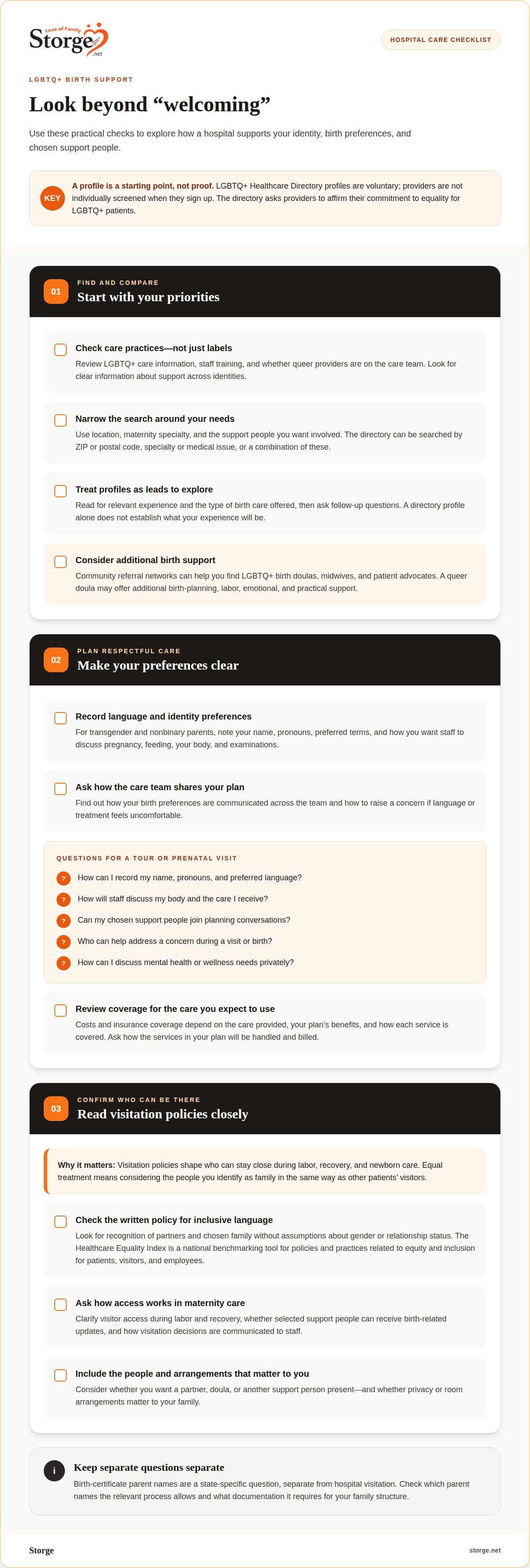
Equal hospital visitation for LGBTQ+ patients and families
Visitation policies shape who can stay close during labor, recovery, and newborn care. For LGBTQ+ families, equal treatment means considering the people you identify as family in the same way as other patients’ visitors.
The Human Rights Campaign Foundation’s Healthcare Equality Index is a national benchmarking tool that evaluates healthcare facilities’ policies and practices related to equity and inclusion for patients, visitors, and employees. Use that framework to consider whether a hospital’s written policy addresses partners, chosen family, and visitors without assumptions about gender or relationship status. Henry Ford Health’s hospital visitation policies grant equal visitation to LGBTQ+ patients and their families.
Look beyond a general statement of welcome. Consider how visitation works in the maternity unit, during labor, and after birth. Think about whom you want present, such as a partner, doula, or other support person, and whether privacy or room arrangements matter to your family. A clear policy can show how the hospital intends to treat your chosen support people.
- Does the written policy recognize chosen family and partners?
- How does the maternity unit handle visitor access during labor and recovery?
- Can your selected support people be included in birth-related updates?
- How are visitation decisions communicated to staff caring for you?
Birth-certificate parent names are a separate, state-specific question. For your state, focus on which parent names the relevant process allows and what documentation it requires for your family structure. This helps you identify the rule that applies rather than assume hospital visitation policies determine how parent names appear.
Keep these questions with your birth preferences to make the conversation specific. Equal visitation is one part of affirming care: it helps partners and family members stay present as your support team, while respectful treatment recognizes the family you are building.
What LGBTQ-inclusive maternity services are available for transgender and nonbinary parents
Affirming maternity care should address your pregnancy needs without making assumptions about gender or family structure. A prenatal conversation, for example, can cover the language you prefer for your body, examinations, feeding, and birth. Clear communication helps you explain what feels respectful and what support you want during care.
Consider how the care team will carry your preferences from prenatal visits into labor and postpartum care. You might ask how staff will use your name and pronouns, what terms they use for pregnancy-related care, and how you can share sensitive information privately. These practical details can help you prepare for interactions throughout your care.
A queer doula may offer additional support with birth planning and labor. Think about what you want that person to help with, such as communicating your preferences, offering emotional support, or keeping your chosen support people involved. A doula’s role can complement the clinical care your maternity team provides.
- Discuss the words you want staff to use for your body and care.
- Identify which parts of pregnancy or birth feel sensitive to discuss.
- Ask how preferences can be shared across prenatal, labor, and postpartum care.
- Consider whether a queer doula would help you feel supported during birth.
For transgender and nonbinary parents, a useful measure is how a service responds to your stated needs. For example, a respectful conversation about an examination can include an explanation of what will happen and space for you to express preferences. You can also raise concerns about stigma or mental health as part of your support plan, without reducing your experience to your identity.
If you’re comparing maternity settings, explore hospital search support to focus your search on the care environment and birth experience that matter to you.
If you are seeking LGBTQ+-affirming birth care, consider exploring support from a queer doula. Reflect on whether that kind of support fits your preferences and discuss it with your maternity team.
Storge: Hospital Search
Storge’s Hospital Search helps LGBTQ+ individuals and couples look for a birth setting that fits their priorities. Use it when weighing factors such as LGBTQ+ care, birth-planning preferences, and visitation policies, and when you want support narrowing your hospital search.
Let your preferences guide the decision. You may want affirming communication, flexibility around your birth plan, or clear recognition of your chosen support people. Identifying what matters most can focus your search and help you compare hospitals against your family’s needs.
Choosing a hospital is a personal decision, and you can take it one step at a time. If you’re ready to discuss your hospital search, contact Storge.
Take the next step with your family’s priorities in mind
Finding a supportive hospital for LGBTQ birth can help you shape a birth experience that reflects your family’s needs. As you continue your search, let your priorities guide the conversations ahead. You do not need to settle every detail at once. Start by deciding what you most want your care team to understand and what would help you feel included.
Storge can support other parts of your family-building journey through Storge PLUS Membership, attorney referrals, and fertility clinic referrals. These resources can help connect different planning needs as you consider the birth experience you are working toward.
If you’d like support considering your options, contact Storge to discuss your next steps. Your path can take shape at a pace that feels right for you, with your family’s needs at its center.
Frequently Asked Questions
How do you know these providers really are LGBTQ+ friendly?
A directory listing can help you find leads, but it is not proof of a particular care experience. Providers create LGBTQ+ Healthcare Directory profiles voluntarily and are not individually screened when they sign up, though the directory asks them to affirm their commitment to equality for LGBTQ+ patients. Consider how a provider describes their approach and whether their answers address your priorities clearly and respectfully.
Which hospitals have LGBTQ-inclusive childbirth policies and staff training?
Henry Ford Health provides training for providers and employees on LGBTQ+ patient-centered care and unconscious bias. Its hospital visitation policies grant equal visitation to LGBTQ+ patients and their families. The Human Rights Campaign Foundation’s Healthcare Equality Index evaluates healthcare facilities’ policies and practices related to equity and inclusion for patients, visitors, and employees. These examples can help you identify policy areas to consider when comparing maternity settings.
What risks of discrimination or mistreatment should LGBTQ parents consider when choosing a hospital?
Consider how a hospital would respond to misgendering, assumptions about your partner, or questions about your family structure. These situations can affect your comfort and willingness to share concerns during care. Think about whom you could approach if an interaction feels disrespectful and whether your chosen support people can help communicate your preferences. Planning for these situations can make your priorities easier to express.


