

A fresh donor egg cycle can cost more than the donor’s compensation alone.
That broader picture matters when you’re planning a family: a quoted donor fee may not reflect the full cost of care, from screening through transfer. It’s also reasonable to ask what happens if screening disqualifies a donor after planning has begun. Fresh egg donors must undergo infectious disease testing as determined by the FDA, and a positive result disqualifies the donor. Because clinics package care differently, headline totals may include different services.
This guide explains expenses that may fall outside the donor fee, where insurance may help and where coverage can vary, and what donor disqualification can mean financially. It also compares fresh-cycle costs with other donor-egg treatment expenses, helping you build a clearer budget and make informed decisions.
Key Takeaways
- Separate clinic, medication, testing, legal, and storage charges to see what a donor fee may leave out.
- Learn why insurance coverage for fertility treatment may not mean every donor-related expense is covered.
- Understand how donor compensation and screening contribute to a fresh-cycle budget.
- Consider how donor disqualification can affect costs, and which agreement terms shape what happens next.
Clinic fees, medications, and testing not included
Donor compensation is only one part of a fresh-cycle budget. Planning for the hidden costs of using a fresh egg donor starts with separating donor expenses from clinic services.
Psychological evaluation is one part of donor screening. The bill may group screening services together or list them separately. A written estimate shows how each charge contributes to the total.
Donor Screening and Medical Testing
Screening evaluates the donor before treatment, while medical testing provides information used in fertility care. An estimate that combines screening, retrieval, and medication covers more than testing alone. These categories help explain why screening estimates differ depending on what each program includes.
Donor and Recipient Medications
Medication covers different stages for the donor and recipient. Separate estimates help distinguish medication from screening and clinic fees. The hidden costs of using a fresh egg donor are easier to track when each medication plan has its own line item.
Monitoring, Lab, and Storage Fees
Clinic fees, laboratory work, and embryo storage are separate cost categories. Storage may continue beyond the transfer cycle.
| Option | What it covers | Cost detail |
|---|---|---|
| Donor screening | Screening and retrieval budget | |
| Medication | Donor stimulation and recipient treatment | |
| Lab and storage | Embryo culture, freezing, ongoing storage |
Choose an estimate that itemizes screening, both medication plans, laboratory work, freezing, and storage so each expense is visible.
Will insurance cover Donor Egg IVF?
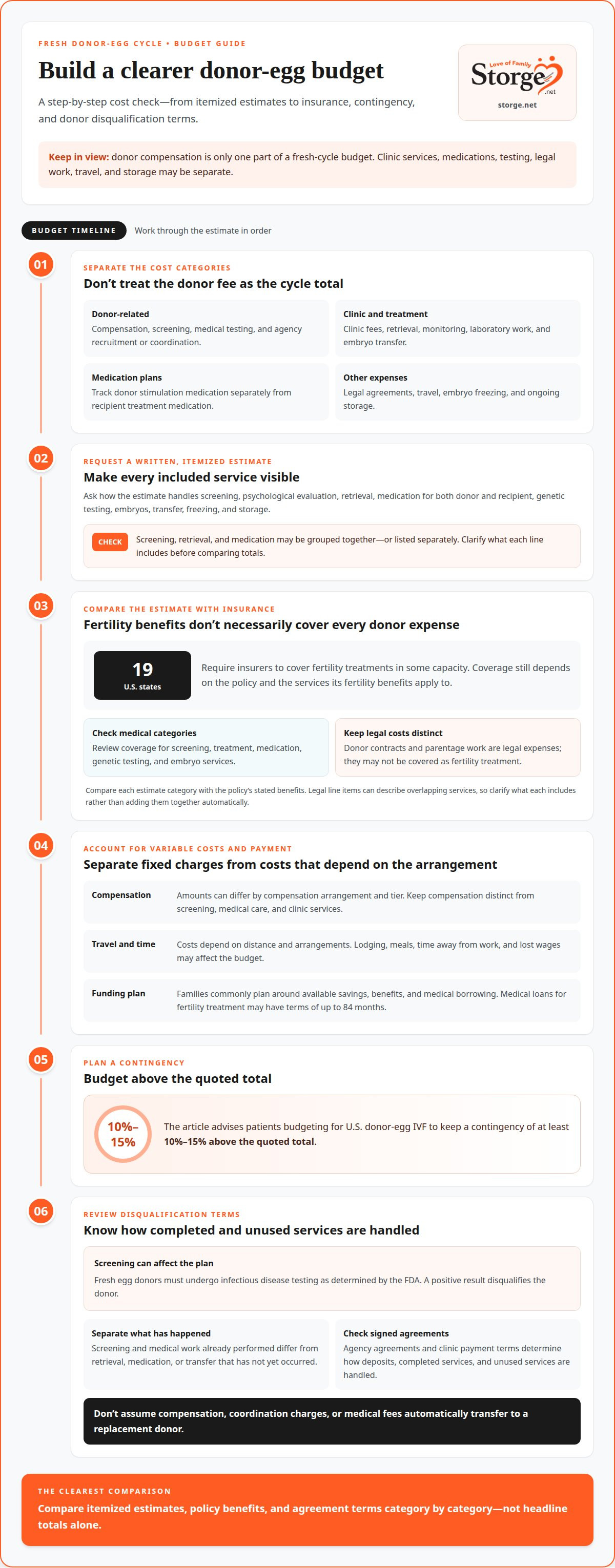
Fresh donor egg costs can vary by clinic, agency, state, and insurance coverage. Nineteen U.S. states require insurers to cover fertility treatments in some capacity, but that does not mean every policy covers donor screening, legal fees, or every treatment component. Coverage depends on the policy’s fertility benefits and the services those benefits apply to.
Separate medical and legal expenses in the estimate. Insurance benefits may cover fertility treatment, while donor contracts and parentage work are legal expenses. A written estimate that identifies screening, medication, genetic testing, embryos, and embryo transfer makes it easier to compare clinic charges with the services covered by a policy.
Legal costs are a separate category. Fees for a donor contract and parentage work may be grouped differently. Because these figures can describe overlapping services, don’t add them together automatically. The estimate should clarify what each line includes.
For a known donor, legal planning can include reviewing the donor agreement and parentage issues. Intended parents are advised to consult an attorney, preferably one who specializes in reproductive law. This consultation is separate from fertility-clinic coordination, medical screening, and genetic testing, each of which addresses a different part of the arrangement.
To estimate likely out-of-pocket costs, organize expenses by category: medical screening, clinic treatment, legal agreements, and services involving frozen embryos. Then compare each category with the insurance policy’s stated fertility benefits. For example, a policy that covers some fertility treatments may still exclude donor-contract fees. State requirements and policy terms shape what is covered, while clinic and agency estimates show how charges are grouped. This breakdown gives intended parents a clearer basis for financial planning.
How do most patients pay for donor-egg IVF?
Donor compensation is a major budget line, separate from clinic treatment and coordination. The amount depends on the compensation arrangement, so it should not be mistaken for the full cycle cost.
Agency coordination also has its own fee. Estimates may include overlapping service categories, rather than separate add-ons. A detailed budget distinguishes donor compensation from recruitment and coordination, making clear what each charge covers.
Tiered compensation schedules can make donor costs look different from one program to another. Each tier should state the compensation amount and distinguish it from screening, medical care, and clinic services. The combined estimate helps explain why a donor’s compensation alone does not represent all donor-related expenses.
Travel adds another variable for donors and intended parents. Costs depend on distance and arrangements; lodging, meals, and time away from work can also affect a family’s budget. Lost wages vary according to each person’s work situation and time away, rather than a standard fee.
Families commonly plan around available savings, benefits, and medical borrowing. Medical loans for fertility treatment may have terms of up to 84 months. Patients budgeting for U.S. donor-egg IVF are advised to keep a contingency of at least 10%-15% above the quoted total. A practical payment plan lists donor compensation, coordination, screening, travel, and clinic charges separately, then identifies which funds will cover each category. This helps intended parents see where genetic testing, monitoring, or storage may fit without confusing those expenses with donor payment.
Costs when a donor is disqualified
A donor’s disqualification can interrupt a fresh cycle after screening, coordination, or other steps have begun. In the United States, fresh egg donors must undergo infectious disease testing as determined by the FDA, and a positive result disqualifies the donor. The financial impact depends on which services have already taken place and what the signed agreements say about payments.
Separate completed expenses from future ones. Screening and medical work already performed differ from retrieval, medication, or embryo transfer that has not yet occurred. The agency agreement and clinic payment terms determine how deposits, completed services, and unused services are handled. Don’t assume donor compensation, coordination charges, or medical fees automatically transfer to a replacement donor.
Timing matters. Disqualification before medication or retrieval affects planned steps differently from costs already incurred for screening and coordination. If embryos have already been created, ask how the clinic’s treatment plan addresses them before arranging another retrieval. A frozen egg cycle is a separate option with its own treatment planning and payment terms, not an automatic substitute for an interrupted fresh cycle.
Intended parents can map the financial impact by listing expenses against each stage: donor screening, agency coordination, medication, retrieval, laboratory work, and transfer. Then mark whether each item is complete, pending, refundable, or transferable under the applicable agreement. This record helps distinguish expenses already incurred in a stopped cycle from charges for future treatment. It also clarifies whether compensation has been paid and how the agreement addresses a replacement donor.
An egg bank offers another pathway to discuss when restarting with a fresh donor no longer fits the treatment plan. Frozen eggs change the process, so compare the clinic’s plan and payment schedule rather than assuming prior fresh-cycle expenses apply. For support with finding a donor, explore donor egg search as you consider the next step.
Storge: Donor Egg / Sperm Search
Storge’s Donor Egg / Sperm Search helps LGBTQ+ individuals and couples explore donor options while planning a family or considering next steps after a donor is disqualified. Finding a donor is only one part of the process. Intended parents may also need fertility clinic or attorney referrals to coordinate care and legal planning. These referrals connect members with relevant resources, and Storge PLUS provides access to a broader fertility-support community. If your plans have changed, donor search and referral resources can help you consider your next step with greater clarity. Explore Storge PLUS to connect with donor and fertility resources.
Make Your Next Step With Clarity
Planning for the hidden costs of using a fresh egg donor also means deciding what matters most to your family: the donor arrangement, treatment path, and support you want around each decision. You don’t need to resolve every detail at once. A useful next step is to write down your priorities and identify which decisions call for medical guidance, legal planning, or donor selection.
That list can turn a complex process into manageable conversations. It helps you discuss your goals, understand the choices ahead, and keep your plans centered on the family you hope to build. Your path can take shape one considered decision at a time.
Contact Storge to discuss your options and explore a next step that feels right for you.
Frequently Asked Questions
What is Donor Egg IVF and how much does it cost?
Donor egg IVF uses eggs from a donor, fertilizes them in a laboratory, and transfers the resulting embryos to the intended parent or a gestational carrier. The total depends on which medical, donor, agency, and legal expenses are part of the treatment plan.
What does the cost of egg donation actually include?
The total may combine donor compensation, screening, agency coordination, clinic treatment, medications, laboratory work, legal expenses, and travel. Some estimates also account for optional genetic testing, embryo freezing, storage, or another transfer. For example, a quoted program price may cover donor matching and treatment but list embryo storage as a separate ongoing expense. The included services determine what the headline amount represents.
Is frozen or fresh cheaper?
Frozen donor eggs generally cost less overall than a fresh donor cycle, although each total reflects different services. Frozen treatment uses eggs already retrieved and frozen, while a fresh arrangement involves coordinating a donor’s cycle. Compare totals only when both estimates include comparable treatment steps.
What is the total cost of using a fresh egg donor in the United States?
The final budget depends on donor compensation, clinic care, medication, screening, agency coordination, legal work, and related treatment expenses. For a useful comparison, review the full cycle estimate rather than donor compensation alone, and note whether it includes additional transfers or embryo storage.
What fees are commonly excluded from advertised fresh donor egg program prices?
Common additional expenses can include optional PGT-A testing, embryo freezing and storage, travel, and legal fees. An advertised program price may not include all these items, so compare the services covered by each estimate.
How much do donor compensation, agency fees, and matching fees cost?
Matching may be included in an agency’s services rather than listed as a separate charge. Check the estimate’s fee labels and included services to understand what the total covers.


