
Financial support for surrogacy can come from several types of programs. Some organizations also offer assistance for adoption.
Searching for support can feel complicated because every program has its own purpose, eligibility rules, and application timing. A grant may cover only one part of a broader plan, rather than provide complete funding. This guide explains grants and other forms of assistance that may support family building, including surrogacy and adoption, along with discounts and sliding-scale options. It also covers why eligibility matters, how application windows affect planning, and how to weigh potential support alongside the other parts of your path to parenthood.
Key Takeaways
- Learn which organizations may support gay fathers-to-be and what kinds of assistance they offer.
- See how grants can contribute to gestational carrier expenses and what eligibility factors may shape an application.
- Explore agency discounts, fee waivers, and sliding-scale options as possible parts of a broader funding plan.
- Understand how adoption and surrogacy grants differ, and why application timing can matter.
1. Organizations supporting gay fathers-to-be
Organizations can help intended parents find fertility resources, community, and financial support. The Chicago Coalition for Family-Building is one organization to know. Its infertility treatment applicants must be 41 years or younger by January 1 of the subsequent year. That age rule can shape whether its program fits a prospective parent’s plans. Peer support matters too. A local LGBTQ+ family group can offer conversations with men having babies through donor conception or surrogacy. Those discussions can help intended parents prepare questions about clinic care, donor arrangements, and the surrogacy journey.
Third-party reproduction can involve several distinct needs: a fertility clinic, an egg donor, a gestational carrier, and legal representation. A fertility organization may connect you with relevant resources, while a peer community can offer practical perspective on the emotional transitions. Create a resource list that separates financial assistance from referrals and community support. This makes it easier to see which organization addresses each part of your plan.
State parentage rules also matter. According to the Massachusetts General Court, the Massachusetts Parentage Act took effect January 1, 2025, and parentage may be granted regardless of marital status, biological relation, or sexual orientation. New York State’s Child-Parent Security Act took effect on February 15th, 2021, legalizing gestational surrogacy and providing a simpler path to establish legal parental rights, according to the New York State Senate. California Family Code § 7962 allows both intended parents to be declared legal parents in a pre-birth order regardless of sexual orientation, marital status, or genetic connection. Michigan’s Surrogacy Parentage Act took effect on April 1, 2025; at least one party must be a Michigan resident, and all parties must use a Michigan-licensed attorney. Illinois’s Equality for Every Family Act strengthened the Illinois Gestational Surrogacy Act, 750 ILCS 47/, with explicit LGBTQ+ protections in 2025.
Surrogate compensation is one part of a broader arrangement that also involves medical and emotional care. Gestational carrier candidates must have had a previous uncomplicated pregnancy and delivery. They must be medically and emotionally healthy and demonstrate financial stability. Candidates also meet with an attorney and undergo evaluation by a mental health professional. These safeguards help clarify the responsibilities involved for everyone.
2. Grants that can help cover gestational carrier costs
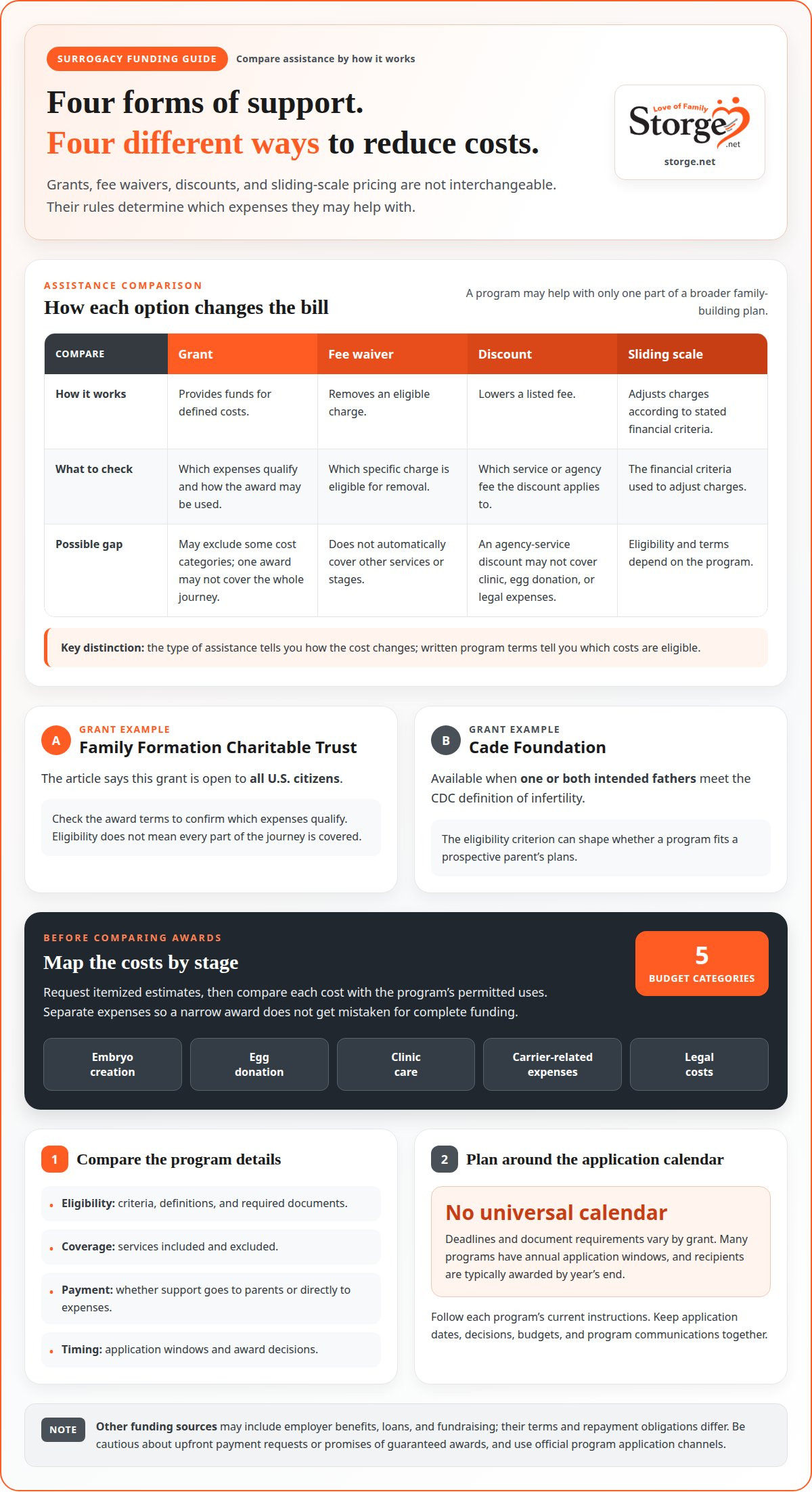
Grants for gay men seeking surrogacy may help with expenses, but each program sets its own eligibility criteria and award terms. The Family Formation Charitable Trust grant is open to all U.S. citizens. The Cade Foundation grant is available when one or both intended fathers meet the CDC definition of infertility. These examples show why eligibility matters as much as the award amount.
Deadlines and required documents vary by grant, so there is no universal application calendar or document list. Many programs have annual application windows, and recipients are typically awarded by year’s end. Review each program’s current instructions and prepare a clear budget separating embryo creation, egg donation, clinic care, carrier-related expenses, and legal costs. A program may limit which costs qualify, so check its award rules before planning how to use the funds.
Grants and other financial assistance for gay men pursuing surrogacy include charitable programs such as the Family Formation Charitable Trust and the Cade Foundation. Eligibility differs: the former is open to all U.S. citizens, while the latter has an infertility criterion. Grant terms also determine whether support applies to agency fees, IVF, egg donation, legal expenses, or medical costs. Don’t assume one award will cover every part of the journey.
For a clearer funding plan, request itemized estimates for each stage, including clinic services, embryo creation, pregnancy-related care, and professional support. Compare those categories with each grant’s permitted uses. Employer benefits, loans, and fundraising can also be considered, but their terms and repayment obligations differ. Track application dates and decisions in one calendar, and save copies of budgets and program communications. Be cautious about upfront payment requests or promises of guaranteed awards; use official program application channels. This preparation helps you understand funding gaps before committing to the next step.
Application windows and document requirements vary by grant. Many programs accept applications annually and typically award recipients by year’s end, so follow each program’s current instructions.
3. Agency grants, fee waivers, discounts, and sliding-scale pricing
Funding doesn’t always come as a charitable grant. Agencies may offer grants, fee waivers, discounts, or sliding-scale pricing, each of which reduces expenses differently. A grant provides funds for defined costs, while a fee waiver removes an eligible charge. A discount lowers a listed fee, and sliding-scale pricing adjusts charges according to stated financial criteria. Understanding these differences can help intended parents identify which assistance could meaningfully reduce a budget gap.
Start with a comparison table. Record each program’s eligibility rules, covered services, application timing, and whether support is paid to parents or applied directly to expenses. For example, a discount limited to an agency service won’t necessarily help with fertility clinic care, egg donation, or legal expenses. A grant may also exclude specific categories. Separating costs by stage makes it easier to identify what remains unfunded.
Infertility criteria can affect access to some assistance programs, while others may consider financial need or household circumstances. Read the written terms for definitions, required documents, renewal conditions, and restrictions on combining awards. Treat each program as a separate source of support rather than assuming one approval covers every step. Update your budget as expenses arise, from clinic planning through pregnancy support.
For clearer cost planning, organize estimates by service and stage, then compare them with the program’s stated coverage. Costs depend on the circumstances and the services and support involved; request estimates based on your needs. This helps distinguish an actual reduction from a delayed payment or conditional benefit. Review the full terms before relying on assistance, especially exclusions, repayment language, or deadlines. A side-by-side record helps you plan for welcoming a child without treating a possible discount as guaranteed funding.
4. Grants for adoption and surrogacy
Adoption and gestational surrogacy are different paths to parenthood, so financial assistance programs may assess them differently. A grant’s family-building focus doesn’t mean every expense or path qualifies. For gay couples, a useful first step is matching the intended path to the program’s written eligibility rules and permitted uses. This distinction can keep an application focused and prevent assumptions about what support will cover.
Two named programs illustrate how eligibility can differ. The Family Formation Charitable Trust grant is open to all U.S. citizens. The Cade Foundation grant is available when one or both intended fathers meet the CDC definition of infertility. These criteria matter whether parents are considering adoption or gestational surrogacy. Review applicant requirements separately from a program’s grant amount or family-building mission.
Build separate budgets for adoption and surrogacy before preparing an application. For a gestational plan, group projected expenses by embryo creation, egg donation, clinic care, carrier support, and legal needs. For adoption, organize expenses according to the specific process and services involved. Then compare each category with the grant’s stated eligible uses. This practical step can reveal whether a program could address a genuine funding gap.
Keep an application file with the program’s eligibility terms, required forms, budget, and submission dates. Grant programs may have annual application windows, so an early start can give applicants more time to assemble materials. Check the official program’s current instructions for deadlines and document requirements, since these vary. Don’t assume that an award for one route transfers to another, or that a program supports every expense. The clearest takeaway is to treat adoption and gestational surrogacy as distinct plans, then seek gay parenting assistance whose written criteria align with the path you intend to pursue. This careful approach supports equality by grounding decisions in each program’s actual rules.
Storge: Surrogacy / Gestational Carrier Search
Storge’s Surrogacy / Gestational Carrier Search connects intended parents with gestational carrier resources as they move from funding research toward planning. It can be a useful next step as you map the support your family needs alongside grant applications. Storge also offers Fertility Clinic Referrals and Attorney Representation Referrals for other parts of the process. Storge PLUS Membership provides access to fertility resources through the platform.
Every family’s path is personal. Consider which connections could help you move forward, whether you’re exploring carrier search, clinic referrals, or attorney referrals. For gay men pursuing parenthood, bringing these needs into one thoughtful plan can clarify next steps without assuming financial assistance will cover every expense.
Contact Storge to explore support for your family-building journey.
Take the Next Step With a Plan That Fits Your Family
Choosing a path to parenthood is personal, and funding decisions work best when they support the family you hope to build. A thoughtful plan for grants for gay men seeking surrogacy can clarify more than the application process: it can also identify the connections and resources that matter for your next stage. Take decisions in sequence, with your priorities and circumstances in view.
Storge offers Storge PLUS Membership, Fertility Clinic Referrals, and Attorney Representation Referrals to help you connect with resources relevant to your family-building process. These connections can complement your planning as you consider the support you need and the steps ahead.
When you’re ready to explore what could fit your situation, Contact Storge to explore your options. Your family’s path can begin with one clear, considered step.
Frequently Asked Questions
What Are LGBTQ+ Fertility Grants?
LGBTQ+ fertility grants are financial awards that help eligible applicants pay for certain family-building expenses. They may support a defined part of treatment or another eligible step, rather than every expense involved. For example, an intended parent might use an award toward a qualifying expense while planning separately for costs the program excludes. Read the grant’s rules to understand its purpose, eligibility criteria, and permitted uses.
When is the right time to apply?
Explore programs while you’re planning, before relying on an award to fund a specific commitment. Some grants have annual application windows, so preparing early gives you time to assemble the required materials. Create a calendar for deadlines and decision dates, and keep your budget up to date. Timing matters because an award decision may not align with when an expense is due.
Where and for who are Gay Surrogacy Grants available?
U.S. charitable programs offer surrogacy grant opportunities, with eligibility determined by each organization. Some consider citizenship, while others may apply an infertility criterion. Same-sex intended parents can assess programs by their stated requirements rather than assuming every grant uses the same eligibility rules. Review geographic and applicant criteria before investing time in an application.
Are there state, local, or nonprofit surrogacy grants specifically for LGBTQ+ intended parents?
Nonprofit family-building assistance may be available, but programs don’t all limit eligibility to LGBTQ+ applicants. The Family Formation Charitable Trust grant, for example, is open to all U.S. citizens, while the Cade Foundation grant has an infertility criterion. Some organizations may focus on fertility treatment rather than surrogacy expenses. Compare each program’s stated purpose and eligible costs with your family-building plan.
What are the application deadlines, award amounts, and required documents for surrogacy grants?
Deadlines and required documents vary by grant. Many programs have annual application windows and typically award recipients by year’s end. Follow each program’s current instructions.


