

What if the path to preserving fertility involves more than one way to seek support? Financing for transgender fertility preservation may involve grants, insurance coverage, and funding resources for IVF and assisted reproduction, with eligibility shaped by each program’s criteria and the terms of an individual insurance plan. Advocacy can also play a role in addressing coverage barriers.
It’s understandable to want clear answers before making decisions about fertility preservation and gender-affirming hormone therapy. This guide explains funding avenues to explore, what insurance may cover, and how to advocate for access to care. You’ll also find practical ways to plan next steps, whether you’re considering egg, sperm, or embryo preservation.
Key Takeaways
- Identify grants that align with your fertility-preservation needs, then review their eligibility rules and application requirements.
- Explore funding options for IVF and assisted reproduction, and understand how the type of treatment can shape your search.
- Review your insurance benefits and learn how clear documentation and advocacy can help you address coverage questions.
- Understand what to ask about payment plans or discounted rates, and how fertility clinic referrals can help you find a next step.
Grants for fertility preservation
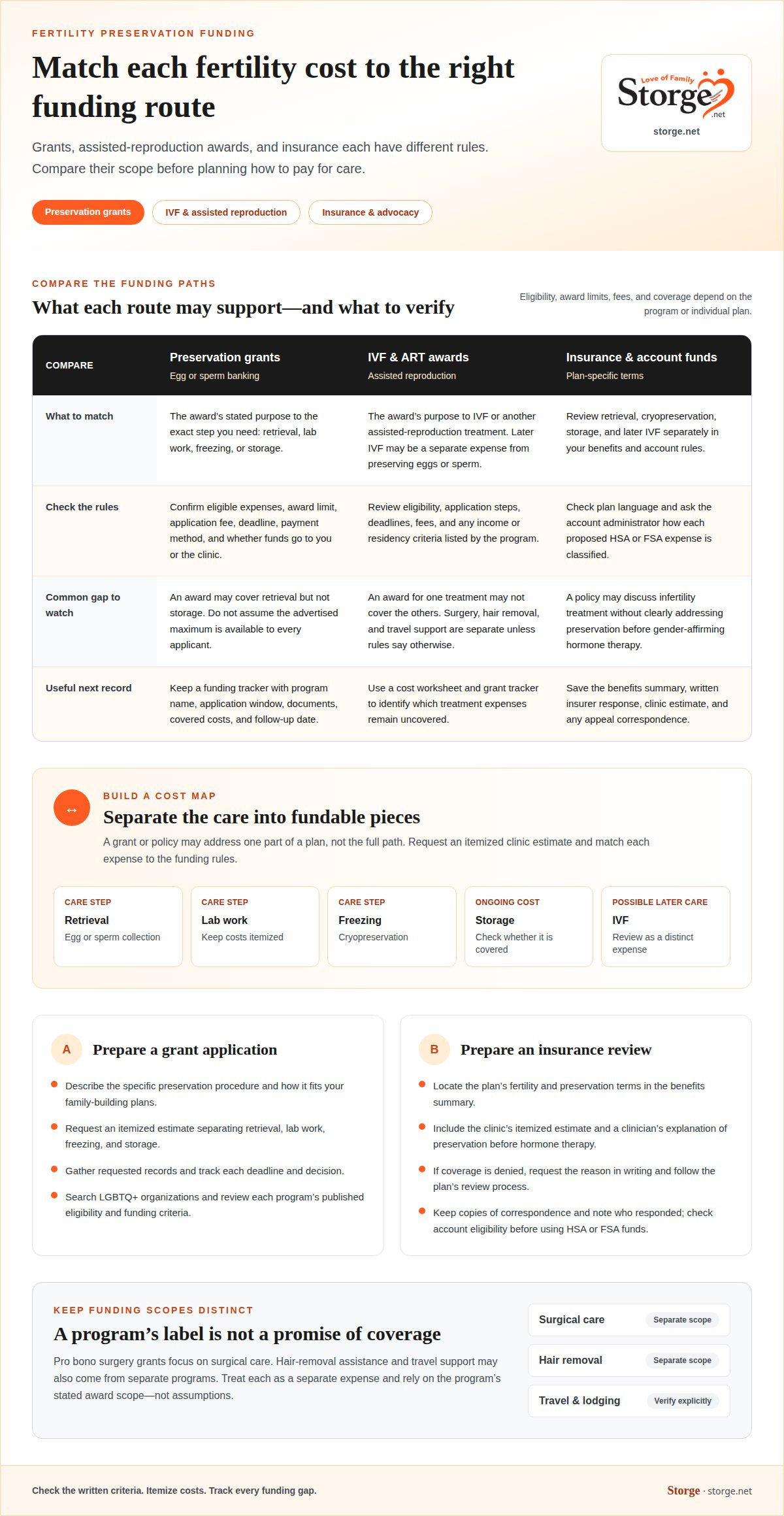
Start by distinguishing fertility-preservation grants from broader assisted-reproduction awards. Check which expense a program supports, such as egg or sperm retrieval, cryopreservation, storage, or later in vitro fertilization. A grant for another treatment may not cover these costs. If you’re planning gender-affirming care, match each funding opportunity to the specific step you need help paying for. Financing for transgender fertility preservation can involve multiple sources, so map each expense to the type of support that fits.
Grant amounts and application fees depend on each funder’s rules. Before applying, look for the award limit, eligible expenses, payment method, deadline, and any application charge in the program materials. Check whether funding goes to you or directly to a clinic. For example, if an award covers retrieval but not storage, it won’t fund the full preservation plan. Don’t assume every applicant receives the advertised maximum.
Use this checklist to organize applications:
- Describe the specific preservation procedure and how it fits your family-building plans.
- Request an itemized clinic estimate separating retrieval, lab work, freezing, and storage.
- Gather requested records, then track each application’s deadline and decision.
Pro bono surgery grants are a separate funding avenue. They focus on surgical care, so review their eligibility and expense rules before treating one as support for fertility preservation. Don’t assume a surgery award will pay for egg or sperm freezing, storage, or IVF. If you can’t afford both care pathways, list their costs separately and apply to programs whose stated purpose matches each need.
Keep a funding tracker with each program’s name, application window, required documents, covered expenses, and follow-up date. This helps you avoid repeating work and spot gaps, such as storage fees excluded from an award. A fertility clinic referral can also help connect your preservation plan with a clinic’s treatment and billing details. For financing for transgender fertility preservation, a tracker keeps applications and expenses organized.
IVF and assisted reproductive technology grants
Funding for IVF and assisted reproductive technology depends on the treatment an award supports. List egg or sperm retrieval, cryopreservation, storage, and later IVF separately in your plan. An award covering one step may not cover the others. For example, frozen eggs can be fertilized with sperm using IVF, so account for that future treatment when reviewing a grant’s stated purpose.
To find financial assistance for transgender fertility care, search LGBTQ+ organizations and grant programs, then review their published eligibility rules. Note whether funding supports fertility preservation, IVF, or other medical care, and whether applicants must meet income or residency criteria. Award amounts and application fees vary by program. A tracker can organize deadlines, documents, fee requirements, and the expenses each award may cover.
To find an LGBTQ+-affirming fertility clinic and financial aid near you, use a clinic directory to identify local reproductive care, then review each organization’s published inclusion and funding criteria. A fertility clinic referral can help connect your care needs with a relevant clinic.
- Cost worksheet: Separate retrieval, lab work, freezing, storage, and IVF to see which expenses remain uncovered.
- Grant tracker: Record each organization’s eligibility rules, application steps, deadline, and decision date.
- Document folder: Keep requested financial records and treatment estimates together for applications.
Assistance with permanent hair removal may be available through programs focused on gender-affirming care, but don’t assume it covers fertility treatment. Treat hair removal as a separate expense and look for programs whose stated award scope includes it. A surgical-care grant also shouldn’t be treated as IVF funding unless its rules say so.
Travel assistance is another distinct need. List transportation and lodging separately from medical treatment, then look for programs that explicitly include travel. If a clinic is farther away, this breakdown can show whether an award covers care alone or also helps with travel.
If you can’t afford every step at once, a funding map clarifies what each application could support. Match each request to a specific expense, and keep your treatment plan alongside the grant criteria.
Insurance coverage and advocacy
Insurance benefits may treat fertility preservation differently from other medical care. Review the plan’s terms for retrieval, cryopreservation, storage, and later IVF separately. A policy may describe infertility treatment without clearly addressing preservation before gender-affirming hormone therapy. A benefits summary and written response from the insurer can help clarify what the plan considers eligible.
Can transgender patients use HSA or FSA funds to pay for fertility preservation? Use these funds only for expenses eligible under the account’s rules. Consider retrieval, cryopreservation, storage, and related treatment separately, and ask the account administrator how each expense is classified before using the funds.
For insurance advocacy, prepare a focused packet rather than relying on a brief phone conversation. Include the relevant plan language, the clinic’s itemized treatment estimate, and a clinician’s explanation of why you’re considering preservation before hormone therapy. If coverage is denied, request the reason in writing and follow the plan’s stated review process. Keep copies of correspondence and note who responded.
- Benefits summary: Helps locate the plan’s fertility and preservation terms.
- Itemized estimate: Separates banking, cryopreservation, storage, and treatment expenses.
- Appeal record: Keeps the written decision, supporting documents, and response deadlines together.
Timing can matter medically. Estrogen, progesterone, finasteride, and other anti-androgens used in gender-affirming hormone therapy may permanently alter the body’s ability to make sperm. Fertility preservation may still be possible after hormones begin, but it usually involves stopping treatment. Some individuals may regain fertility 3 to 6 months after stopping hormone therapy. Discuss fertility preservation and any decision to stop or delay treatment with a counselor and the clinician supporting your care.
A partner may be part of the planning conversation if future family-building could involve their egg or sperm. Scholarships or grants can complement insurance, but keep those applications separate from coverage appeals. A clear record showing which source addresses each expense helps prevent gaps in your plan.
Do fertility clinics offer payment plans or discounted rates for transgender patients?
Clinic billing policies determine whether payment plans or reduced rates are available. These options aren’t a universal benefit for transgender patients. A clinic’s payment plan may cover treatment charges but exclude medication, laboratory services, or ongoing storage. Get the terms and included expenses in writing before building a budget around an arrangement.
Use an itemized estimate to understand the full treatment sequence. For example, list consultation, retrieval, freezing, storage, and future IVF as separate expenses. Then compare the estimate with your insurance benefits and any grant award. This makes it easier to identify remaining costs and see whether a payment schedule fits the treatment timeline.
A simple cost worksheet can help organize the conversation. List each service, its billing date, the amount due, and the funding source. A clinic billing question list can help you ask:
- Does the clinic offer installments, and which treatment charges do they cover?
- Are medication, lab work, storage, and later IVF billed separately?
- Does the clinic have income-based discounts or reduced rates for specific services?
- Can the clinic provide payment terms and discount criteria in writing?
Discounts and payment plans serve different purposes. A discount reduces the amount charged for an eligible service; a payment plan spreads payments over time. Neither should be assumed to cover every stage of fertility preservation. If a quote includes egg freezing but not storage, ask the billing office to make that distinction clear in the estimate.
A quote comparison table can help you organize clinic estimates without treating different services as equivalent. Use the same categories in each column, including storage and future treatment. Note the payment schedule and any stated discount rules alongside each item. This gives you a clearer picture of the financial commitment before choosing a care pathway.
For help connecting your fertility needs with a clinic, explore fertility clinic referrals as a next step.
Storge: Fertility Clinic Referrals
Storge offers Fertility Clinic Referrals to help connect your preservation goals with a fertility clinic. Consider this when you’re ready to discuss treatment options, funding questions, or how care may fit alongside gender-affirming hormone therapy. The clinic can explain its services and billing directly, while Storge helps connect you with fertility resources.
If your next steps involve finding donor eggs or sperm, Storge also offers Donor Egg / Sperm Search. Attorney Representation Referrals and Storge PLUS Membership provide additional resources for people exploring related family-building needs.
If you’d like support finding a fertility clinic, contact Storge.
Move forward with a plan that fits
Your next step can be small and specific: decide what you want to preserve, which questions matter most, and what support would make planning easier. Financing for transgender fertility preservation is one part of a larger personal decision. Your priorities can guide the order in which you explore care and family-building options.
Storge offers Fertility Clinic Referrals, Storge PLUS Membership, and Attorney Representation Referrals to support different parts of the process. These resources can help you move from gathering information toward identifying assistance that fits your needs.
You don’t need to have every decision settled before taking a next step. Share what you’re considering with Storge and explore resources that can help you plan with more clarity.
Contact Storge to discuss your options.
Frequently Asked Questions
What does fertility preservation cost for transgender patients in the United States?
There isn’t one standard total because treatment plans can include different services. A preservation estimate may list consultation, testing, retrieval, laboratory work, medication, freezing, and storage separately. Future IVF or the use of donor eggs or sperm can add distinct expenses. Someone considering sperm banking, for example, may need different services from someone planning egg retrieval and freezing.
Does health insurance cover fertility preservation for transgender people?
Coverage depends on the policy, the treatment, and how the plan classifies fertility preservation. A plan may treat preservation before gender-affirming care differently from infertility treatment. Review the relevant benefit language and request a written explanation of covered and excluded services. Ask whether retrieval, cryopreservation, storage, and future use are addressed separately rather than treated as one service.
Which states require insurance coverage for fertility preservation related to gender-affirming care?
A state-by-state answer depends on applying the relevant state insurance rule to the policy type. Start with the state governing the policy and whether coverage is employer-sponsored or individually purchased. Then review the policy’s fertility-preservation terms with an insurance advocate. A clinic’s location alone may not determine which rules apply, so distinguish where care takes place from how the policy is regulated.
What grants and financial assistance are available for transgender fertility preservation?
Potential support includes fertility-preservation grants, IVF or assisted-reproduction awards, and broader LGBTQ+ financial assistance. Each program sets its own eligibility criteria and covered expenses. Before applying, match the award’s stated purpose to the service you need. For example, don’t treat a surgery-focused grant as funding for egg freezing unless its terms include fertility preservation.
How much do egg freezing, sperm banking, and embryo freezing cost, including medication and storage?
There isn’t one reliable figure for every treatment plan. Egg freezing may involve medication, retrieval, laboratory work, and storage; sperm banking and embryo freezing involve different services. The total also depends on whether future IVF is part of the plan. Request an itemized estimate that separates each stage so you can see what insurance or assistance may cover.
Does LGBTQ+ or transgender-specific financial assistance cover fertility preservation?
Some LGBTQ+- or transgender-focused assistance may support fertility care, but eligibility and covered expenses depend on each program. Look for explicit wording about preservation, cryopreservation, storage, or IVF. A program supporting gender-affirming surgery may have a different purpose. Keep the award criteria with your treatment estimate, and organize applications by the expense each program says it can support.


