

The most successful surrogacy matches aren't bought through high-priced agencies; they're built through vetted communities grounded in shared values. While the average cost of a surrogacy journey in the United States has climbed toward $220,000 in 2026, you don't have to face these financial and emotional hurdles in isolation. Learning how to find gestational carrier options that feel safe and affirming is often the most stressful part of the process for LGBTQ+ parents. You deserve a partner who doesn't just meet medical guidelines, but someone who truly celebrates your family's unique story.
It's completely normal to feel overwhelmed by the "patchwork" of state laws or the fear of high agency fees. We understand that you're looking for a genuine connection, not just a transaction. This guide provides a clear, step-by-step path to finding a compatible, vetted carrier while protecting your legal rights and your budget. We'll explore how to leverage community-based models, understand the latest 2026 legal updates in states like Michigan and Hawaii, and ensure you have the right specialized legal representation to secure your future.
Key Takeaways
- Evaluate the trade-offs between traditional agencies and community-based models to choose the most sustainable path for your family.
- Master the art of creating an authentic Intended Parent profile that clearly communicates your values and vision to potential carriers.
- Navigate how to find gestational carrier connections within secure, inclusive environments that prioritize the safety of the LGBTQ+ community.
- Recognize the essential medical and psychological vetting steps that protect both your future child and your gestational carrier.
- Learn how to leverage the Storge PLUS community to access a verified network of carriers and expert legal referrals without agency overhead.
Understanding Your Search Options: Agency, Independent, or Community?
Deciding which path to take when building your family is a deeply personal milestone. For many in our community, the first major hurdle is determining how to find gestational carrier partners who align with their values and vision. You generally have three primary avenues to explore: traditional agencies, independent searches, and community-based platforms. Each path offers a different balance of emotional support, financial commitment, and personal safety.
The traditional agency path is often seen as the most hands-off option. These organizations act as full-service intermediaries, handling everything from initial matching to ongoing case management. While this provides a high level of administrative support, it comes with high five-figure fees that can make the dream of parenthood feel financially out of reach. For many LGBTQ+ parents, these costs are a significant barrier that doesn't always guarantee an inclusive or affirming experience.
Independent searches represent the opposite end of the spectrum. These often occur in unmoderated social media groups or public forums. While this method avoids agency fees, it carries maximum risk because there is zero formal vetting. Understanding Surrogacy legalities is complex, and navigating this "wild west" without professional guardrails leaves intended parents vulnerable to legal complications and emotional heartbreak.
Pros and Cons of the Three Primary Search Paths
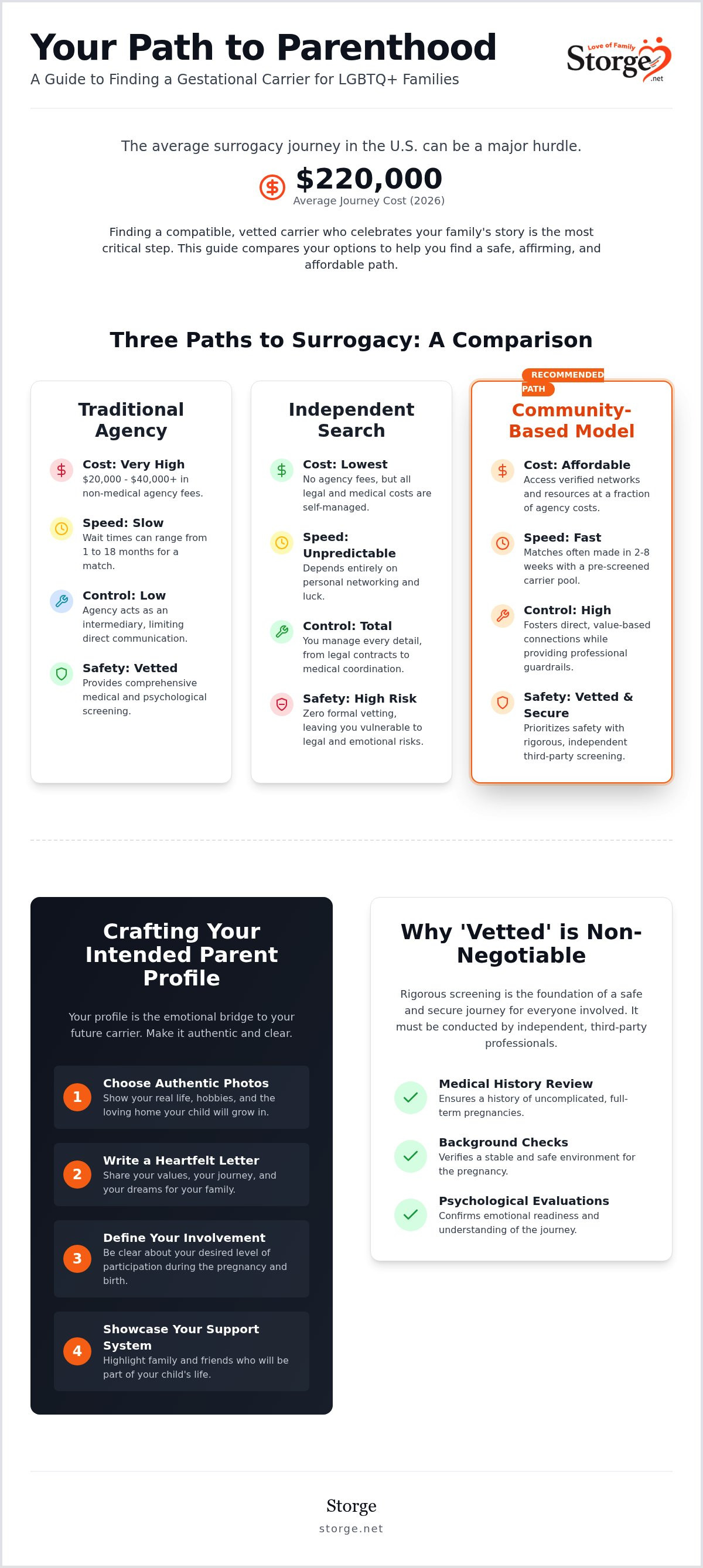
When evaluating these paths, it's helpful to compare them across three main pillars: cost, control, and speed. Agencies are the most expensive, often adding $20,000 to $40,000 in fees on top of medical and legal costs. Independent searches are the least expensive but require you to manage every legal and medical detail yourself. Community-based models, such as Storge PLUS, offer a middle ground by providing professional vetting and resources at a fraction of the cost of an agency.
In the 2026 surrogacy landscape, speed is also a major factor. While wait times can range from 1 to 18 months, platforms with a pre-screened pool of carriers can often facilitate matches in as little as 2 to 8 weeks. For LGBTQ+ parents, the community model is increasingly popular because it fosters authentic connections while ensuring all parties are protected by specialized legal and medical standards.
Why 'Vetted' Matters More Than 'Agency'
Vetting isn't just a checklist; it's the foundation of a secure journey. Real vetting involves a rigorous review of a carrier's medical history to ensure they have a record of uncomplicated term pregnancies. It also includes background checks and psychological evaluations conducted by independent third-party professionals. These steps are non-negotiable for ensuring the safety of the carrier, the intended parents, and the future child. Community platforms bridge the gap between safety and affordability by providing these essential screenings without the heavy overhead of a traditional agency. The vetted community model is a modern alternative to traditional agencies that prioritizes safety through rigorous screening while fostering direct, value-based connections between intended parents and carriers.
Step-by-Step: Crafting Your Intended Parent Profile
Your profile is far more than a resume; it's the emotional bridge between your dream and the person who will help you achieve it. When considering how to find gestational carrier matches that last, the strength of your narrative is your most powerful tool. A well-crafted profile invites a carrier into your world, showing her the love and stability she will be supporting. This process requires a blend of vulnerability and clear logistics to ensure a lasting partnership.
- Step 1: Choose authentic photos. When you are learning how to find gestational carrier matches that are truly compatible, being specific about your daily life is key. Avoid overly staged professional shots. Instead, select images that capture your real life, hobbies, and the environment where your future child will grow.
- Step 2: Write a heartfelt letter. This is your "letter to our carrier." Focus on your values, your journey to this point, and why you are choosing surrogacy to build your family.
- Step 3: Define your involvement. Be clear about how you envision the pregnancy. Do you want to attend every appointment? How do you see the birth day unfolding?
- Step 4: Showcase your support system. Carriers often worry about the intended parents' well-being. Highlighting your extended family or close-knit community shows her that you have the resources to handle the transition to parenthood.
- Step 5: Seek a community review. Before publishing, share your profile with a trusted peer or a moderator in the Storge PLUS community to ensure your message is landing as intended.
Telling Your Story with Empathy and Clarity
It's easy to fall into the trap of using clinical terminology, but carriers are looking for a human connection. Vulnerability isn't a weakness here; it's a magnet. For LGBTQ+ parents, this is an opportunity to share the unique hurdles you've overcome and the intentionality behind your desire to parent. Speak from the heart about what this child will mean to your family. This honesty helps potential carriers see the profound impact their gift will have on your lives.
Setting Boundaries and Expectations Early
While the emotional connection is vital, the legal and ethical framework of your journey must be solid. This includes being upfront about sensitive topics like pregnancy termination, multi-fetal reduction, and your desired level of contact after the birth. Addressing these Legal and Ethical Considerations early prevents painful misunderstandings later. Clearly stating your budget and legal requirements doesn't make you unapproachable. It makes you a reliable partner who respects the carrier's time and boundaries as much as your own.
Where to Look: Identifying Safe and Inclusive Spaces
Once your profile is ready, the next challenge is deciding where to share it. The internet has made the search more accessible, but it has also created a "wild west" of unmoderated groups where misinformation and scams can thrive. For LGBTQ+ families, finding a space that isn't just "tolerant" but actively affirming is essential. When you are researching how to find gestational carrier options, the environment you choose dictates the quality of the connections you'll make. Unmoderated social media forums often lack the identity verification and medical pre-screening necessary to protect intended parents from emotional and financial risk.
Instead of casting a wide net in public groups, look for specialized fertility communities. These spaces prioritize inclusive family building and often provide educational resources, such as this guide on surrogacy for gay couples, to help you vet potential platforms. Peer referrals are also a goldmine of information. A recommendation from another parent who has successfully navigated the same path carries a level of trust that no advertisement can match. Hearing directly about someone else's lived experience can provide the reassurance you need to move forward with confidence.
Navigating Digital Communities Safely
Safety in digital spaces requires a keen eye for red flags. Be cautious of individuals who request direct payments early in the conversation or those who seem evasive about their medical history. A reputable platform should offer identity verification to ensure every participant is who they claim to be. Once you've found a promising connection, transition from text to a video introduction quickly. This step helps humanize the interaction and allows you to gauge whether your personalities and values truly align before moving toward formal screenings. It's about building a bridge of trust before any medical or legal steps are taken.
Leveraging Vetted LGBTQ+ Networks
Identity-specific platforms lead to more successful matches because they filter for shared values from the start. When you use a resource like the Storge PLUS Membership, you are entering a safer search environment where carriers are already familiar with and supportive of LGBTQ+ family structures. This community-led approach significantly reduces the "transactional" feel often found in larger agencies. It transforms the search from a cold business deal into a partnership rooted in mutual respect and a shared goal of bringing a new life into a loving home. Understanding how to find gestational carrier matches in these protected spaces ensures your journey starts on a foundation of security and belonging.
Vetting Your Match: Essential Screening and Legal Safety
Finding a potential match is an exhilarating milestone, but the vetting process is where your family's future security is truly built. Once you've learned how to find gestational carrier candidates through community-led platforms, the focus shifts to a rigorous screening process that leaves no stone unturned. This phase ensures that your carrier is medically, emotionally, and legally prepared for the journey ahead. It's not just about checking boxes; it's about building a foundation of mutual trust and safety.
- Medical Screening: Your fertility clinic will review the carrier's previous obstetric records. Professional guidelines in 2026 recommend that carriers be between 21 and 45 years old with at least one uncomplicated term pregnancy and no more than five prior deliveries.
- Psychological Evaluation: A third-party mental health professional specializing in reproductive medicine must conduct an evaluation. This ensures the carrier and her partner fully understand the emotional complexities and are ready for the commitment.
- Background and Financial Checks: Professional criminal background checks and an assessment of financial stability provide peace of mind. This confirms the carrier is in a secure position to focus entirely on a healthy pregnancy.
- The Legal Fit: You must ensure your carrier resides in a state with clear, supportive laws for LGBTQ+ parents. As of 2026, states like Michigan, Hawaii, and Idaho have established modern frameworks that expressly permit gestational surrogacy and protect your parental rights.
The Role of Professional Referrals
Success in surrogacy requires a team of independent experts who prioritize your family's specific needs. You should never use the same attorney as your carrier. Each party needs dedicated, independent representation to ensure their interests are fully protected during contract negotiations. A formal surrogacy contract must be fully executed and notarized before any medical procedures or embryo transfers begin. Working with fertility clinics that specialize in third-party reproduction is equally vital, as they understand the clinical nuances of gestational cycles. If you are ready to build your professional team, you can access specialized attorney and clinic referrals through the Storge PLUS community.
Ensuring Legal Compliance Across State Lines
The legal landscape of surrogacy remains a patchwork of state-level regulations, making the carrier's location a critical decision. You need to understand the difference between a pre-birth order, which places your names on the birth certificate at the hospital, and a post-birth order. Even with a strong surrogacy agreement, many legal professionals still recommend second-parent adoption to ensure your parental rights are recognized in every jurisdiction. This multi-layered legal approach protects the child's right to a secure family and ensures that everyone involved has a clear, enforceable understanding of their roles and responsibilities. Understanding how to find gestational carrier partners in legally secure states is the best way to prevent future complications.
Streamlining Your Search with the Storge PLUS Community
The journey to parenthood is often paved with complex decisions, but you don't have to walk this path alone. Choosing how to find gestational carrier matches through a community-based platform like Storge PLUS represents a shift toward transparency and empowerment. Unlike traditional agencies that often treat matching as a "black box" process, our membership model gives you the tools to lead your own search while remaining within a protected, vetted environment. This approach removes the heavy agency markup, allowing you to direct your resources toward the specialized care and legal protection your family deserves. It's about reclaiming your agency while benefiting from a framework of professional reliability.
Our platform is designed to be a steady companion through both the emotional highs and the practical hurdles of your search. We understand the specific legal and social nuances that LGBTQ+ parents face in 2026. By joining a network grounded in shared values, you are connecting with carriers and donors who are intentionally seeking to support diverse family structures. This shared understanding creates a foundation of mutual respect that is often missing from more transactional agency models.
Moving from Match to Contract with Confidence
Once you've identified a compatible match, the transition to the clinical and legal phases must be seamless. Storge PLUS facilitates this by providing direct access to specialized Attorney Representation Referrals. These professionals are experts in reproductive law and understand the latest state-level statutes that protect your parental rights. Having a dedicated advocate ensures that your surrogacy agreement is robust and enforceable before any medical steps begin.
We also offer a vetted directory of Fertility Clinic Referrals and hospitals that specialize in third-party reproduction. Instead of navigating hundreds of options, you can utilize our community-vetted shortlist of providers who have a proven track record with LGBTQ+ families. This streamlined access allows you to move from an initial "hello" to a formal embryo transfer with a team of experts who are already familiar with the intricacies of your journey.
The Peace of Mind of a Vetted Network
The greatest challenge in an independent search is often the overwhelming amount of conflicting information. Storge PLUS reduces this "noise" by focusing on high-quality, verified resources. Our membership fee is a deliberate choice to maintain a high-integrity environment. It ensures that every participant is committed to the process and has undergone the necessary identity and background verifications to keep our community safe. This layer of protection allows you to focus on building a genuine connection with your carrier rather than worrying about the legitimacy of the match.
Building a family through surrogacy is a profound act of community and collaboration. When you choose a community-led path, you aren't just finding a service provider; you're joining a network of people who believe in the beauty of your future family. This supportive environment provides the emotional equilibrium needed to navigate the 18 to 24 month timeline of a typical journey. Your dream of parenthood is a vision we share, and we're here to ensure the reality of achieving it is as safe and joyful as the dream itself.
Taking the Next Step Toward Your Future Family
The path to parenthood through surrogacy is a journey of intentionality and deep connection. By prioritizing a vetted community over a transactional agency, you've already taken a significant step toward a more authentic and affordable experience. You now have the tools to navigate how to find gestational carrier partners who share your values, from crafting a heartfelt profile to ensuring your legal rights are protected through specialized representation. Your story is unique, and the right partner is out there waiting to help you write its next chapter.
Security and peace of mind are within reach when you have the right support system by your side. We invite you to join the Storge PLUS community today. You'll gain immediate access to our vetted community of donors and carriers, our specialized LGBTQ+ legal referral network, and a comprehensive hospital and clinic directory. We're here to serve as your steady guide, bridging the gap between your dream and the reality of holding your child for the first time. Your family's story is just beginning, and we're honored to be part of it.
Common Questions About the Surrogacy Journey
How much does it typically cost to find a gestational carrier independently?
You can save significantly on agency fees, which generally range from $20,000 to over $40,000, by choosing an independent or community-based search. While you avoid these high matching fees, you remain responsible for the carrier's base compensation, medical procedures, and specialized legal representation. These costs vary based on the carrier's experience and your specific state. This model allows you to allocate your budget directly toward the care and safety of your future child rather than administrative overhead.
Is it legal to find a gestational carrier on my own without an agency?
Yes, it's legal to find a carrier on your own, provided you follow the specific surrogacy laws of the state where the carrier resides and gives birth. There is no federal law requiring the use of an agency for matching. However, you must work with independent legal counsel to draft a formal agreement and establish your parental rights. As of 2026, many states have updated their statutes to provide clear, safe pathways for independent matches and parental recognition.
What are the most important questions to ask a potential surrogate during the first meeting?
Focus on values, expectations, and communication styles to ensure a deep and lasting connection. Ask about her motivation for becoming a carrier, her views on pregnancy termination or multi-fetal reduction, and her desired level of contact after the birth. You should also discuss her support system at home and how she envisions your involvement in medical appointments. These honest conversations help you determine if your personalities and future visions for the journey truly align before moving forward.
Can a gestational carrier change her mind and keep the baby?
In a gestational surrogacy arrangement, the carrier has no genetic link to the child, which makes it legally distinct from traditional surrogacy. When you follow the proper legal steps, including a pre-birth or post-birth order, your parental rights are established before or shortly after the birth. Modern surrogacy-friendly laws in states like Michigan and Hawaii are designed to protect all parties, ensuring the child goes home with their intended parents as planned in the legally binding contract.
How do I know if a surrogacy platform is safe and inclusive for LGBTQ+ parents?
Look for platforms that prioritize identity verification and have a clear focus on inclusive family building. A safe space will often feature educational resources tailored to our community and provide referrals to LGBTQ-affirming legal and medical professionals. When researching how to find gestational carrier options, prioritize communities where carriers are pre-screened for their support of diverse family structures. This ensures your search begins in an environment of mutual respect, safety, and belonging.
What is the difference between a traditional surrogate and a gestational carrier?
A traditional surrogate uses her own eggs and is genetically related to the baby, while a gestational carrier has no genetic connection. In gestational surrogacy, an embryo is created using the intended parents' genetic material or donor eggs and sperm, then transferred to the carrier's uterus. This is the preferred path for 85% of gay male couples in 2026 because it offers greater legal security and allows both parents to be genetically related to their children if they choose.
Do I need an attorney if I find a carrier through a community network?
You absolutely need independent legal representation, even if you find your carrier through a trusted community network. An attorney specializing in reproductive law is essential for drafting a robust contract and navigating the complex patchwork of state regulations. They protect the rights of the child, the intended parents, and the carrier. Using specialized referrals ensures your legal team understands the specific hurdles of LGBTQ+ family building and can secure your parental rights effectively in any jurisdiction.
How long does the matching process usually take in 2026?
The entire process typically takes 18 to 24 months, but the initial matching phase can vary significantly based on your search method. While traditional agency wait times can stretch up to 18 months, learning how to find gestational carrier matches in vetted community pools can reduce this to between 2 and 8 weeks. This efficiency allows you to move into the medical and legal phases sooner. However, you should still expect a deliberate pace that respects the emotional and physical requirements of a healthy pregnancy.


