
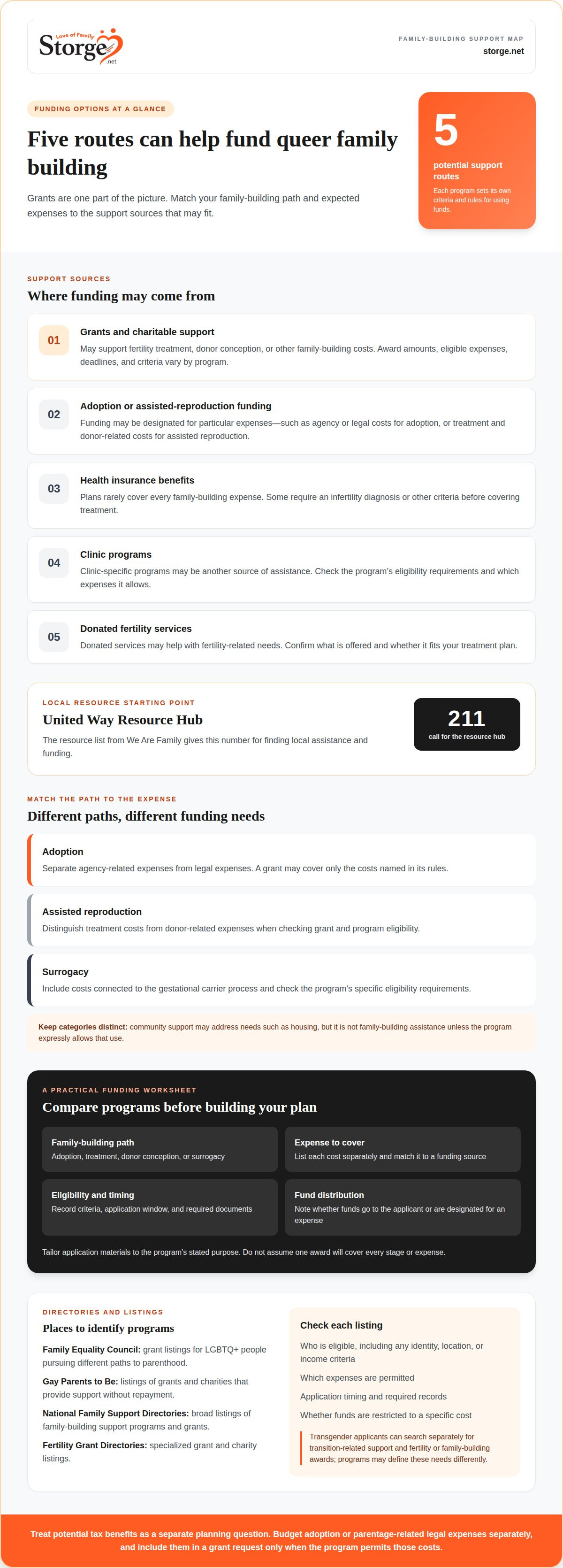
A grant isn’t the only source of financial assistance for queer family building. Support may include grants, adoption or assisted-reproduction funding, health insurance benefits, clinic programs, and donated fertility services. Health plans rarely cover every family-building expense, and some require an infertility diagnosis or other criteria before covering treatment.
It’s understandable if the options feel scattered. Adoption, donor conception, and surrogacy involve different expenses and eligibility rules. This guide explains where to look for grants and financial support, what adoption and assisted-reproduction funding may cover, and how clinic programs or donated fertility services may help. It also explains how to assess insurance as one part of a broader funding plan, so you can focus on options that fit your family-building goals.
Key Takeaways
- Learn how to narrow grant searches by the family-building path and the program’s eligibility criteria.
- See how adoption and assisted reproduction funding can involve different expenses and support options.
- Explore resource lists that can help you identify grants and charitable support for LGBTQ+ family building.
- Find out which insurance requirements may affect coverage, and where clinic-specific or donated fertility services may fit.
Grants for assisted reproduction and fertility treatment
Grants can help LGBTQ+ individuals and couples pursue fertility treatment, donor conception, or another path to parenthood. Financial assistance for queer family building may also come from charities and local resource programs. Each program sets its own award amount, eligible expenses, application window, and criteria. Compare these details before building your funding plan.
How do LGBTQ+ family-building grants compare by award amount, covered expenses, and eligibility? Amounts and eligible expenses vary by program. One may help pay for treatment, while another limits funding to specific family-building costs. Eligibility may depend on identity, location, income, treatment plan, or application timing.
- National Family Support Directories: Comprehensive listings help LGBTQ+ people identify family-building support programs and grants.
- Fertility Grant Directories: Specialized resources help locate grants and charities offering support without repayment.
- United Way Resource Hub: Regional resource lists provide direct contact numbers to help locate local assistance and funding.
Transgender applicants can search separately for transition-related support and fertility or family-building awards. Programs may define these needs differently, so compare each award’s purpose and eligible expenses. State and regional programs may also vary by residence. The United Way Resource Hub can be a starting point for finding local resources.
What tax credits, deductions, and legal costs should LGBTQ+ families consider when planning? Treat potential tax benefits as a separate planning question, since eligibility depends on the expense and your circumstances. Budget separately for adoption or parentage-related legal expenses, and include them in a grant request only if the program permits those costs.
Start your search for financial assistance for queer family building with your intended path and the expenses you need help covering. Use specialized grant directories and resource listings to identify relevant programs. Record each program’s deadline, eligibility criteria, permitted expenses, and required documents. Then tailor your application materials to the program’s stated purpose.
Adoption and assisted reproductive technology funding
Adoption and assisted reproductive technology have different funding paths. Adoption support may focus on agency or legal expenses, while fertility assistance may apply to treatment or donor conception. Surrogacy can involve distinct costs and eligibility requirements. Map each expected expense to a potential funding source before committing to a plan.
Start with the path you’re considering, then list the expenses that need support. For adoption, separate agency-related and legal expenses. For assisted reproduction, distinguish treatment costs from donor-related expenses. For surrogacy, include costs connected to the gestational carrier process. A grant’s purpose matters: funding designated for one category may not cover another.
Use the Family Equality Council’s grant listings to find programs for LGBTQ+ family-building needs. Gay Parents to Be lists grants and charities that provide support without repayment. These are starting points, not a guarantee that an application is open or that every expense qualifies. Read each organization’s eligibility requirements and rules for using funds before applying.
Create a simple funding worksheet with the family-building path, expense, potential program, and application deadline. If the program explains how funds are distributed, note whether support goes directly to the applicant or is designated for a particular expense. This helps reveal gaps, such as legal costs that a treatment grant may not cover.
Some LGBTQ+ community organizations focus on barriers affecting people across sexual orientation and gender identity. Their support may address immediate needs, such as housing, rather than family-building expenses. Keep these categories separate in your plan. Don’t treat a housing grant as adoption or fertility assistance unless its rules expressly allow that use.
Before submitting an application, match it to your family-building plan and gather the requested records. Explain how the requested funds relate to the program’s stated purpose, whether you’re pursuing adoption, treatment, donor conception, or surrogacy. This focused approach helps you assess available support without assuming one award will cover every stage.
What grants and financial assistance are available for LGBTQ+ family building in the United States?
In the United States, LGBTQ+ family-building support can include grants and charitable assistance. The right starting point depends on your path, the expenses you need help covering, and where you live. Some resources focus on family-building programs; others help you find community support that may ease related financial pressures.
Family Equality Council lists grants for LGBTQ+ people pursuing different paths to parenthood. Use its resource list to identify programs relevant to your plans, then review each program’s eligibility criteria and permitted expenses. A grant intended for a specific purpose may not cover every part of adoption, fertility treatment, donor conception, or surrogacy.
Gay Parents to Be lists grants and charities that provide family-building financial support without repayment. Its listings can help you look beyond awards labeled specifically as fertility grants. Read the program details to understand who can apply, which expenses qualify, and whether applications follow a particular schedule.
We Are Family’s resource list gives 211 as the number to call for the United Way Resource Hub. This can be a useful route to finding local resources. It may help identify community assistance that supports broader needs while you plan for family-building expenses.
To make these tools useful, organize your search around your intended path and expense categories. For example, keep adoption expenses separate from fertility treatment and donor-related costs. Record each program’s name, stated purpose, eligibility criteria, application dates, and required documents. This makes it easier to see which support may fit your circumstances.
Track your findings in a comparison table or spreadsheet. Include a column for whether the support is a grant, charitable assistance, or a local resource referral. Note unanswered questions for your planning, but assess eligibility using each program’s published criteria. If a resource doesn’t address your expense, continue through the other listings instead of assuming all assistance works the same way.
These directories are starting points, not a single funding application. Combine a national grant search with a local resource search, then focus on programs whose stated purpose matches your family-building plans.
Does health insurance cover fertility treatment, donor conception, or surrogacy for LGBTQ+ families?
Health insurance plans rarely cover every family-building expense, and coverage varies by plan and expense. Some plans require an infertility diagnosis or other criteria before covering treatment. Donor conception and surrogacy may be treated differently from fertility treatment, so don’t assume coverage for one service means other costs are covered.
Start with your plan’s Summary of Benefits and Coverage and full plan document. These explain stated benefits, exclusions, and definitions that may affect fertility care. Use your insurer’s member portal to find fertility coverage information and relevant forms. Review the terms for treatment, diagnostic services, medications, donor-related services, and any criteria the plan specifies.
Keep each expense distinct. A plan may, for example, address a fertility procedure separately from donor sperm, donor eggs, or services connected to a gestational carrier. The plan’s terms determine whether an expense is eligible. An infertility-diagnosis requirement may also affect access, even when fertility services are needed to build a family through donor conception.
For a focused review, create a list with three columns: expense, plan language, and remaining questions. Enter treatment, donor-related expenses, and surrogacy-related services separately. This can show where benefits may apply and where you may need another funding source. Keep plan documents together with any explanations of benefits you receive.
Coverage can shape which treatment path feels financially workable, but it shouldn’t be the only planning input. A fertility clinic referral can help connect your family-building goals with clinical care options. For support finding a clinic, explore fertility clinic referrals. If donor conception or a gestational carrier is part of your plan, account for those needs separately from treatment coverage.
Use your plan documents to distinguish covered from uncovered categories before making decisions. Pair that review with grant research and a clear list of expenses. This gives you a more organized basis for planning fertility treatment, donor conception, or surrogacy without treating insurance as the answer to every cost.
Storge
Storge connects LGBTQ+ individuals and couples with fertility resources as they consider family-building options. If you’re weighing funding paths alongside donor conception or fertility care, explore relevant connections through Storge PLUS Membership, Fertility Clinic Referrals, and Donor Egg / Sperm Search. Attorney Representation Referrals can connect you with legal representation for your family-building journey.
These resources can help with practical next steps after you’ve reviewed grants, insurance, and other potential funding. They don’t replace a grant or guarantee financial support, but they can connect your family-building plans with relevant resources.
If you’d like support exploring your options, contact Storge.
Choose a next step that fits your family
Family building rarely follows a perfectly straight line. Your priorities may shift as you learn which options feel right, what support is available, and how each choice fits your circumstances. Treat your funding plan as a working guide, not a measure of how committed or ready you are. Write down the decision you need to make now, then separate it from questions that can wait. This can make financial assistance for queer family building feel more manageable without requiring you to settle every detail at once.
If you’d value support connecting your family-building goals with relevant resources, you can contact Storge to explore your options. Share the path you’re considering and the kind of guidance that would be useful. You can take the next step at your own pace, with room to make thoughtful choices for your family.
Frequently Asked Questions
Which organizations offer fertility grants for queer and LGBTQ+ individuals and couples?
Family Equality Council and Gay Parents to Be are useful places to find grant and charitable-support listings. They can help you identify programs aligned with your family-building path, then you can review each organization’s application details. For example, if you’re pursuing donor conception, focus on programs that list fertility or family-building expenses as eligible instead of assuming every grant covers the same needs.
What are the eligibility requirements and application deadlines for LGBTQ+ family-building grants?
Each grant program sets its own eligibility criteria and deadlines, so there is no shared application calendar. Read current instructions for requirements such as location, identity, intended family-building path, income, and eligible expenses. Record the deadline and required materials in one place. If an application asks for a budget, connect each requested expense to the program’s stated purpose.
Which states require insurance coverage for fertility treatment, and do laws include LGBTQ+ people?
State insurance requirements vary, and plan terms also affect coverage; the available information here doesn’t support naming specific states or determining how each law applies to LGBTQ+ people. A practical first step is to review your plan’s fertility-benefit language and note any diagnosis or eligibility criteria. Then compare that wording with the treatment or donor-related service you’re considering.
What financial assistance is available for LGBTQ+ adoption, foster care, and legal parentage?
Support may come from family-building grants or charitable programs, but each program defines which expenses qualify. Separate adoption costs, foster-care needs, and legal parentage expenses in your planning, then look for funding that expressly covers the relevant category. For legal questions, Storge’s Attorney Representation Referrals can connect families with legal representation suited to their family-building needs.
What tax credits, deductions, and legal costs should LGBTQ+ families consider when planning?
Treat potential tax benefits as a separate planning question, since eligibility depends on the expense and your circumstances. Budget separately for adoption or parentage-related legal expenses, and include them in a grant request only if the program permits those costs.


