

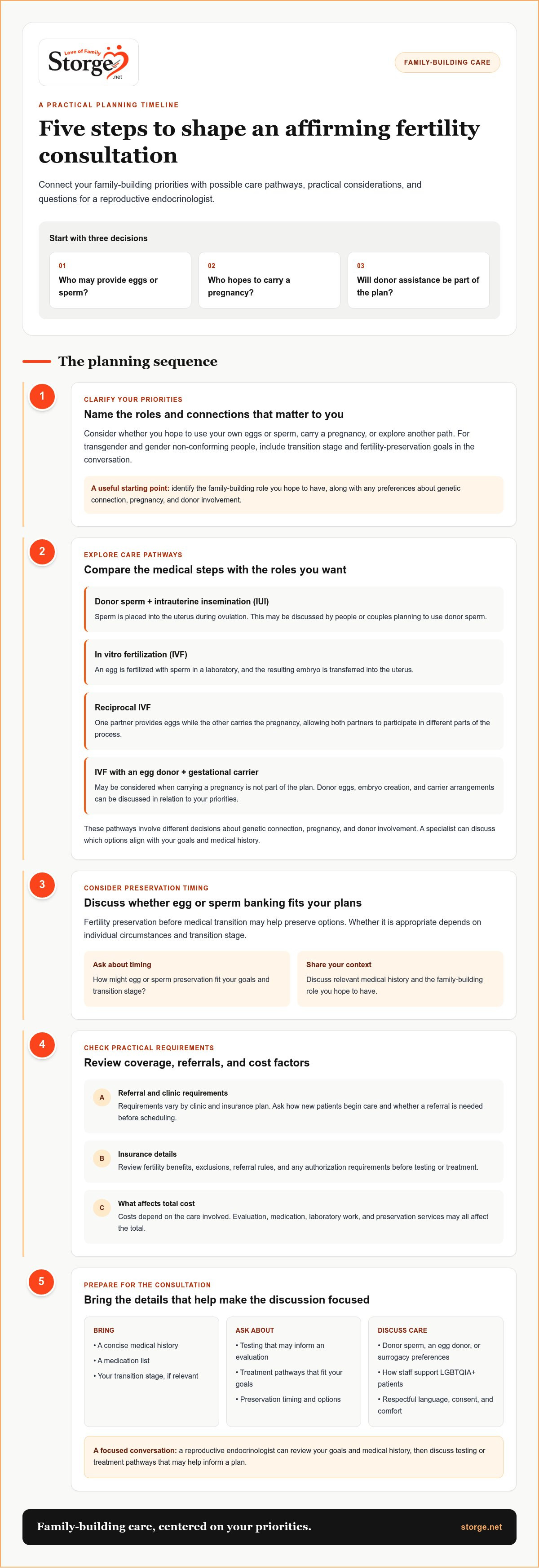
Fertility care for LGBTQIA+ individuals and couples may include donor sperm with intrauterine insemination, IVF, reciprocal IVF, or IVF with a gestational carrier. A reproductive endocrinologist referral for LGBTQIA+ patients can help connect family-building goals with options based on who hopes to provide eggs or sperm and who may carry a pregnancy. Transgender and gender non-conforming people may also consider egg or sperm banking before medical transition.
Choosing a path can bring practical questions alongside deeply personal hopes. It’s reasonable to want care that respects your relationships, identity, and priorities while making the medical steps easier to understand.
This guide explains common fertility and family-building options, what a reproductive endocrinologist may discuss at an initial consultation, and how to prepare. It offers a clearer starting point for a conversation centered on the family you hope to build.
Key Takeaways
- Compare donor sperm insemination, IVF, reciprocal IVF, and gestational-carrier pathways by considering who hopes to provide eggs or sperm and who may carry a pregnancy.
- If you’re transgender or gender non-conforming, discuss how fertility preservation may fit your goals and stage of transition.
- Prepare for a reproductive endocrinology consultation by outlining your family-building goals, relevant medical history, and questions about testing and treatment options.
- Think about what gender-affirming, trauma-informed care would look like for you, including respectful language, consent, and comfort during appointments.
Care for transgender and gender non-conforming patients
For transgender and gender non-conforming people, fertility planning may include preservation before medical transition. Egg or sperm banking may preserve options before treatment, depending on individual circumstances and transition stage. A reproductive endocrinologist can discuss approaches that reflect a person’s goals and medical history.
Start by identifying your priorities: whether you hope to use your own eggs or sperm, carry a pregnancy, or explore another path. For example, a transgender person who wants a genetic connection may ask about banking eggs or sperm before transition. A consultation can help clarify which options align with those goals.
Insurance coverage for fertility consultations and treatment varies by plan. Review your fertility benefits, exclusions, and any authorization requirements before scheduling testing or treatment.
The cost of fertility testing, IUI, IVF, or egg and sperm freezing depends on the care involved. Evaluation, medication, laboratory work, and preservation services may all affect the total.
Family-building options may include donor sperm with intrauterine insemination or in vitro fertilization, which uses eggs and sperm to create an embryo. Someone who hopes to carry a pregnancy can discuss how their goals and medical history inform treatment planning. If carrying a pregnancy isn’t part of the plan, IVF with an egg donor and a gestational carrier may be considered. These pathways involve different decisions about genetic connection, pregnancy, and donor involvement.
Prepare for an appointment by noting your transition stage, relevant medical history, and preferred family-building role. Ask how egg or sperm preservation fits your timing, what testing may be part of an evaluation, and which treatment pathways could meet your goals. If donor sperm, an egg donor, or surrogacy is part of your plan, bring up those preferences. Clear priorities can make a reproductive endocrinology consultation more focused and affirming.
LGBTQ family-building care
Family-building plans can reflect who wants a genetic connection, who may carry a pregnancy, and whether donor assistance is part of the picture. For couples where both partners produce sperm, deciding whose sperm to use can be part of early planning. In 64.4 percent of couples in the intended-father study, both partners wanted to provide sperm, according to the Authors of the retrospective intended-father study.
For intended fathers, IVF with donor eggs and a gestational carrier can offer a route to parenthood. In the study, 69.7 percent of participants used egg donation and an agency-based gestational carrier, according to the Authors of the retrospective intended-father study. The study’s finding describes those participants, not a requirement for every family. Couples can discuss how donor eggs, embryo creation, and carrier arrangements relate to their own priorities.
For couples using donor sperm, intrauterine insemination places sperm into the uterus during ovulation. IVF may be considered when a treatment plan involves fertilizing eggs in a laboratory and transferring an embryo. Reciprocal IVF is another option: one partner provides eggs while the other carries the pregnancy. These approaches differ in their medical steps and in how partners may participate.
Before choosing a fertility treatment, consider whose eggs or sperm may be used, who hopes to carry, and how donor involvement fits your plans. For example, partners who both want a genetic connection can ask how choices about sperm sources affect embryo creation. Individuals and couples can also discuss whether a gestational carrier fits their desired role in pregnancy. These details help focus a reproductive endocrinology consultation on decisions that matter to your family.
For support connecting family-building goals with fertility care, explore fertility care resources as you consider the next steps.
In IVF, an egg is fertilized with donor sperm in a laboratory, and the resulting embryo is transferred into the uterus. The Reproductive Medicine Group recommends sperm and egg banks to patients seeking donor sperm or eggs.
CARS estimates that more than 1,500 babies have been born to LGBTQ individuals and couples. A retrospective study of intended fathers included 119 participants at 18 fertility centers; 5 single intended fathers and 39 coupled intended fathers completed an IVF cycle.
Consultation with a reproductive endocrinologist
An initial consultation connects your family-building goals with medical options and possible next steps. A reproductive endocrinologist referral for LGBTQ patients can help begin that conversation.
Referral Requirements
Referral requirements vary by clinic and insurance plan. Before scheduling, ask the clinic how new patients begin care, then review your plan’s referral and fertility-care rules. This can clarify whether you can book directly or need a referral first. A reproductive endocrinologist referral for LGBTQ patients may also help when coordinating coverage with your chosen clinic.
Specialist Support for LGBTQ Patients
A reproductive endocrinologist discusses your goals, reviews your medical history, and considers testing or treatment pathways. For example, a lesbian patient may ask about donor sperm and intrauterine insemination, while another family may discuss IVF or a gestational carrier. Ask how each option relates to your priorities and what evaluation may help inform the plan.
Before choosing a clinic, ask how its staff support LGBTQ patients, explain treatment options, and foster an affirming environment. You might ask who coordinates testing and how the clinic approaches donor sperm, reciprocal IVF, or care involving a gestational carrier.
For your appointment, bring a concise medical history, a medication list, and records from prior fertility testing or treatment. Write down your family-building goals and questions about infertility evaluation. The specialist may discuss goals and options, take your history, and order diagnostic or screening tests. Ask what each recommended test is intended to assess and how the results may inform next steps.
Take notes during the visit, including follow-up instructions and questions to revisit. If your partner is involved, decide beforehand which topics you’d like to discuss together.
Women’s Health Connecticut recommends beginning fertility assistance with a consultation with a board-certified reproductive endocrinology and infertility doctor. At an initial fertility consultation, the specialist discusses goals and options, takes a medical history, and may order diagnostic and screening tests; a financial services representative discusses costs. For cisgender women seeking fertility assistance, the initial process commonly includes an examination by a reproductive endocrinologist and routine baseline fertility testing. For cisgender men seeking fatherhood, a reproductive endocrinologist can perform a semen analysis and review fertility treatment pathways. The Reproductive Medicine Group advises patients to check their insurance plan’s fertility-care coverage before their first visit.
Gender-affirming and trauma-informed care
Clinic policies shape the experience of fertility care, from intake forms to appointment conversations. Asking a few specific questions can help you assess whether a clinic’s approach fits your needs.
Affirming Care Practices
Ask how the clinic records names, pronouns, and gender information, and whether its forms let you describe your identity accurately. You can also ask how staff discuss pregnancy, fertility, and treatment options without making assumptions about your body or family structure. These details can make routine steps feel more respectful and clear.
Trauma-informed care centers choice, consent, and clear explanations. Before an examination, for example, you can ask what it involves, why it is recommended, and whether staff can pause when requested. Ask how the clinic handles sensitive conversations and explains each step. The answers can help you understand its approach before an appointment.
Finding an Affirming Specialist
To find an LGBTQ-affirming reproductive endocrinologist, start with clinics within your travel range and ask about their experience supporting LGBTQ patients. Ask how the team approaches care for transgender people, same-sex couples, and patients using donor sperm or a gestational carrier. Specific answers about intake, communication, and treatment planning can offer useful insight into the clinic’s approach.
Before scheduling, ask whether the clinic offers an initial conversation and what information it needs from you. You can also ask how it coordinates appointments and explains treatment choices. Note what matters most to you, such as respectful language, privacy, and space to discuss your goals without assumptions. Comparing these practical details can help narrow your options.
If you’re seeking an affirming clinic connection, explore fertility clinic referrals as a next step in finding care aligned with your needs.
Storge: Storge PLUS Membership
Storge PLUS connects LGBTQIA+ individuals and couples with fertility resources that support their family-building goals. Its membership provides access to a network of egg donors, sperm donors, and gestational carriers, along with broader community resources. Storge also offers fertility clinic referrals and donor egg and sperm searches. Attorney referrals can help you find legal support as your plans develop.
Explore these resources when you have questions for a clinic or are considering donor options. Take the next step at your own pace, guided by your priorities.
Contact Storge or visit storge.net to learn more.
Take Your Next Step With Your Priorities in View
Your next step doesn’t have to settle every decision. Start with one practical question, such as which clinic environment feels respectful or what information to bring to an initial visit. A reproductive endocrinologist referral for LGBTQ patients can open a conversation about care pathways that fit your goals, without committing you to a particular treatment.
As you prepare, consider what helps you feel informed and involved: clear explanations, room to ask questions, and choices discussed without assumptions. Move at a pace that gives you time to understand each step and decide what matters most.
When you’re ready to talk through your care needs, contact Storge to discuss your care. Your family-building path is personal, and thoughtful next steps can help make it feel more manageable.
Frequently Asked Questions
What Are the Fertility Treatment Options for LGBTQIA+ Individuals and Couples?
Options may include donor sperm, intrauterine insemination, IVF, reciprocal IVF, donor eggs, and gestational-carrier arrangements. To narrow them down, start with three priorities: who hopes to provide eggs or sperm, who may want to carry a pregnancy, and whether donor involvement is part of your plan. Bring those preferences to a fertility consultation to discuss which pathways align with your goals.
What fertility options are available for same-sex couples and transgender people?
Same-sex couples may consider donor sperm or eggs, insemination, IVF, reciprocal IVF, or a gestational carrier, depending on their family-building goals. Transgender people may discuss egg or sperm preservation before medical transition, as well as treatment pathways suited to their circumstances. A practical first step is to note your preferences around genetic connection and pregnancy, then bring them to a reproductive endocrinology consultation.


