

A generous fertility benefit can still leave LGBTQ+ employees without a fair path to parenthood. Equitable employer fertility benefits for LGBTQ employees apply the same family-building benefit limit to each employee and cover routes such as donor-assisted reproduction, surrogacy, and fertility preservation. Eligibility shouldn’t depend on a person being able to meet a definition of infertility based on intercourse or a period of trying to conceive.
It’s understandable to expect a workplace benefit to support the family-building journey you need, not just one assumed path to parenthood. Clear coverage helps employees understand what’s included and where limits may affect their options.
This article explains what inclusive fertility benefits can cover, how donor eggs or sperm and gestational surrogacy fit, and why eligibility rules matter. It also explores how employers can explain benefits in plain, affirming language so employees can understand their options and feel recognized.
Key Takeaways
- Review eligibility rules for assumptions that could exclude employees whose path to parenthood doesn’t involve trying to conceive through intercourse.
- Consider how coverage can account for donor-assisted reproduction, gestational surrogacy, and other distinct family-building journeys.
- Look at whether employees have equitable access to benefits, rather than limits that vary according to the route they need.
- Communicate eligibility, covered services, and benefit limits clearly so employees can understand their options with confidence.
What do Equitable, Inclusive LGBTQ+ Fertility Benefits Look Like?
U.S. employers may offer health insurance coverage for IVF, donor-assisted reproduction, surrogacy, adoption, and fertility preservation, but covered services and eligibility vary. Equitable employer fertility benefits for LGBTQ employees apply fair criteria across individuals and family-building paths. Employees can review plan documents, request a written explanation of a denial, and use the plan’s appeal process.
Covered Family-Building Services
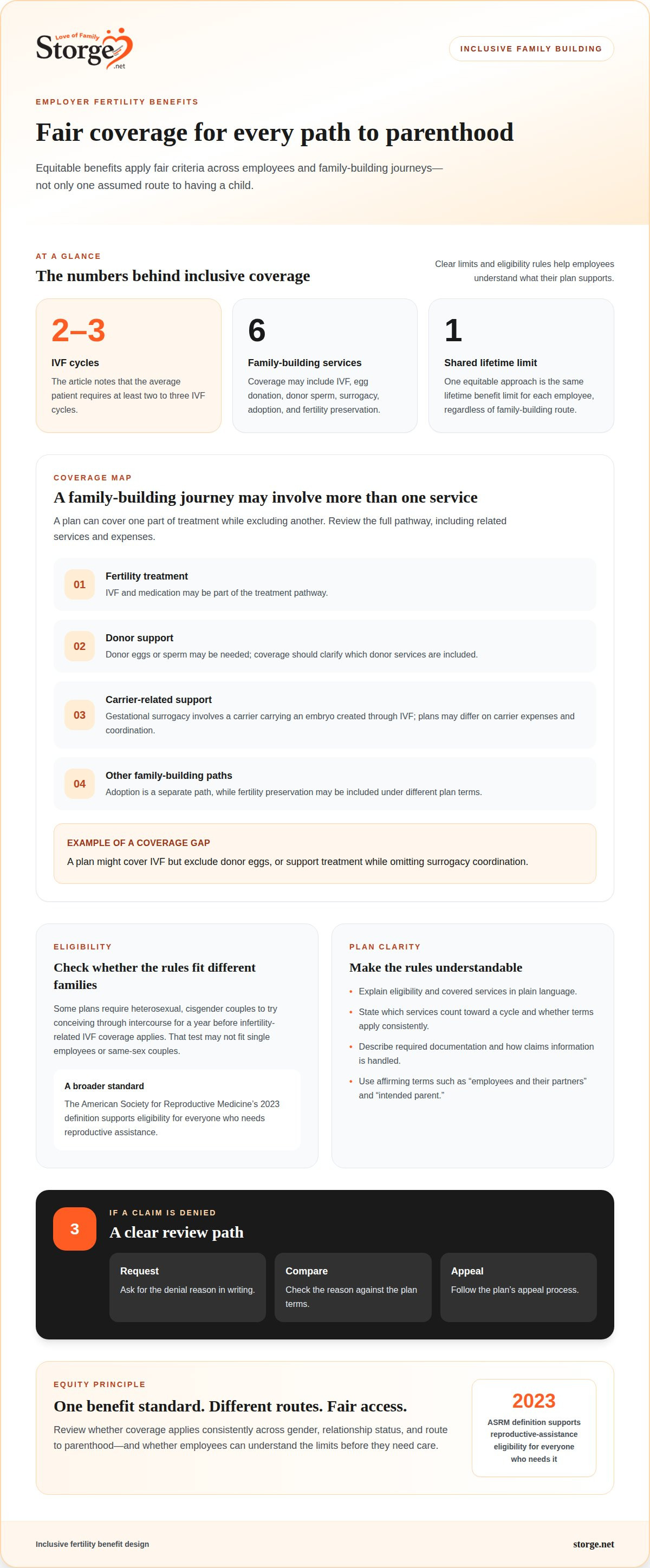
Family-building coverage can include IVF, egg donation, surrogacy, adoption, and fertility preservation. LGBTQ+ employees may need different combinations of care to build a family. A plan that covers IVF but excludes donor eggs or gestational surrogacy can leave a significant gap. Inclusive fertility coverage considers the full treatment pathway, not just one procedure.
Coverage Differences and Equity
Employer benefits differ in covered services, eligibility rules, and limits, so LGBTQ+ employees don’t receive equal coverage in every workplace. Some health insurance plans described require heterosexual, cisgender couples to try conceiving through intercourse for a year before infertility-related IVF coverage applies. That test may not fit single employees or same-sex couples. The American Society for Reproductive Medicine’s 2023 definition supports eligibility for everyone who needs reproductive assistance.
Exclusions and Legal Challenges
Fertility exclusions can raise discrimination concerns when plan rules deny a benefit based on an employee’s protected characteristics or family-building route. Title VII of the Civil Rights Act of 1964 prohibits employment discrimination in compensation, terms, conditions, or privileges of employment on specified protected grounds, according to the U.S. House Office of the Law Revision Counsel. This rule doesn’t establish that every coverage exclusion is unlawful, but it makes fair plan design important. For a denied claim, employees can request the reason in writing, compare it with the plan terms, and follow the plan’s appeal process.
Gestational surrogacy and donor-assisted reproduction
Family-building journeys can combine fertility treatment, donor support, and options such as adoption. Privacy, discrimination, and out-of-pocket costs can become concerns when benefit rules exclude a needed option or require sensitive information. That’s why coverage details and documentation processes matter.
Donor-Assisted Reproduction and Family-Building Paths
Donor-assisted reproduction uses donor eggs or sperm, while gestational surrogacy involves a carrier carrying an embryo created through IVF. These options can overlap: an intended parent may need both donor gametes and a gestational carrier. Coverage should clarify which parts of the journey it supports, including treatment, donor services, and carrier-related expenses.
Reciprocal IVF allows one partner to provide eggs and the other to carry the pregnancy. Adoption is a separate family-building path, not fertility treatment, and may have different benefit terms. For example, a plan might cover IVF but exclude donor eggs, or support treatment while omitting surrogacy coordination. Employees seeking donor support can explore a donor egg and sperm search as part of understanding their options.
Costs and Potential Risks
IVF and surrogacy involve distinct cost categories, including fertility treatment, medication, donor services, and carrier-related expenses. The average patient requires at least two to three IVF cycles. Because coverage may treat each category differently, employees could face out-of-pocket costs even when a plan advertises fertility benefits.
Privacy also matters: benefit and claims processes may involve sensitive personal and medical details. Employees can review the documentation a plan requires and how it handles claims information. Exclusions affecting same-sex couples, single employees, or transgender employees may raise discrimination concerns. Employers can reduce confusion by clearly explaining eligibility, covered services, limits, and appeal steps. These details help employees and leaders understand how coverage applies to different family-building journeys.
Inclusive employer fertility and surrogacy benefits
An inclusive offering supports family building without assuming every employee follows the same medical or family path. Employers can assess whether coverage applies consistently across gender, relationship status, and route to parenthood. For example, a benefit could provide the same lifetime limit to each employee instead of setting separate limits for fertility treatment, adoption, or surrogacy. That structure lets parents use support for their individual needs.
Cycle-based benefits count treatment cycles, so their rules can shape access as much as the total benefit limit. Employers can explain which services count toward a cycle, how eligibility is determined, and whether the same terms apply across family-building journeys. A policy that ties access solely to an infertility diagnosis may create barriers for people who need fertility care but don’t meet a conventional definition based on trying to conceive.
Inclusive language makes rules easier to understand and helps employees feel recognized. Benefits materials can say “employees and their partners” instead of assuming a husband and wife, and use “intended parent” when discussing surrogacy. Employers can also describe fertility preservation in ways that include transgender employees, such as explaining that egg freezing is covered for employees of any gender when the plan covers it for women.
Employee advocacy can help leaders identify gaps and work toward greater equality. An LGBTQ+ Employee Resource Group can ask HR whether inclusive family-building coverage is on the agenda and offer to bring attention to the issue. Members can share specific examples, such as a plan that covers fertility treatment but not adoption or surrogacy. If employees feel uncomfortable speaking alone, a trusted manager, colleague, or ERG member can help raise the concern. A petition or sign-on letter can show leadership that employees want more inclusive benefits.
Communicating fertility benefits to employees
Clear communication helps employees understand and use their benefits. Employers can feature fertility and family-building support prominently in the total rewards package instead of burying it in plan documents. This visibility can also connect inclusive fertility benefits with recruitment, retention, inclusion, and DEI goals. A benefits portal, enrollment guide, and HR overview can each explain where to find relevant details.
Use plain language to describe eligible treatments and family-building paths. Name IVF, IUI, donor eggs or sperm, surrogacy, adoption, and fertility preservation when covered. Explain eligibility criteria, benefit limits, exclusions, and how to submit a claim. For example, replace a broad label such as “infertility services” with a clear explanation of whether single employees and couples can access treatment without meeting a year-of-trying requirement.
Specific examples help clarify distinctions. If health insurance covers freezing when medically necessary, explain how elective egg or sperm freezing is funded, such as through a family-building benefit. If coverage treats reciprocal IVF or gestational surrogacy differently from other treatments, say so directly. Employees shouldn’t have to guess whether a partner, donor, or carrier-related service falls within the plan’s terms.
Inclusive wording matters across every channel. Use “employee” and “partner” instead of assuming a spouse’s gender, and describe care in ways that include transgender employees. Provide consistent explanations during hiring, open enrollment, and later benefits updates. HR teams can give managers a short, accurate summary and a clear contact route for detailed plan questions. Using the same terms across materials helps prevent confusion.
For employees seeking treatment, explore fertility clinic referral options as a way to connect benefits information with the next stage of care.
Storge: Fertility Clinic Referrals
Storge offers fertility clinic referrals for LGBTQ+ individuals and couples exploring family-building care. When you’re ready to consider next steps, a referral can connect you with fertility resources. Storge also offers donor egg and sperm searches, attorney referrals, and Storge PLUS Membership to support different parts of the journey.
These resources may help as you consider donor-assisted reproduction or seek a fertility clinic referral. They complement this guide but don’t replace medical treatment or legal representation. Your path may involve one resource or several, depending on your family-building goals.
If you’d like support exploring these resources, contact Storge.
Bring your next step into focus
Workplace benefits are most meaningful when employees understand how they apply to their family-building plans. If you’re discussing coverage with HR, clearly explaining your needs can make the conversation more specific and productive. That clarity can also help you consider what support would be useful beyond an employer plan.
For LGBTQ+ individuals and couples, a next step may be exploring fertility resources, seeking an attorney referral, or finding community support through Storge PLUS Membership. Storge offers these resources alongside fertility clinic referrals, helping people find information suited to their family-building journey. Thoughtful employer fertility benefits for LGBTQ employees matter, and Storge can help you explore resources that respect your goals.
Contact Storge about inclusive benefits to discuss the resources that may fit your next step. Your path is personal, and you deserve to approach it with care and confidence.
Frequently Asked Questions
Which fertility treatments and services are typically covered by employer benefits?
Employer benefits may cover treatments such as IVF or IUI, fertility medications, fertility preservation, and related family-building services. The exact combination depends on the health plan and any separate employer benefit. For example, a plan might cover treatment but apply different rules to medication or preservation. Adoption and surrogacy support may also come through a separate benefit rather than medical insurance.
What are the typical costs and coverage limits for IVF, IUI, egg freezing, and fertility medications?
There isn’t one typical cost or coverage limit across U.S. employer plans. Your out-of-pocket costs depend on plan terms, deductibles, covered medications, treatment-cycle limits, and whether services such as elective egg freezing qualify. A plan may handle medications separately from procedures or apply a shared family-building limit. Review the benefit summary to see how each category is counted and covered.
Do employer plans cover donor sperm, donor eggs, embryo donation, and gestational surrogacy?
Some employer benefits include donor sperm, donor eggs, embryo donation, or gestational surrogacy, while others exclude some of these needs. Coverage may distinguish between the medical procedure and donor- or carrier-related expenses. For instance, a plan might cover IVF treatment but not the donor material needed for it. Separate family-building benefits may cover services that medical insurance does not.
What eligibility rules or medical-necessity requirements can exclude LGBTQ employees from fertility coverage?
Rules requiring an infertility diagnosis or a period of trying to conceive may create barriers for single people and same-sex couples. Some plans define infertility as a year of trying through intercourse, a standard that doesn’t reflect everyone’s path to care. Other rules may limit fertility preservation coverage to a specific medical reason, excluding elective egg or sperm freezing.
How do employer fertility benefits compare across major U.S. companies and benefit providers?
Major U.S. employers don’t share one standard coverage design. Benefits differ in eligibility rules, covered services, limits, and whether support comes through health insurance or a separate family-building benefit. A useful comparison goes beyond the headline benefit amount: examine how donor services, surrogacy, preservation, and medication are handled, and whether employees can access coverage without an infertility diagnosis.
What federal and state laws affect employer fertility benefits for LGBTQ employees?
Federal Title VII of the Civil Rights Act of 1964 prohibits employment discrimination in compensation, terms, conditions, or privileges on specified protected grounds, according to the U.S. House Office of the Law Revision Counsel. State rules differ. New York passed a law in 2021 requiring insurers to cover basic infertility treatments, particularly IUI, for people unable to conceive because of sexual orientation or gender identity.


