

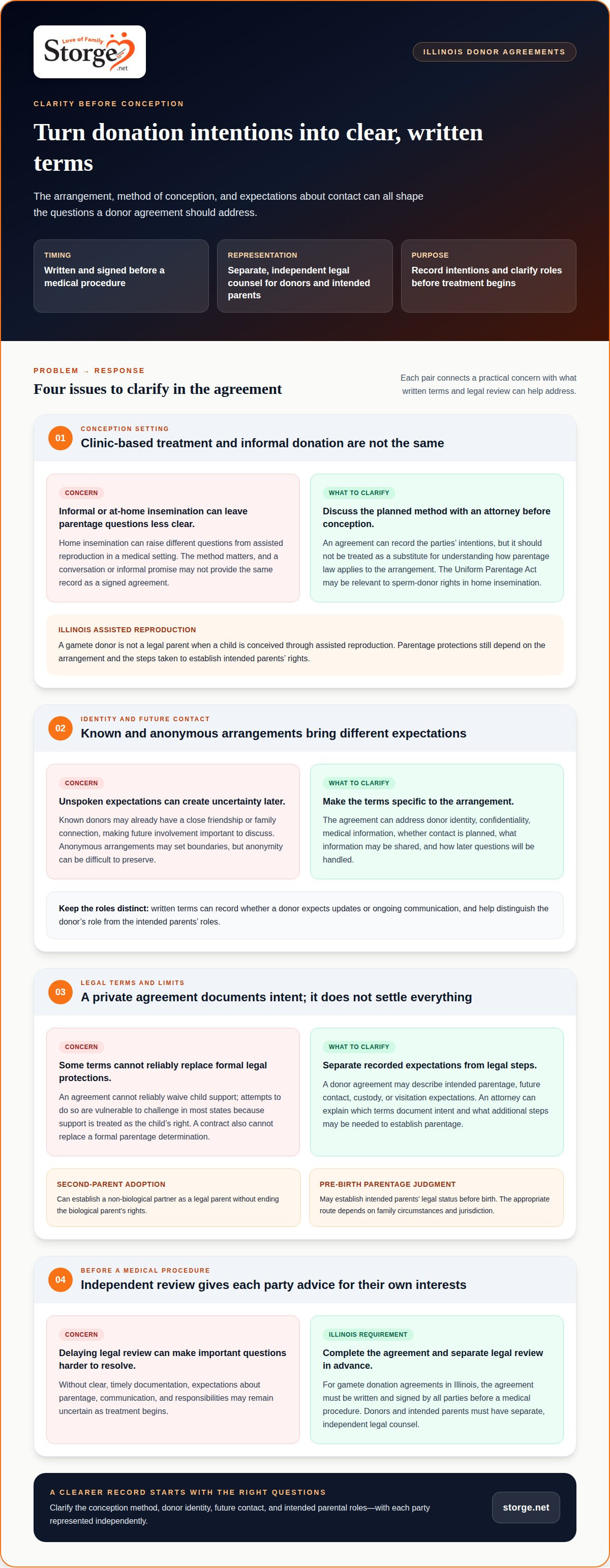
A donor agreement is more than a record of shared intentions. Under Illinois law, gamete donation agreements must be written and signed by all parties before a medical procedure, and intended parents and donors must have separate, independent legal counsel. Storge recognizes that seeking specialized legal guidance for LGBTQ donor agreements can clarify parental roles and address questions about known or anonymous donation before conception.
Building a family involves hopes as well as practical decisions, and delaying legal review can make important questions harder to resolve. Illinois law provides that a gamete donor is not a legal parent of a child conceived through assisted reproduction. Informal donation outside a medical setting can raise different parentage questions. This article explains what donor agreements cover, how they relate to donor liability and parental rights, what may differ between known and anonymous arrangements, and why early review matters. It also explains how legal referrals can support the process, helping you approach next steps with greater clarity.
Key Takeaways
- In Illinois, gamete donation agreements must be written and signed before a medical procedure, with donors and intended parents represented by separate, independent legal counsel.
- Understand how Illinois law treats a donor’s legal parentage in assisted reproduction, and why informal arrangements can leave parentage questions less clear.
- Known and anonymous arrangements can raise different questions about identity, future contact, and expectations, so agreement terms should reflect the arrangement.
- Early legal review gives everyone a chance to discuss parentage, contact, and other key terms before conception or treatment begins.
Do egg donors have parental rights?
In Illinois, a gamete donor is not a legal parent when a child is conceived through assisted reproduction. Parentage protections still depend on the conception arrangement and the steps taken to establish both intended parents’ rights.
Donor Rights and Intended-Parent Parentage
For assisted reproduction in Illinois, the donor is not a legal parent of the resulting child. A donor agreement can document the parties’ intentions and address parental roles, future contact, confidentiality, and the use of donated material. An attorney can help LGBTQ+ intended parents put these terms in writing before conception or treatment. This creates a clearer record of the planned legal and family relationships.
Parenting Agreements and Shared Intent
A parenting agreement can describe how intended parents plan to raise a child, but such agreements are not legally binding in every state. They may still offer evidence of shared intent in a custody dispute. Examples include school enrollment forms listing both parents, medical forms naming both as contacts, shared child-related expenses, and records of shared caregiving. An attorney can help address parental responsibilities and expectations in a donor agreement in the United States.
Second-Parent Adoption and Pre-Birth Judgments
When one partner is not biologically related to the child, a second-parent adoption can establish that person as a legal parent without ending the biological parent’s rights. A pre-birth parentage judgment may also establish intended parents’ legal status before birth. These are distinct legal routes, and the appropriate option depends on the family’s circumstances and jurisdiction. An adoption order or parentage judgment can provide stronger protection than relying on a private agreement alone.
Home Insemination and the Uniform Parentage Act
Home insemination can raise different parentage questions from assisted reproduction in a medical setting. The Uniform Parentage Act may be relevant to sperm donors’ rights when insemination happens at home, so the method of conception matters. A donor agreement can record the parties’ intentions, but it should not be treated as a substitute for understanding how applicable parentage law relates to the arrangement. Discussing the planned method with an attorney before conception can help clarify the legal issues.
Can an Illinois gamete donor be held legally responsible for a child?
An Illinois agreement should describe the donation arrangement and clarify each party’s intended role. Legal review can address parentage, future contact, and other terms before treatment begins.
Known Donors and Clinic-Based Donations
Known-donor and clinic-based donations can involve different communication and documentation needs. An agreement may identify the parties and address medical information, donor identity, and future contact, including when sperm comes through a clinic. In Illinois, the agreement must be written and signed before the medical procedure, and donors and intended parents need separate, independent legal counsel. That way, each party receives advice focused on their own interests.
Risks of Informal Donation
Donation without a doctor’s office or legal documentation can leave custody and parentage questions unclear. A conversation or informal promise may not provide the same record as a signed agreement prepared before conception. Illinois’s Parentage Act of 2015 provides a framework for assisted reproduction and parentage, but the details of the arrangement still matter. A family law attorney can review the planned method and document the parties’ intentions in context.
Child Support, Custody, and Visitation Terms
A donor agreement can document intended parentage and expectations about future contact, custody, or visitation. It cannot reliably waive child support: agreements attempting to do so are vulnerable to challenge in most states because support is treated as the child’s right. A contract also cannot replace a formal parentage determination. An attorney can explain which terms record the parties’ intentions and which legal steps may be needed to establish parentage.
Attorney fees depend on the case and the scope of drafting or review, with pricing provided after a quote request.
Medical terms can address how parties share relevant health updates after donation. Blood-donation screening is a separate process: testing is not 100 percent effective at detecting very early infections, a fact that should not be treated as a gamete-donation testing rule. For help connecting with separate counsel, explore attorney representation referrals.
Anonymous and known donor arrangements
A written agreement can reflect whether an egg, sperm, or embryo donor is known, anonymous, or open to future contact. These choices shape expectations about identity, communication, and medical information. Legal counsel can help make the document specific. For example, it can describe whether contact is planned, what information may be shared, and how the parties will handle questions that arise later.
With a known donor, intended parents and the donor may already have a relationship, such as a close friendship or family connection. That familiarity can make expectations about future involvement especially important to discuss before conception. The agreement can record whether the donor expects updates or contact, and whether the intended parents anticipate ongoing communication. Clear written terms help distinguish the donor’s role from the parents’ roles.
An anonymous arrangement may set boundaries around identifying information and future communication, but anonymity can be difficult to preserve. The American Society for Reproductive Medicine advises counseling egg donors about the risk of losing anonymity through direct-to-consumer DNA websites. A relative’s DNA results may also lead to unexpected discoveries. Discussing this possibility before donation helps everyone consider what openness could mean over time.
Known and anonymous sperm donor arrangements also call for clear, tailored terms. For example, an agreement can address donor identity, access to medical updates, future contact, and how stored samples may be used. These details matter whether donation happens through a clinic or a personal arrangement. Legal counsel can explain how the planned arrangement affects the agreement’s language and help the parties address expectations before treatment or conception.
For LGBTQ+ intended parents, choosing between openness and anonymity is personal, but everyone involved should discuss it. An early step is to identify which topics need written terms, including identity disclosure, contact, and medical information. That conversation can give the agreement a practical purpose: recording shared expectations while recognizing that circumstances may change.
Early legal review of donor agreements
Reviewing a donor agreement before conception gives everyone time to consider how it fits their family-building plans. In Illinois, gamete donation agreements must be written and signed before a medical procedure, with donors and intended parents represented by separate, independent legal counsel. Legal guidance for LGBTQ donor agreements can help each person understand the proposed terms before deciding about treatment or conception.
Do donor agreements need to be signed before conception to be valid? Illinois requires a written agreement before the medical procedure. For known-donor arrangements, signing before conception is recommended because an agreement made later may appear to be an afterthought. For egg donation, agreements are signed after medical screening and before fertility medications start.
Early review gives everyone time to discuss the relationship they expect with the donor and child. The agreement can address intended parentage, confidentiality, future contact, medical information, and sample storage and use. For embryo donation, intended parents may also discuss whether leftover embryos can go to other patients or research. Legal guidance for LGBTQ donor agreements can bring these distinct decisions into one conversation before treatment begins.
An attorney can explain where a private contract ends and when other legal steps may matter. A parenting agreement isn’t binding in every state, and a second-parent adoption or parentage judgment may offer a separate way to establish a non-biological parent’s legal relationship. Discussing custody and contact expectations early helps clarify what the agreement covers.
Online templates may help identify topics for discussion, but they aren’t a substitute for legal counsel. A qualified family law attorney can prepare an agreement tailored to a known-donor arrangement before conception. That gives each party time to understand the terms before signing.
Planning a donor arrangement? Explore your family-building options as you consider the next steps.
Storge: Donor Egg / Sperm Search
Storge’s Donor Egg / Sperm Search helps LGBTQ+ individuals and couples explore donor options as they plan to build a family. It can be a useful next step if you’re considering a known or anonymous donor and want support finding a path that reflects your family’s needs.
Donor selection and legal planning are connected, but they serve different purposes. Storge also offers Attorney Representation Referrals for people seeking independent legal counsel, along with Fertility Clinic Referrals for those exploring clinical care. An attorney can discuss how the proposed arrangement, parentage intentions, and expectations about future contact should be addressed in a written agreement.
You can take these decisions one at a time, with room to consider what matters to you and your family. If you’re ready to explore donor options, contact Storge.
Take Your Next Step With Clarity
Family-building decisions take time, and legal planning can move alongside them. As you consider what feels right for your family, look for support that respects your goals and helps you understand the choices ahead. Seeking legal guidance for LGBTQ donor agreements can be one part of a thoughtful plan, alongside donor and fertility resources.
Storge offers Storge PLUS Membership, Attorney Representation Referrals, and Fertility Clinic Referrals. These resources can help you explore your options while keeping legal counsel and fertility care as distinct parts of the process. Move forward at a pace that feels comfortable, with space to discuss your priorities and decide what support would be useful next.
If you’re ready to discuss donor agreements and your family-building plans, contact Storge. Your next step can be a conversation grounded in your needs and hopes.
Frequently Asked Questions
What is a Donor Agreement?
A donor agreement is a written contract that records the parties’ intentions and terms for a donation arrangement. It can identify who is involved and address issues such as confidentiality, future communication, medical information, and use of donated material. For example, parties considering embryo donation may need to discuss what happens to embryos not used in treatment. The agreement documents expectations; it doesn’t replace a legal parentage order.
Do egg donors need their own lawyer?
In Illinois, donors and intended parents must have separate, independent legal counsel for a gamete donation agreement. A donor’s attorney advises the donor, while the intended parents’ attorney advises them. Separate representation helps each person understand the terms from their own perspective, including responsibilities, confidentiality, and future contact. This differs from clinic consent paperwork, which addresses facility procedures rather than serving as a complete agreement about personal legal rights.
How is compensation handled in the agreement?
Compensation terms can explain what a payment recognizes and how the parties will handle a donation that stops early. The American Society for Reproductive Medicine says compensation should recognize a donor’s time, inconvenience, and discomfort during screening, stimulation, retrieval, and recovery, not the number or quality of eggs retrieved. It also notes that a program may pay a donor who stops for medical or other reasons in proportion to the time and effort contributed.
Are sperm or egg donor agreements legally enforceable in the U.S.?
Enforceability depends on the state and the agreement’s circumstances; there is no single federal law regulating third-party reproduction. Courts generally examine whether a contract includes offer, acceptance, consideration, and mutual intent. A clause cannot necessarily control every issue: provisions attempting to waive child support are vulnerable to challenge in most states because courts treat support as belonging to the child. State-specific legal review matters.
How do state laws treat known sperm donors and parental rights?
State rules differ, so a known donor’s legal status depends on the applicable law and conception arrangement. In Illinois, the Parentage Act of 2015 provides a framework for assisted reproduction, and a gamete donor is not a legal parent when conception occurs through assisted reproduction. Informal arrangements can leave parentage less clear. For a donor known personally, the agreement and method of conception are important issues for counsel to assess.
How do home insemination and clinic-assisted insemination affect donor agreements and parentage?
The method matters because legal rules may treat home and clinic-assisted insemination differently. For home insemination, the Uniform Parentage Act may be relevant to sperm donors’ rights. Clinic consent forms, by contrast, address facility procedures and aren’t comprehensive personal legal contracts. For example, intended parents and a known donor may have expectations about contact that clinic paperwork doesn’t capture, making a separately prepared agreement useful.


