

In reciprocal IVF, one partner provides the eggs and the other carries the pregnancy, using donor sperm to fertilize the eggs.
It can be difficult to pin down the total cost of reciprocal IVF because treatment may involve care for both partners. Medication, testing, donor sperm, and additional procedures can all affect the bill. This guide explains the main cost factors and how insurance or financing may help, so you can compare expenses as you plan your family-building journey.
Key Takeaways
- Understand how reciprocal IVF shares the process between partners and why both may have care-related costs.
- See which parts of a treatment estimate can shape the total, including donor sperm, medications, and embryo transfer.
- Learn why insurance coverage can depend on plan terms and how fertility coverage laws differ across states.
- Explore financing options, including tax-advantaged accounts, and how they may help manage eligible expenses.
Does Insurance Cover IVF for Lesbian Couples?
Insurance may help cover IVF for lesbian couples, but eligibility and covered services depend on the plan. Because reciprocal IVF involves care for both partners, benefits may apply differently to each person’s treatment.
Coverage for Reciprocal IVF
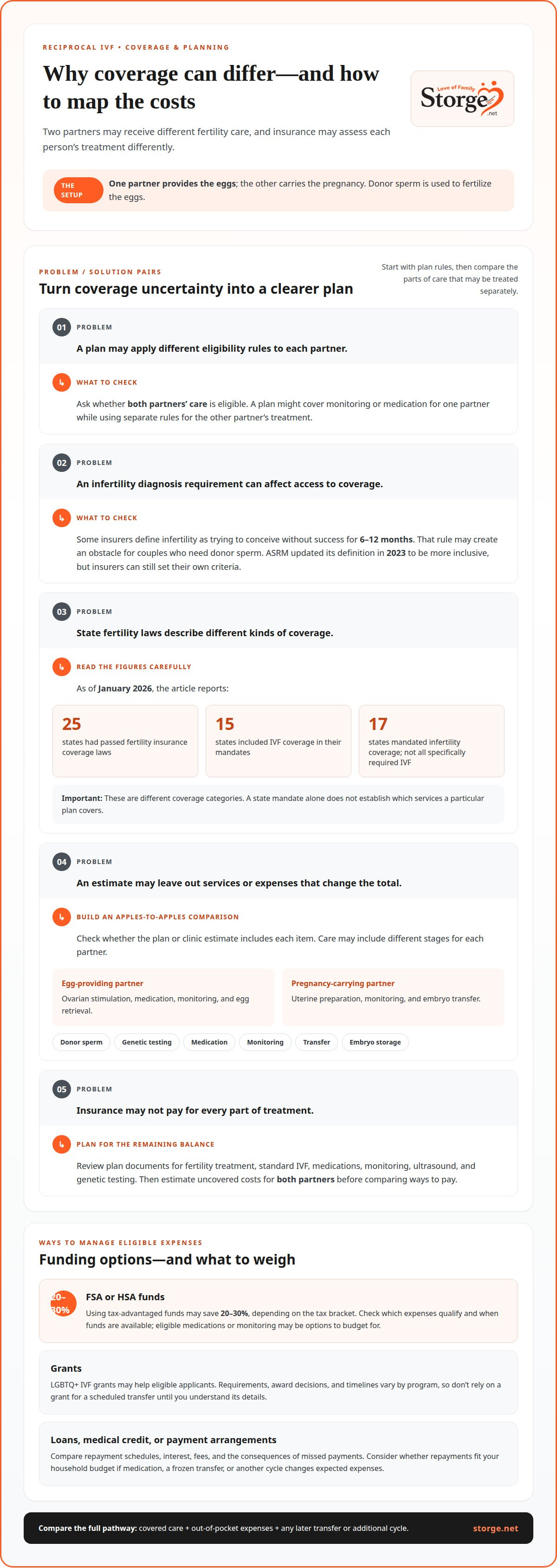
Reciprocal IVF is a treatment in which one partner provides eggs and the other carries the pregnancy. Coverage matters because a plan may assess each partner’s fertility care differently. For example, it might cover monitoring or medication for one partner while applying separate eligibility rules to the other partner’s treatment.
Some insurers require a clinical infertility diagnosis, often defined as trying to conceive without success for 6-12 months, before covering fertility treatment. That requirement can create an obstacle for couples who need donor sperm to conceive. The American Society for Reproductive Medicine updated its infertility definition in 2023 to be more inclusive of LGBTQ+ couples and single parents, but insurance policies can still set their own coverage criteria.
State requirements also differ. As of January 2026, 25 states had passed fertility insurance coverage laws, and 15 states included IVF coverage in their mandates. Separately, 17 states mandate infertility coverage, though not all specifically require IVF. These figures describe different coverage categories, so a state mandate alone doesn’t establish which services a particular plan covers.
Employer fertility benefits can add another layer. Review plan documents for coverage of fertility treatment, standard IVF, medications, monitoring, ultrasound, and genetic testing. A benefit might cover IVF procedures but exclude some medications or tests. Ask the plan administrator how reciprocal IVF and donor sperm expenses are classified, and whether both partners’ care is eligible.
Insurance and Financing
Financing can cover the portion of treatment expenses insurance does not pay. First, identify covered services and any eligibility conditions, then estimate the remaining expenses for both partners. This separates covered treatment from out-of-pocket costs, such as excluded medications or genetic testing, before you compare financing options.
Financing, grants, and tax-advantaged accounts
After insurance, financing can spread the remaining treatment expenses over time. Budget for the full treatment pathway, not just one IVF cycle. Include medication, donor sperm, genetic testing, and any later frozen transfer. If treatment may involve multiple cycles, estimate each separately to account for likely costs and timing.
Tax-advantaged accounts may help reduce the effective cost of eligible medical expenses. Using FSA or HSA funds may save 20-30%, depending on the tax bracket. Consider which expenses qualify and when funds are available before assigning them to treatment. For example, patients might reserve account funds for eligible medications or monitoring, then use another payment method for uncovered services.
LGBTQ+ IVF grants may offer another funding option for eligible applicants. Each program sets its own application requirements, award decisions, and timelines, so review the details before relying on a grant to fund a scheduled transfer. Prepare a clear treatment budget and gather any requested financial or clinical documents. If a grant does not cover the full plan, consider combining it with savings or another financing option.
Financing options may include personal loans, medical credit, or payment arrangements. Compare repayment schedules, interest, fees, and the consequences of missed payments before choosing. A loan may provide funds upfront, while a payment arrangement can spread charges over time. Make sure repayments fit your household budget, particularly if medication, a frozen transfer, or another cycle changes the expected expenses.
For help connecting treatment planning with clinic resources, explore fertility clinic referrals as you map out your next steps.
Reciprocal IVF cost range and average
The total depends on the treatment components, insurance coverage, and whether another cycle or transfer is needed.
Understanding the Overall Cost Range
The process involves ovarian stimulation and egg retrieval for the partner providing eggs, followed by fertilization with donor sperm. The other partner carries the pregnancy, so their uterine preparation and monitoring also contribute to care costs. Testing, medication, and transfer services can affect the total.
Variation by State and Clinic
State and clinic pricing, insurance coverage, and the services included in an estimate can all affect the total. State fertility coverage requirements also differ, which may change how much a patient pays out of pocket.
For a useful comparison, break each estimate into egg retrieval, laboratory work, medication, monitoring for both partners, and transfer. Then check whether donor sperm, genetic testing, or embryo storage is included. This makes differences between clinic estimates easier to understand.
Risks That Add to Total Costs
Extra expenses may arise if treatment requires additional procedures or another attempt.
Both partners’ care contributes to the budget: one partner has ovarian stimulation and egg retrieval, while the other has uterine preparation and embryo transfer. Monitoring may take place for each partner at different stages. Including these steps in the initial estimate helps show how the treatment plan affects the overall cost.
How much does embryo transfer cost in reciprocal IVF, including frozen embryo transfer?
In reciprocal IVF, embryos created from one partner’s eggs are transferred to the partner carrying the pregnancy. A fresh transfer may take place during the retrieval cycle, while a frozen embryo transfer uses an embryo preserved for later. Transfer expenses may be separate from retrieval and embryo-creation charges, so check which treatment stages the estimate includes.
These ranges reflect different cost estimates, not one fixed fee.
Some estimates bundle the transfer with related care. A broader figure may include expenses beyond the transfer procedure itself. For a meaningful comparison, check whether the estimate covers preparation, monitoring, medication, and follow-up, rather than comparing totals alone.
Frozen embryos may be transferred to the carrying partner in a later treatment cycle. These figures represent different estimates and should not automatically be combined. Ask for transfer, freezing, and storage costs to be itemized separately in the treatment budget.
A clear estimate can help you understand how a transfer fits into your overall plan. Explore fertility clinic referrals for support finding clinic resources as you consider the next stage.
Storge
Storge helps connect you with fertility resources as you consider the practical questions around reciprocal IVF. If you’re weighing clinic options, donor sperm, or support for your journey, Storge offers Fertility Clinic Referrals and Donor Egg / Sperm Search to help you explore those parts of your family-building plan. Attorney Representation Referrals can connect you with legal guidance relevant to your journey.
Consider turning to Storge as you move from cost research toward organizing your next steps. You can explore Storge PLUS Membership as part of finding support suited to your needs, without needing to have every decision settled first.
Contact Storge to discuss the fertility resources that may fit your journey.
Shape a plan that fits your family
The average cost of reciprocal IVF for same-sex female couples is only one part of a deeply personal decision. Turn what you’ve learned into a plan that reflects your priorities, your roles in treatment, and the support that feels right for both of you. You don’t need to resolve every question at once. Start by identifying what matters most, then decide which questions to address as you get guidance.
Shared planning can help each partner feel included and informed. Talk through the roles you hope each person will have, the questions you want answered, and the professional support that could help you feel prepared. These conversations can make the path ahead feel more intentional and connected.
When you’re ready to explore your options, Contact Storge to explore your options. Your family-building journey can move forward at a pace that feels thoughtful and true to you.
Frequently Asked Questions
What is reciprocal IVF?
Reciprocal IVF lets both partners take part biologically: one provides eggs, and the other carries the pregnancy. Donor sperm fertilizes the eggs, and an embryo is transferred to the carrying partner’s uterus. Partners can decide together who provides eggs and who carries, based on their preferences and medical circumstances. The process requires care planning for both partners.
How Much Does It Really Cost for Two Moms to Have a Baby?
The final amount depends on the services included in the estimate and whether additional treatment is needed. A broader budget should account for possible later transfers, rather than treating the first cycle as the full family-building cost.
How much does in vitro fertilization (IVF) cost?
Reciprocal IVF includes care for the partner carrying the pregnancy and donor sperm, so the total can differ from other IVF estimates. For a useful comparison, check what each estimate includes, such as medication, monitoring, retrieval, laboratory services, and transfer. A base cycle figure may not cover every treatment expense.
Quick Answer: What Does Reciprocal IVF Cost?
The range reflects differences in clinic charges, medication, donor sperm, and add-on services. Before using a figure for planning, distinguish a single-cycle estimate from a budget that includes later transfers or another attempt.
What is the average total cost of reciprocal IVF in the United States?
“Total” may mean one cycle or the broader path to pregnancy. Label each estimate clearly and list any anticipated frozen transfer or additional cycle separately.
What do reciprocal IVF clinic fees typically include, and what costs are extra?
Clinic fees may cover services such as monitoring, egg retrieval, laboratory work, and embryo transfer, but estimates vary in what they include. Separate charges may include medication, donor sperm, genetic testing, embryo freezing, and storage. Reviewing an itemized estimate helps distinguish the clinic’s cycle fee from additional services and ongoing storage.


