
What if the most challenging part of starting your family wasn't the complex logistics, but finding a space where your identity is celebrated rather than just tolerated? It's a question many intended fathers face when they begin the search for an egg donor for gay couple parenthood. You likely already know that the path to fatherhood is filled with significant emotional and financial decisions. It's natural to feel a bit overwhelmed by the technical jargon or the fear of facing discrimination from traditional agencies that don't quite "get" your family structure.
We believe you shouldn't have to handle these transitions alone or settle for a process that feels cold and clinical. This guide is designed to help you move forward with confidence, offering a clear roadmap from understanding different donor types to securing a vetted match within a supportive community. We'll explore how to find a donor who aligns with your personal values while ensuring every legal and medical step is handled with expert care. By the end of this article, you'll have a steady plan to bridge the gap between your dream of a child and the practical reality of making it happen.
Key Takeaways
- Understand the pivotal role an egg donor plays in your surrogacy journey and why this choice is your first major milestone.
- Compare the benefits of known, anonymous, and semi-open donors to find the connection level that best fits your future family.
- Learn to evaluate potential donors using specific medical benchmarks and genetic screening to ensure a healthy and secure start.
- Simplify the search for an egg donor for gay couple parenthood by moving away from unmonitored databases into a safe, vetted community.
- Navigate the transition from finding a match to receiving medical clearance at your fertility clinic with a clear, step-by-step roadmap.
Understanding the Role of an Egg Donor in Your Surrogacy Journey
Starting your family through surrogacy is a multi-layered process, but it truly begins with a single, vital contribution. Finding an egg donor for gay couple parenthood is more than a clinical transaction; it is the moment your future child's genetic story begins. In the IVF process, the donor provides the oocytes, or eggs, that will be fertilized with your sperm to create embryos. Because this choice determines the biological foundation of your child, it represents the first major milestone in your journey. It sets the entire timeline in motion, usually occurring as the very first active step before you finalize your match with a gestational carrier.
Selecting a donor requires balancing practical medical data with deep, personal intuition. This phase isn't just about checking boxes on a medical form. It's about finding a partner in your story who understands the weight of her contribution to your future family. The donor's role is foundational, as her health and genetic history directly influence the success of the IVF cycle and the long-term well-being of your child.
The Biological and Emotional Connection
For many gay couples, the first step is deciding which partner will provide the sperm. Some choose to use one partner's genetics for the first child and the other's for a second, while others may split a single IVF cycle between both. Once that decision is made, the focus shifts to the donor. You might look for physical traits that mirror your own or prioritize a specific educational background or health history. Beyond the data, there is an emotional layer. You're looking for a connection that feels right, ensuring your child's biological heritage aligns with the values you intend to pass down. It's a delicate balance between looking for a "reflection" of your family and finding a healthy, vetted contributor.
The Importance of LGBTQ-Inclusive Vetting
Traditional donor banks can sometimes feel detached or even exclusionary. They may lack the specific screening protocols that ensure a donor is fully supportive of LGBTQ+ family structures. Working within a trusted community changes this dynamic. When you find an egg donor for gay couple building through a vetted platform, you are connecting with women who have intentionally chosen to support gay fathers. This mutual respect creates a foundation of safety and legitimacy. It transforms the search from a stressful hunt through unmonitored databases into a supported experience within a community that values your path to parenthood. This intentionality ensures that everyone involved is aligned with the same goal: bringing a healthy child into a loving, supportive home.
Choosing Between Known, Anonymous, and Semi-Open Donors
Deciding on the level of contact you wish to have with your donor is a deeply personal choice that shapes your family's future narrative. In 2026, the landscape of egg donation has shifted significantly away from total anonymity toward models that prioritize transparency and long-term clarity. Whether you choose a friend, a family member, or a donor from a vetted community, each path offers distinct emotional and legal considerations. Finding an egg donor for gay couple parenthood requires looking beyond the immediate medical process to consider how this relationship might evolve over the next twenty years.
Navigating the Known Donor Path
Choosing a friend or family member as a known donor can create a beautiful sense of continuity and shared history. It often feels more intimate and can reduce some of the initial vetting anxiety. However, this path requires rigorous boundaries to protect both your friendship and your legal rights as parents. Psychological screening is a standard and necessary step to ensure everyone is emotionally prepared for the shifting dynamics. Because these arrangements involve existing personal bonds, having a specialized surrogacy attorney for gay couples is essential. They will draft a contract that clearly defines parental rights, avoiding the "handshake deal" pitfalls that can lead to heartache later. Clear legal structures allow you to focus on the joy of the connection rather than the stress of uncertainty.
The Rise of Open and Semi-Open Donations
The traditional anonymous model, where the donor and parents never exchange identifying information, is becoming less common. Many modern parents now prefer semi-open or open arrangements. In a semi-open match, non-identifying information is shared through a third-party intermediary, allowing for updates on medical history as the child grows. This shift is driven by a growing understanding of the needs of donor-conceived children, who often benefit from having access to their biological heritage and health data.
Choosing an open path doesn't mean the donor is a co-parent; rather, it creates a bridge for future communication if and when your child has questions. This transparency fosters a sense of honesty within the family from day one. If you are looking for a match that values this level of integrity, exploring the vetted resources at Storge can help you find donors who are specifically screened for their comfort with open or semi-open communication. Managing these expectations early ensures that your partnership with a donor remains a source of support throughout your child's life.
How to Evaluate and Vet Potential Egg Donors
Finding a match is an exciting milestone, but the vetting process is what ensures that match is built on a solid foundation. This stage transforms a compelling profile into a verified medical and psychological reality. When searching for an egg donor for gay couple parenthood, the vetting process must be twofold: it should confirm clinical health while also ensuring a deep, values-based alignment with your family structure. Taking the time to look closely at the data now provides peace of mind throughout the rest of your surrogacy journey.
The evaluation process usually begins with a thorough review of the donor's medical records and a formal psychological assessment. These steps aren't meant to be intimidating; rather, they serve as a protective layer for everyone involved. A clinical evaluation ensures the donor is physically capable of a successful retrieval, while the psychological component confirms she fully understands the emotional weight of her gift. This comprehensive approach creates a sense of safety, allowing you to move forward with a partner who is as prepared as you are.
Clinical and Genetic Screening
Your fertility clinic will lead the clinical vetting, focusing on the donor's reproductive health and genetic history. They look for a clean bill of health and a family history free of significant hereditary conditions. Carrier screening is a critical part of this, as it identifies whether the donor carries genetic mutations that could be passed to a child, especially when compared against the sperm provider's results. Anti-Müllerian Hormone (AMH) is a blood test that measures a woman's ovarian reserve, providing a reliable estimate of her remaining egg supply. Along with an antral follicle count, these numbers help your medical team predict the likely success of an egg retrieval cycle.
Personal and Values-Based Matching
Beyond the lab results, you need to understand the human behind the profile. Reviewing a donor's personal statements, videos, and social history provides insight into her personality and her "why." For gay men, a donor's motivation is particularly significant. You want to work with someone who isn't just participating for compensation, but who is genuinely excited to help two dads bring a child into the world. Shared values are the heartbeat of a successful match, ensuring that the donor respects and celebrates your family's identity. Many traditional databases don't filter for this specific affinity, which can lead to uncomfortable interactions or misaligned expectations. Storge PLUS solves this by connecting you with donors who are specifically vetted for being LGBTQ-affirming, ensuring your search is focused only on women who are proud to support your path to fatherhood.
The Step-by-Step Process of Securing a Donor Match
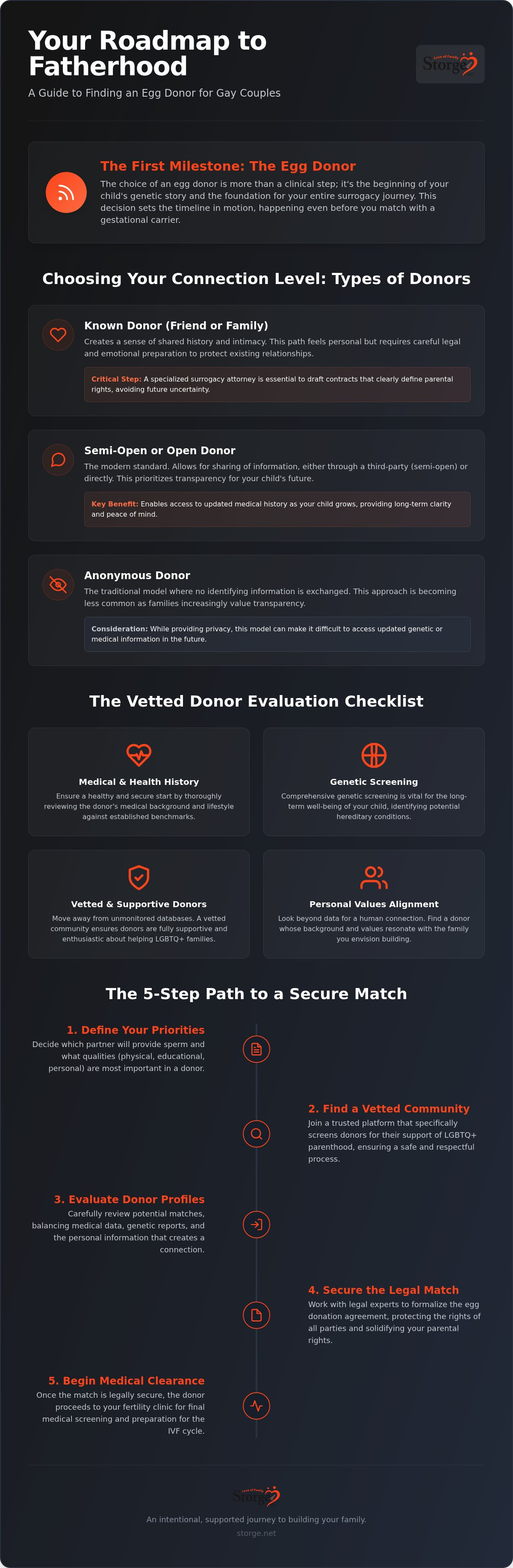
Once you've identified a potential match, your journey shifts from discovery to active coordination. This phase is about turning a shared vision into a secure reality through a series of logical, protective steps. Securing an egg donor for gay couple parenthood requires a methodical approach that balances medical requirements with legal safeguards. By following a clear roadmap, you can transition from the initial search within a trusted LGBTQ donor community to the finalization of your embryos with total peace of mind.
The process moves quickly once a match is confirmed, so it's helpful to understand how each piece of the puzzle fits together. From the moment you place a "hold" on a profile to the day of the egg retrieval, you'll be working closely with your fertility clinic and legal team to ensure every detail is handled with precision. This structured progression is designed to protect your future family and the well-being of the donor who is helping you build it.
From Matching to Medical Clearance
After you select a donor, the clinic will usually place a temporary hold on her profile. This gives you the space to finalize your decision without the pressure of other intended parents viewing the same match. During this time, the donor undergoes a final round of medical exams specifically synchronized with your clinic's protocols. This includes a physical exam, updated blood work, and a psychological clearance. The psychological component is particularly vital; it's a supportive session that ensures the donor is emotionally prepared for the process and understands the long-term nature of her gift. Once the clinic issues "medical clearance," the donor is officially ready to begin her stimulation cycle.
Legal Protection and Contract Finalization
Before any medical procedures begin, a formal legal agreement must be in place. It is a non-negotiable standard that both the intended parents and the donor have their own independent legal representation. This ensures that everyone's interests are protected and that the agreement is truly mutual. Your contract will clearly define the financial terms, the level of future contact, and, most importantly, the establishment of your parental rights same sex couple protections. These legal documents are the foundation that allows you to focus on the arrival of your child without fear of future ambiguity.
The final stage is the egg retrieval cycle itself. The donor follows a medication protocol overseen by your fertility clinic, culminating in a minor surgical procedure to retrieve the eggs. These eggs are then fertilized with your sperm to create embryos. If you're ready to begin this structured path with a team that understands your specific needs, you can find expert donor search support through our community to ensure every step is handled with care.
Finding Your Match Through the Storge PLUS Community
The search for an egg donor for gay couple parenthood shouldn't feel like a solitary struggle against an impersonal system. Many intended fathers find that traditional databases lack the human touch and specialized vetting their journey requires. Storge PLUS serves as a sanctuary where safety, legitimacy, and mutual support are the primary focus. It acts as a bridge between your personal dream and the practical reality of starting your family, providing a sense of belonging within a community that truly understands your path.
By moving away from unmonitored databases, you gain access to a curated environment where every donor is specifically screened for her commitment to LGBTQ+ families. This intentionality eliminates the fear of discrimination and ensures that every interaction is rooted in respect. You aren't just browsing profiles; you're connecting with individuals who are eager to be part of your story. This level of transparency is essential for building a foundation of trust before you ever step foot in a clinic.
The Storge PLUS Advantage
A Storge PLUS Membership offers more than just a search tool; it provides the gold standard for safe and inclusive donor matching. We prioritize high-quality, verified resources to ensure your peace of mind. The platform helps reduce the stress and anxiety of the search process by breaking down complex stages into manageable, less intimidating phases. You'll find that our community is built on shared values, where donors are vetted not just for medical criteria, but for their genuine desire to support gay fathers. This focus on connection and legitimacy transforms a clinical process into a heartfelt partnership, allowing you to move forward with a sense of safety and belonging.
Taking the First Step Toward Parenthood
Storge acts as your steady guide through the often overwhelming fertility landscape. While we don't handle medical procedures directly, we offer the critical connections you need to succeed. This includes professional Attorney Representation Referrals to ensure your contracts are secure and Fertility Clinic Referrals to lead you to inclusive medical experts. You'll also have the opportunity to build a support network with other intended parents who are walking a similar path, sharing insights and encouragement along the way. This communal approach ensures you never feel like a number in a database, but rather a valued member of a supportive family-building network.
Your journey to fatherhood is a significant life transition, and you deserve a partner who respects the emotional weight of your decisions. We're here to help you move from broad, visionary concepts to concrete, actionable steps. Join Storge PLUS to start your donor search today and take the first concrete step toward the family you've always envisioned.
Your Path to Fatherhood Starts with a Trusted Partnership
Building your family is a profound journey that requires a blend of heart and strategy. By understanding the different donor types and prioritizing a rigorous vetting process, you've already taken the most important steps toward clarity. Finding the right egg donor for gay couple parenthood is about more than genetics; it's about finding a partner who shares your values and respects your path to fatherhood. These foundational decisions ensure your child's story begins with honesty and security.
The complexities of medical jargon and legal contracts don't have to be a barrier when you have a steady guide by your side. You deserve a process that feels as intentional and loving as the family you are creating. We're here to help you bridge the gap between your dream and reality with a community built on safety and mutual support.
Join Storge PLUS: Your Vetted Path to LGBTQ+ Family Building and gain access to our vetted network of donors, specialized legal and clinic referrals, and a supportive LGBTQ+ community environment. Your future child's story is waiting to begin, and we're honored to walk this path with you.
Frequently Asked Questions
How much does an egg donor for a gay couple typically cost in 2026?
An egg donor for a gay couple typically involves compensation between $6,000 and $15,000 for a first-time donor, while repeat donors may receive $15,000 to $25,000 or more. When you include the costs of the IVF cycle and clinic fees, the total investment generally ranges from $25,000 to $45,000. Fresh egg donor cycles coordinated through agencies can sometimes exceed $50,000. These figures represent the industry standard for 2026.
Can we use an egg donor and a surrogate who are the same person?
You can use the same person as both a donor and a surrogate in a traditional surrogacy, but this path is increasingly rare today. Most intended fathers choose gestational surrogacy, where an egg donor and a gestational carrier are two different people. This separation simplifies the legal process of establishing parental rights and reduces the emotional complexity of the arrangement. Most modern clinics and attorneys recommend this separate approach to ensure a secure path to fatherhood.
What is the difference between an egg donor and a gestational carrier?
The difference is entirely biological: an egg donor provides the genetic material, while a gestational carrier carries the pregnancy and has no genetic link to the child. In most IVF journeys, an egg is fertilized with sperm to create an embryo that is then transferred to the carrier. This distinction is vital for legal clarity, as it ensures the carrier is not the biological parent. This structure provides a safer, more predictable roadmap for your family's future.
How do we ensure our parental rights are protected when using an egg donor?
Protecting your parental rights requires a formal, written legal contract drafted by a specialized reproductive attorney before any medical steps are taken. This agreement clearly states that the donor has no parental rights and that you are the sole legal parents of any resulting children. Depending on your location, your attorney may also help you obtain a pre-birth order. This legal foundation is essential for your peace of mind and your family's long-term security.
Is it better to use a fresh or frozen egg donor for IVF?
Choosing between fresh and frozen eggs depends on your specific timeline, budget, and the number of children you hope to have. Frozen eggs are often more cost-effective and allow you to start the IVF process immediately since the eggs are already retrieved. Fresh cycles are more expensive and require more coordination, but they often yield a higher number of eggs. Your fertility clinic will help you decide which option aligns best with your medical needs and family goals.
How long does the process of finding and securing an egg donor take?
Finding an egg donor for gay couple parenthood typically takes between one and four months, depending on your specific preferences and the donor's availability. Once you've made a match, the medical and psychological clearance process adds another four to six weeks to the schedule. The legal contract phase and the donor's stimulation cycle usually take an additional two months. Working with a vetted community can help you navigate these stages more efficiently and with greater confidence.
Can a gay couple use two different egg donors for one surrogacy journey?
You can use two different donors, but this is rarely recommended for a single surrogacy journey due to the significant cost and logistical hurdles. Most couples prefer to work with one donor for all embryos to ensure that any future siblings share a genetic connection. If you wish for children from different biological backgrounds, it's usually more practical to plan two separate journeys. This allows your team to focus on the health and success of one cycle at a time.
What medical tests should we expect our egg donor to undergo?
Your donor will undergo comprehensive medical testing, including Anti-Müllerian Hormone (AMH) levels to assess her egg reserve and detailed genetic carrier screening. The clinic also performs infectious disease testing and an ultrasound to evaluate her ovarian health. In addition to these physical exams, a psychological evaluation is a standard requirement to ensure she is emotionally prepared for the process. These steps are designed to maximize the safety and success of your journey toward fatherhood.


