
What if a resource that looks professional still doesn’t answer the questions your family needs to ask? When you’re considering donor conception, sorting dependable guidance from outdated or promotional information can feel like another big decision. Verified resources for LGBTQ donor conception can offer a clearer starting point, but trust also means understanding what a resource can and can’t confirm.
You deserve information that respects your family structure and supports your choices without adding pressure. This guide shows you how to assess donor-conception resources, find affirming support, and identify practical next steps. It also explains why verification matters and why it can’t guarantee medical, legal, or personal outcomes.
We’ll look at ways to explore donor, fertility clinic, legal, and community resources, and how to keep your questions grounded as you move forward. Storge connects LGBTQ+ individuals and couples with a vetted community that includes egg donors, sperm donors, and gestational carriers, as well as referrals to fertility clinics, attorneys, and hospitals. Knowing what each resource can do helps you build a path that feels informed, supported, and true to your family.
Key Takeaways
- Check a resource’s purpose, accountable source, and review date to judge whether its guidance is relevant and current.
- Verified resources for LGBTQ donor conception can help you find a useful starting point, but verification alone can’t establish medical, legal, or personal outcomes.
- Match your question to the right resource, such as educational guidance, clinical referrals, legal guidance, donor connections, or peer support.
- Keep established information separate from unanswered questions so you can identify practical follow-ups without feeling rushed.
- Storge connects LGBTQ+ individuals and couples with donors, gestational carriers, fertility clinic and attorney referrals, hospital searches, and community.
Verified resources for LGBTQ donor conception: where to begin
LGBTQ+ families have different paths to donor conception, and the information that’s useful depends on your family, questions, and circumstances. You might be exploring donor sperm, donor eggs, fertility care, or a gestational carrier. You don’t need to solve every question at once. Start by naming what you need to understand now, then choose a resource designed to address it.
Verified resources for LGBTQ donor conception should make it possible to understand who provides the information, what it is intended to help with, and what it can’t answer. An educational article, a professional referral, a donor connection, and a peer community can each be useful, but they serve different purposes. A verification label alone doesn’t guarantee an outcome or replace advice tailored to your medical or legal circumstances.
What counts as a verified donor-conception resource?
Look for a clear source, a stated purpose, and information you can examine. An educational article explains a topic; a professional referral helps you find relevant expertise; a donor connection supports exploration of donor options; and a community space offers connection and shared perspectives. These resources aren’t interchangeable. First check who is responsible for the information and whom it is meant to serve.
Verification means transparent, reviewable information, not a guaranteed result. For clinical or legal questions, the source’s perspective matters. Educational material can orient you, while an individualized question belongs with an appropriately relevant medical or legal professional.
Which resources might fit your family-building questions?
Choose resources according to the question in front of you, rather than treating a broad LGBTQ+ family-building hub as one complete guide. If you’re comparing paths, an overview of Assisted Reproductive Technology for LGBTQ+ People can introduce common assisted-reproduction approaches and related considerations. Use it as a starting point for learning, not as individualized guidance.
- Donor information: Explore donor profiles and connections, and note what information is available to intended parents.
- Fertility care: Use clinic referrals and educational material to prepare questions about care options that may fit your circumstances.
- Legal guidance: Seek relevant attorney guidance for questions about agreements and parentage. Laws and individual situations can differ.
- Emotional support and community: Peer spaces can offer understanding and connection, while professional support may help with personal or family concerns.
Not every family will use the same combination of donors, fertility care, or gestational-carrier support. Your needs may also change as you learn more. For a closer look at connection and shared experience within donor communities, explore the LGBTQ+ donor community guide. Treat each resource as one part of your research, and ground personal medical or legal decisions in guidance specific to you.
How to assess whether LGBTQ donor-conception guidance is trustworthy
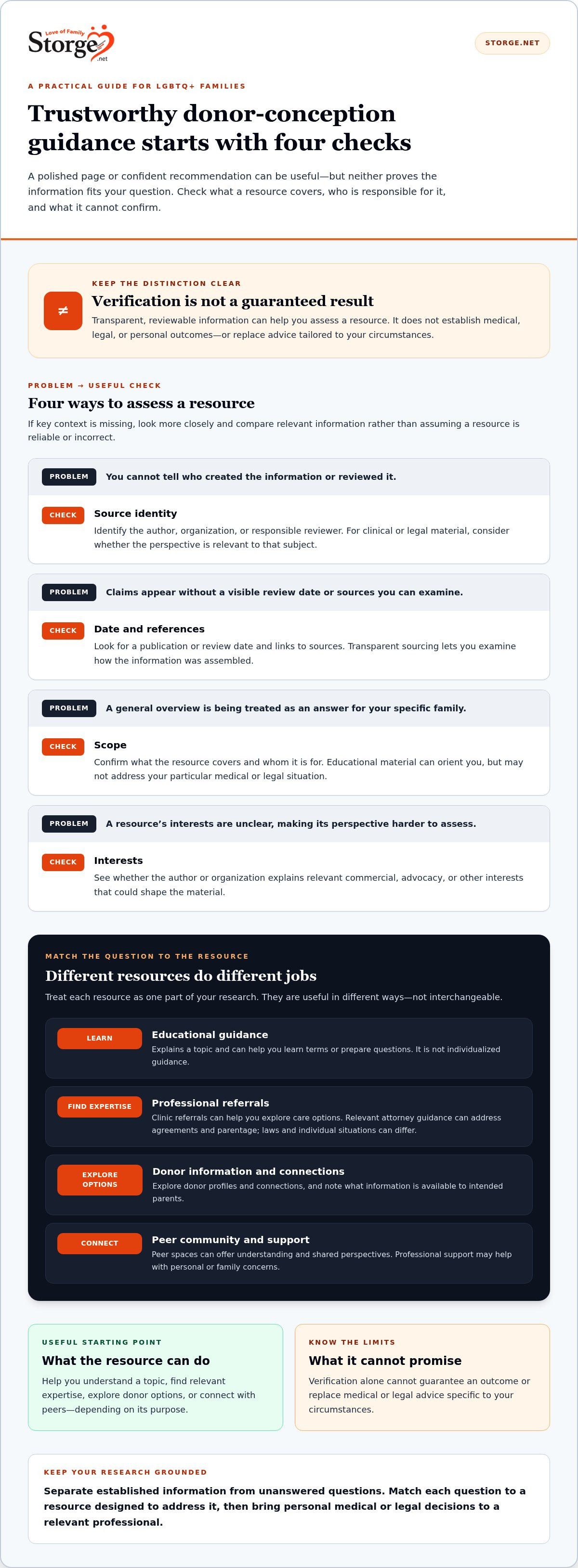
A polished page or confident recommendation can be useful, but neither tells you on its own whether the information fits your question. Use a short checklist to understand who created a resource, what it covers, and where its limits are. The goal isn’t to distrust every source. It’s to recognize what kind of help you’re receiving and what still needs a specific answer.
Credibility signals to look for in a resource
Before relying on a resource, pause to check its basic details. If key context is missing, look more closely and compare it with other relevant information rather than assuming it is either reliable or incorrect.
- Source identity: Can you identify the author, organization, or responsible reviewer? For clinical or legal material, look for a perspective relevant to that subject.
- Date and references: Is a publication or review date visible? Are claims linked to sources you can examine, rather than presented without explanation?
- Scope: Does the resource say what it covers and whom it is for? A general overview may help you learn terms, but it may not address your family’s particular medical or legal situation.
- Interests: Does the author or organization explain relevant commercial, advocacy, or other interests that could shape the material?
Transparent sourcing lets you examine how information was assembled; it isn’t an endorsement or a promise of a particular outcome. For example, the American Society for Reproductive Medicine’s discussion of donor sperm and LGBTQ+ family building offers a professional medical perspective on related considerations. The ASRM resource on LGBTQ+ family building can inform your reading. Questions about your own care still belong in a conversation with a relevant professional.
How to recognize limits, bias, and outdated information
Different resources serve different purposes. Evidence-based educational material explains what research or professional guidance supports. Advocacy content makes a case for change or access. Personal stories share lived experience. Service descriptions explain an organization’s offerings. Each can provide value, but they shouldn’t be treated as the same kind of evidence.
Commercial interests may influence which options a resource emphasizes or what next step it recommends. Notice whether the material distinguishes general information from promotion and presents qualifications alongside claims. Be cautious with undated pages, sweeping guarantees, or statements that leave out conditions that could affect the answer.
Peer experiences can help you feel less alone and suggest questions you hadn’t considered. They can’t determine what will happen in your medical care or resolve a legal question for your circumstances. Write down uncertainties rather than filling gaps with assumptions. Bring consequential clinical questions to a fertility professional and legal questions to an attorney with relevant experience.
For a supportive starting point to explore donor-conception connections and community, Storge’s LGBTQ+ family-building resources can help you continue your search with your questions in hand.
Compare donor-conception resources by the question they answer
A directory can show you what’s available, but the most useful next step is matching a resource to the question you actually have. Educational material can orient you; a clinic referral can connect you with care; legal guidance can address representation and family-specific questions. Donor communities and peer support offer different kinds of connection. These resources work best together, not as substitutes for one another.
| Resource type | Questions it can help answer | Its limits |
|---|---|---|
| Educational resources | What terms, pathways, or topics should I understand? | General information isn’t a personal diagnosis or treatment plan. |
| Fertility clinic referrals | How can I connect with a clinic to discuss care? | A referral is a connection, not a medical procedure or treatment recommendation. |
| Legal guidance or attorney referrals | What legal questions should I raise about agreements or parentage? | General information can’t replace advice or representation for your circumstances. |
| Donor communities | Where can I explore donor connections and related information? | A connection doesn’t decide whether a donor arrangement is right for your family. |
| Peer support | How have others experienced donor conception or family building? | Another person’s story can’t predict your medical or legal outcome. |
Education, clinical referrals, and legal guidance serve different roles
Use educational resources to learn vocabulary and prepare focused questions. If you’re seeking care, a clinic referral can help connect you with a fertility clinic, where clinical professionals can discuss your situation. An attorney referral can connect you with legal representation; it isn’t in-house legal advice from the referral platform. Keeping these roles distinct helps you know where to take your next question.
For example, an article may help you understand a treatment term, while a clinic conversation can address whether a care option fits your needs. A general legal explainer may point out topics to discuss, but an attorney can provide guidance specific to your circumstances. Verified resources for LGBTQ donor conception are most useful when you know what each one can and cannot answer. No single resource category has to carry the whole decision.
Community and peer resources add connection, not professional advice
Donor communities can help you explore connections and feel less alone in a process that may involve personal questions. Peer spaces also make room for shared experience, practical perspectives, and a sense of belonging. A family-building journey can feel different when you have people who understand its context. Storge connects LGBTQ+ individuals and couples with a vetted community that includes donors and gestational carriers.
Still, one family’s experience may not reflect another’s circumstances, choices, or outcomes. Treat personal stories as context and possible prompts for questions, not individualized clinical or legal advice. The LGBTQ fertility community guide offers more perspective on the value of supportive connection. You can draw on community for understanding while bringing professional questions to the relevant clinical or legal resource.
A practical way to use verified donor-conception resources
Research feels more manageable when each search has a purpose. Rather than opening every link you find, use a simple sequence: name the question, choose the resource type, assess its source, and record what you want to follow up on. This turns browsing into useful next steps without asking you to decide everything at once.
Start with one decision or question at a time
Begin by identifying the subject that matters most right now: donor information, fertility care, legal questions, or emotional support. For example, “What should we understand about donor options?” calls for a different resource than “What should we ask a fertility clinic?” Choose a small group of relevant resources, then compare what they say and where their guidance differs. You can explore without committing to a particular family-building path before you feel ready.
As you read, separate established information from items that still need clarification. Mark a point as established only when you can identify its source and understand what it applies to. Put unanswered questions, conflicting explanations, or details that may depend on your circumstances in a separate follow-up list. That distinction helps prevent a general article or someone else’s experience from becoming an assumption about your situation.
Turn information into questions for qualified support
General education can help you learn terms and prepare, but questions about your individual care or legal circumstances call for relevant professional guidance. Before a conversation, write down the question you need answered, the source that prompted it, and any detail you want clarified. Keep notes concise; you don’t need to arrive with every possible decision already made.
If your questions concern clinic care, the questions for an LGBTQ-friendly fertility clinic can help you organize topics for discussion. For a legal conversation, record the specific issue and note which parts of what you’ve read remain unclear. Share useful source links when they provide context, and ask the professional how the information relates to your circumstances.
A simple tracker can keep your research clear. Use one entry for each resource, and update it when you learn something new:
- Topic: Donor information, fertility care, legal questions, or support.
- Source: Author, organization, professional referral, or community space.
- Date: Publication or review date, if provided, and when you accessed it.
- Useful points: A brief summary of what the resource actually helped answer.
- Follow-up questions: Anything uncertain, personal to your circumstances, or worth raising with a professional.
Keeping these notes together makes it easier to return to what matters without starting from scratch. Verified resources for LGBTQ donor conception can support informed exploration, while your tracker helps you carry questions forward at a manageable pace. To bring donor and professional connections together as you explore, explore Storge’s donor-conception resources.
Find LGBTQ donor-conception resources and community through Storge
Finding relevant information is easier when resource discovery and supportive connections sit in the same place. Storge is a platform for LGBTQ+ individuals and couples exploring donor conception, with access to a vetted community that includes egg donors, sperm donors, and gestational carriers. Storge also connects members with fertility clinic and attorney representation referrals, as well as hospital searches.
What Storge can help you connect with
Through the Storge PLUS community, you can explore donor and gestational-carrier connections alongside other family-building resources. The right starting point depends on what you’re trying to learn or arrange. You might begin by exploring donor options, looking for a clinic referral to discuss care, or seeking an attorney referral for legal representation. Hospital searches offer another type of connection as your plans develop.
These connections have distinct roles. A fertility clinic referral connects you with a clinic, while medical care is discussed with that clinic’s professionals. An attorney referral connects you with legal representation. A gestational-carrier search is a connection resource, not full-service surrogacy. Understanding these boundaries helps you use each resource for its intended purpose and bring clinical or legal questions to the relevant professional.
Verified resources for LGBTQ donor conception can help organize where to look, but a platform connection alone doesn’t establish a medical or legal outcome. Consider what you need next, then use the resource that fits that question. If you’re still exploring, it’s fine to begin with learning and community rather than trying to settle every detail of your family-building plan.
Choose a next step that feels manageable
Start with one focused question. Are you hoping to learn about donor connections, find a clinic referral, explore attorney representation, or understand how community might support you? Choosing one topic can make the next step clearer without requiring you to make decisions before you’re ready.
You can explore Storge at your own pace, keeping track of what you learn and the questions you want to bring to a fertility professional or attorney. For an overview of the membership and how it relates to LGBTQ+ family building, the Storge PLUS membership guide offers more context. Use it to decide whether exploring the community and its connections is a useful next step for you.
If you’re ready to continue, explore Storge’s donor and professional connections. Begin with the question that matters most today. Your next step can be small, specific, and guided by what feels right for your family.
Take your next step with confidence
You don’t have to resolve every question before moving forward. A useful next step can be as small as naming what you want to understand, saving a question for a professional, or finding a community that helps you feel less alone. Let your priorities, not the volume of information online, set the pace.
Think of Verified resources for LGBTQ donor conception as a way to make your next conversation more informed, not as a demand to have every answer. Your family’s path is personal, and it’s okay for the plan to take shape over time. Focus on the connection or information that would make the biggest difference right now.
When you’re ready to explore supportive LGBTQ+ family-building connections, take a look at Storge PLUS. Explore Storge PLUS and find supportive LGBTQ+ family-building connections. One thoughtful step is enough to begin, and you deserve support as you take it.
Frequently Asked Questions
What are verified resources for LGBTQ donor conception?
Verified resources for LGBTQ donor conception are resources whose source and purpose are clear enough for you to assess what they offer. For example, a clinic’s educational page, a donor connection, and a peer group each provide different kinds of information. Check who maintains the resource, what audience it serves, and whether it points to material you can review. Verification helps with informed exploration, not certainty about what will happen.
How can I tell whether a donor-conception resource is trustworthy?
Look for an identifiable author or organization, a publication or review date, and clear references for important claims. Check whether the resource explains what it covers and discloses relevant interests, especially if it also promotes a service. If an article makes broad promises or leaves you unsure what its advice applies to, note that uncertainty and compare it with a relevant professional source before relying on it.
Is a verified donor resource the same as a medical or legal recommendation?
No. A resource may help you learn about donor options or prepare questions, but that doesn’t make it a personalized treatment recommendation or legal opinion. For instance, general information about donor sperm can’t determine which fertility approach suits your health or circumstances. Bring clinical questions to a fertility professional and legal questions to an attorney who can address your situation.
Can LGBTQ+ families use donor-conception resources for different family-building paths?
Yes. The resources that fit depend on your family structure, goals, and questions. Some families may explore donor sperm with fertility care, while others may consider donor eggs and a gestational carrier. You can research a path without deciding that it’s right for you. Start with the information you need now, and revisit other options as your questions become clearer.
What resources should I look for when exploring donor conception?
Consider what kind of help you need: educational information to understand terminology, donor connections to explore possible arrangements, fertility clinic referrals to find care, attorney referrals for legal representation, or peer spaces for shared experience. Hospital searches may also be useful as plans develop. These resource types serve different purposes, so choosing one based on your immediate question can make your search more focused.
How can I find LGBTQ-inclusive fertility and legal referrals?
Storge connects members with fertility clinic referrals and attorney representation referrals, as well as hospital searches. Before a conversation, write down the questions that matter to you, such as how a clinic approaches your family-building goals or what legal topics need attention. Referrals are a starting point for connection; discussions about your care or legal circumstances should happen with the relevant professionals.
Does Storge provide fertility treatment or legal services?
Storge connects LGBTQ+ individuals and couples with family-building resources, including fertility clinic and attorney representation referrals. It does not perform fertility treatment or provide in-house legal services. If you’re exploring treatment, discuss care with medical professionals at a clinic. For legal questions, an attorney can provide guidance and representation tailored to your circumstances.


