
What if an affirming fertility network is about more than a clinic’s welcoming language? Finding a queer-friendly fertility network means looking for support that respects your identity and family-building goals in practice, not just on a website. The search can feel daunting: medical care, donor or gestational-carrier resources, legal guidance, and hospital support may involve different people and organizations. The right starting point depends on the path you’re considering.
This guide covers practical signs of respectful, LGBTQ+-inclusive support and how a connected network can help you understand your options. You don’t need to have every decision settled before you begin. Start with the question that matters most to you now, then identify the kind of resource that can help answer it.
We’ll look at what to consider in affirming care, how community and professional referrals can support different family-building journeys, and how to choose a manageable next step. Storge connects LGBTQ+ individuals and couples with a trusted community, fertility clinic and attorney representation referrals, and hospital searches, bringing relevant resources together as you explore what comes next.
Key Takeaways
- A fertility network brings together people, professional referrals, and community resources. It is distinct from a clinic, agency, directory, or peer-support group.
- Look for practical signs of affirming support, relevant expertise, clear referral pathways, and community access rather than relying on broad promises alone.
- Finding a queer-friendly fertility network can start with one current question. You don’t need to decide every detail of your family-building path first.
- Knowing what different referrals connect you with helps clarify where clinical care, legal support, and community resources fit in your journey.
- Storge PLUS provides access to a trusted community that includes donors and gestational carriers. Storge also connects members with professional referrals and hospital searches.
What Does Finding a Queer-Friendly Fertility Network Really Mean?
Finding a queer-friendly fertility network means looking beyond one appointment or organization to the connections that can support your family-building journey. A network brings together people, professional referrals, and community resources, helping you identify which kinds of support may be relevant as your plans take shape.
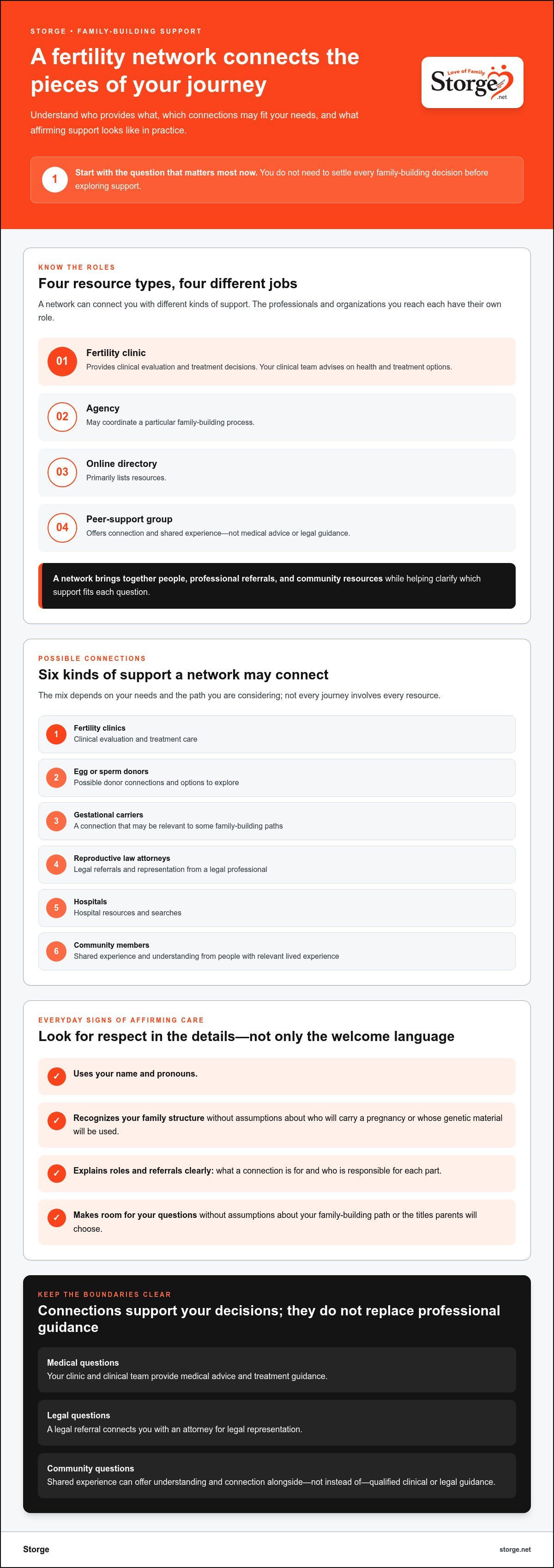
A network has a different role from a fertility clinic, which provides clinical care; an agency, which may coordinate a particular family-building process; an online directory, which primarily lists resources; or a peer-support group, which offers connection and shared experience. A network can connect you with several kinds of support while the professionals you are referred to provide medical or legal services.
Inclusive language is a welcome first sign, but it doesn’t show by itself how care works in practice. Respect also appears in everyday interactions: whether people use your name and pronouns, recognize your family structure, explain their roles clearly, and make room for your questions without assumptions.
What can a fertility network connect you with?
Depending on your needs, connections may include fertility clinics, egg or sperm donors, gestational carriers, reproductive law attorneys, hospitals, and community members with relevant lived experience. Different paths involve different combinations. One person may be exploring fertility preservation; a couple may be considering donor sperm and IUI or reciprocal IVF; another family may be learning about an egg donor and gestational carrier. For an overview of options, see assisted reproductive technology for LGBTQ people.
Community can offer understanding and help you feel less alone, but shared experience is different from medical advice or legal guidance. Each resource has its own role, so note which kind of support you need when you review a connection.
What does queer-friendly support look like day to day?
In practice, affirming support recognizes that LGBTQ+ people build families in many ways. It avoids assuming who will carry a pregnancy, whose genetic material will be used, or what titles parents will choose. It also makes the process easier to follow by explaining what a referral is for, who is responsible for each part, and what a possible next step involves.
An affirming fertility network connects you with relevant care, expertise, and community while respecting who you are and how you want to build your family.
Your needs may shift as you gather information. Begin with the question that matters most today, without committing to a particular path or settling every decision in advance.
How a Queer-Friendly Fertility Network Brings Support Together
Family-building can involve several people and organizations, each with a distinct role. A connected network helps you see how those pieces may fit together, from exploring possible paths to finding clinical care, community connections, and professional referrals. It can make the process easier to navigate while keeping clear which organization provides each service.
Connecting medical care with community and referrals
A fertility clinic is responsible for clinical evaluation and treatment decisions. A network can connect you with a clinic, while your clinical team provides advice about your health and treatment options. Community connections offer something different: the perspective of people who have faced similar questions. They can provide understanding and shared experience alongside, not in place of, qualified clinical guidance.
Legal referrals also have a distinct role. An attorney representation referral connects you with a legal professional for legal representation. Depending on your needs, connections may also include donors, gestational carriers, or hospital resources. The American Society for Reproductive Medicine offers practical guidance on creating an inclusive environment, including ways reproductive care settings can better welcome LGBTQ+ patients.
Different family-building paths call for different connections
There isn’t one standard route, and identity alone doesn’t determine what someone will need. A person exploring donor conception may want to learn about donor connections and clinical options. An LGBTQ+ couple considering fertility treatment may work with a clinic to understand which approaches fit their circumstances. For additional perspective, explore an LGBTQ donor community as one possible source of shared experience and connection.
A gestational-carrier journey can involve distinct relationships and professional roles, including intended parents, a carrier, a fertility clinic, and legal professionals. People considering surrogacy for gay couples may find it useful to understand how these connections differ from clinical care and what each professional is responsible for. The specific mix depends on the people involved and their plans.
Finding a queer-friendly fertility network is partly about making those connections easier to understand: who supports each part of the journey, and which resource fits your next question? Storge brings LGBTQ+ individuals and couples together with fertility resources, donors, gestational carriers, and referrals. If you’re beginning to explore those connections, Storge’s fertility resources and community can be a place to start.
How to Recognize a Queer-Friendly Fertility Network You Can Trust
An LGBTQ+-friendly label can be a useful starting point, but it doesn’t tell you everything about how support will feel or whether the resources fit your needs. Look for inclusion across the experience: in communication, the expertise represented, the clarity of referrals, and access to community. A welcoming interaction matters, but it is only one part of the picture.
Signs that inclusion is part of the experience
Notice whether information recognizes diverse identities, relationships, and family structures without assumptions. Look for clear descriptions of what each resource does, what a referral connects you with, and who is responsible for clinical or legal guidance. Consider whether the network’s resources relate to the path you’re exploring, such as donor conception, fertility treatment, or a gestational-carrier journey.
Use this comparison table to organize what you learn. You don’t need every answer at once; it can help you identify where you’d like more clarity.
| Area to assess | Useful signs | What to clarify |
|---|---|---|
| Affirming communication | Respectful language and recognition of different identities and family structures. | Does the information avoid assumptions about partners, parents, or roles? |
| Relevant expertise | Resources describe experience related to LGBTQ+ family-building needs. | Does that expertise match the path you’re exploring? |
| Referral scope | Each referral has a clear purpose and connects you with an appropriate professional. | Is this a clinical service, legal representation, or a connection to a provider? |
| Community access | There are opportunities to connect with people who understand similar questions. | Is community offered as support, rather than a substitute for professional advice? |
How to assess trust without expecting guarantees
Separate details you can evaluate from broad promises. A clearly described professional role or referral pathway gives you concrete information about what a resource does. Testimonials may offer a sense of someone else’s experience, but they can’t predict your medical outcome. Treat success stories and outcome claims as individual accounts, not assurances about what will happen for you.
Finding a queer-friendly fertility network is about assessing fit, not finding one label that answers every question. Compare the purpose and scope of available resources with your current needs. If you’re assessing a clinic specifically, questions to ask an LGBTQ-friendly fertility clinic can help you focus on communication, relevant expertise, and care processes.
How to Start Finding a Queer-Friendly Fertility Network
You don’t have to map your entire family-building journey before taking a first step. Finding a queer-friendly fertility network can begin with one question you want help answering now. Start with that question, then add connections as your priorities become clearer.
Start with what you need now
Write down your current questions, even if they’re broad. Are you exploring fertility clinics, donor eggs or sperm, a gestational carrier, legal representation, or hospital resources? You may be considering more than one area, or simply trying to understand your options.
Note what respectful support means to you, too. You might want people to use particular names or pronouns, recognize your relationship or family structure, or explain information without making assumptions. These preferences can help you assess whether a resource feels relevant to you. Your priorities may change as you learn more, which is a normal part of making decisions.
Build a manageable map of support
Keep a simple list or document so referrals and next steps don’t blur together. Group contacts by their role rather than treating every resource as interchangeable:
- Clinical care: clinics for medical evaluation and treatment discussions.
- Donor or carrier connections: resources related to donor conception or gestational-carrier journeys.
- Legal support: attorney representation referrals for questions that call for legal guidance.
- Hospital resources: options to explore for care connected with your plans.
- Community: people and shared experiences that can offer connection and perspective.
For each contact, record what the resource is for, who it connects you with, the questions you want answered, and the next step you’re considering. If legal representation is relevant, learning about an LGBTQ family law attorney can help you identify the kind of professional connection you’re seeking. Legal questions can depend on individual circumstances, so keep them distinct from clinical questions.
One entry is enough to begin. Build on your list as needs emerge instead of trying to coordinate everything at once. Storge connects LGBTQ+ individuals and couples with fertility resources, professional referrals, and a trusted community that includes donors and gestational carriers. Explore Storge’s fertility community and resources as you consider your next step.
How Storge Helps You Find a Queer-Friendly Fertility Network
Finding a queer-friendly fertility network can feel more manageable when community and practical resources are connected. Storge is an online platform for LGBTQ+ individuals and couples, bringing together fertility resources and a trusted community that includes egg donors, sperm donors, and gestational carriers. Storge connects members with resources relevant to their family-building plans, while clinics provide clinical care and agencies coordinate their own services.
A connected community for LGBTQ+ family building
If you’re exploring donor conception, you may be looking for an egg or sperm donor as part of a larger process. If you’re considering a gestational carrier, you may want to understand the people and professional roles involved. Storge PLUS is the membership that provides access to Storge’s trusted community, including donors and gestational carriers. Community access can be one part of your support system, alongside clinical care and other professional guidance.
Storge also connects members with fertility clinic referrals, attorney representation referrals, and hospital searches. These connections serve different purposes: clinics provide clinical care, attorneys provide legal representation, and hospital searches help you explore hospital resources. Keeping those roles clear can help you identify where a particular question belongs and what kind of support you’re seeking.
For a closer look at membership, explore Storge PLUS Membership. Community access gives you a place to explore connections; it does not determine which family-building path is right for you.
Take your next step with support around you
You don’t need to arrive with a complete plan. Start by identifying which connection would be most useful now. You might want to explore community access, look into a clinic referral, consider a donor or gestational-carrier connection, or learn about attorney representation or hospital resources. One clear question is enough to begin.
Your priorities may shift as you learn more, and exploring support doesn’t commit you to a specific path. Storge brings community and professional referrals together so you can consider relevant connections at your own pace. If access to a trusted community would be a helpful next step, explore Storge PLUS and the resources available through Storge.
Take Your Next Step Toward Connected Support
Finding a queer-friendly fertility network is about more than spotting inclusive language. Look for support that respects your identity, explains each resource’s role, and connects you with people and professionals relevant to your needs. You can begin with one question; your path doesn’t have to be fully decided.
Storge brings community and practical resources together for LGBTQ+ individuals and couples. Through Storge PLUS, members can access a trusted community that includes egg donors, sperm donors, and gestational carriers. Storge also connects members with fertility clinic and attorney representation referrals, along with hospital searches, helping you explore different kinds of support in one place.
Your next step can be as simple as exploring the community and considering which connection would be most helpful right now. Explore Storge PLUS and find a supportive community for your family-building journey. You deserve to move forward at your own pace, with support that recognizes and respects the family you hope to build.
Frequently Asked Questions
What is a queer-friendly fertility network?
A queer-friendly fertility network connects LGBTQ+ people with relevant professionals, community, and family-building resources. Unlike a clinic, it does not provide medical treatment; it can connect you with clinical referrals, donor or gestational-carrier resources, legal referrals, and other support. Finding a queer-friendly fertility network means considering how these connections work together and whether they respect your identity, relationships, and individual needs.
How can I tell whether a fertility resource is genuinely LGBTQ+-inclusive?
Look for practical signs of respect, not only an LGBTQ+-friendly label. Notice whether information recognizes varied identities and family structures, and whether people use your name and pronouns and explain roles without assumptions. Clear descriptions of expertise, referral purposes, and next steps help show what support a resource provides. Testimonials may offer perspective, but they don’t establish whether a particular resource fits your needs.
Can a fertility network help me find donors or a gestational carrier?
Yes. Some fertility networks connect LGBTQ+ individuals and couples with egg donors, sperm donors, and gestational carriers. Storge, for example, provides access to a trusted community through Storge PLUS. A community connection is one part of family-building support, alongside clinical and legal professionals. Your needs will depend on your plans and the guidance you receive.
Does a fertility network replace a fertility clinic or attorney?
No. A network can connect you with resources, while a fertility clinic provides clinical evaluation and care and an attorney provides legal representation and advice. Referrals connect you with those professionals; they are not medical treatment or in-house legal services. Direct medical questions to a qualified clinical professional and legal questions to an attorney familiar with your circumstances.
What should I look for in a fertility clinic as an LGBTQ+ patient?
Look for signs that inclusion is reflected in the clinic’s everyday processes, not just its public language. Consider whether forms and conversations make room for your identity, pronouns, relationship, and family structure, and whether the clinic describes experience related to the path you’re exploring. Clear explanations of treatment options and next steps also help you understand the care process. The clinic’s clinical team should address medical questions about your specific circumstances.
How do I find LGBTQ+-inclusive fertility resources across the United States?
Start by naming the kind of connection you’re looking for, such as a clinic, donor, gestational carrier, attorney, or hospital resource. Storge is a national online platform that connects LGBTQ+ individuals and couples with fertility clinic and attorney representation referrals, hospital searches, and a trusted community. Keep track of each resource’s role and your questions. For medical and legal decisions, seek guidance from the relevant qualified professionals.
Can I explore a fertility network before choosing a family-building path?
Yes. You can explore resources while you’re still learning about your options. Begin with one current question, such as whether you want to understand donor connections, clinical care, or community support. You don’t need to decide every detail first. As you gather information, your priorities may change, and you can explore other connections when they become relevant to your journey.


