
What if the support you need isn’t one perfect guide, but a few trusted people and resources that can adapt as your plans take shape? Queer family creation journey support can make the difference between facing unfamiliar decisions alone and feeling accompanied as you explore your options.
If finding affirming information or professionals has felt difficult, you’re not alone. Family building can bring emotional questions, practical choices, and new decisions at every stage. It’s natural to wonder which kind of support would help most right now.
This guide will help you build a manageable support system for the emotional, informational, and logistical parts of your journey. You’ll learn how to draw on personal connections, find reliable resources, and seek relevant professional referrals without expecting one person or platform to meet every need. We’ll also look at how Storge’s online community and connected resources can fit into a broader circle of support as your plans change.
Key Takeaways
- Queer family creation journey support can take different forms. There’s no single timeline or right way to build it.
- Emotional connection, peer community, reliable information, and professional referrals can complement one another.
- Match the support you seek to your current question, whether you need orientation, connection, or a relevant referral.
- Create a flexible plan by naming your next question, choosing one type of support, and keeping useful resources in an easy-to-update place.
- Storge PLUS connects members with a trusted community and vetted resources as part of a broader support system.
Queer family creation can feel complex, support makes the journey easier to navigate
There’s no single timeline, family structure, or correct way to seek support while creating a family. Your next step may be exploring possibilities, making a decision, or finding someone who understands what you’re weighing. Queer family creation journey support should fit your circumstances, not ask you to follow someone else’s path.
Support can mean emotional connection, reliable information, practical help, or professional guidance. These needs may overlap, but they aren’t interchangeable. A friend might listen as you talk through hopes and concerns; a peer community can offer shared experience; medical and legal professionals can provide guidance within their areas of expertise.
A support system is more than a directory or a single provider. It’s a connected circle of people and resources that can help with different needs as they arise.
What does support look like while creating a queer family?
Support is whatever helps you feel informed, respected, and less alone while making decisions. It might include a trusted person who listens without assuming what your family will look like, peers who understand parts of the experience, or clear resources that help you prepare questions. Background on same-sex parenting describes routes including adoption, foster care, donor insemination, and surrogacy.
Peer connection can help you feel understood, but it doesn’t replace individualized medical or legal guidance. A professional referral can point toward relevant expertise, while friends and community may offer ongoing encouragement. Choose the combination that feels useful now, and adjust it as your questions change.
Why can the journey feel isolating or hard to organize?
Family-building decisions can carry emotional weight, even when you feel hopeful or certain about some parts of the process. You might be weighing personal priorities, coordinating with others, or trying to understand unfamiliar terms. There’s no one way to feel, and needing information or support doesn’t mean you’re unprepared.
Information can be spread across community conversations, health resources, and legal guidance. Each may address a different piece, leaving you to connect the details and work out what applies to your situation. Start by writing down the question you’re trying to answer. Then note whether it calls for peer perspective, general information, or professional advice.
Your needs may depend on your family, the path you’re considering, and where you are in the process. You don’t need to settle every question before asking for help, and you don’t have to choose one source for everything. Start with what would make the next decision clearer or more manageable.
Over time, the people and resources around you may change. A useful support system leaves room for that: it can offer connection when you want to talk, practical help when you’re organizing next steps, and professional guidance when a question calls for it. The goal isn’t to have every answer at once. It’s to know where to turn for the next one.
Build a support system around emotional, practical, and professional needs
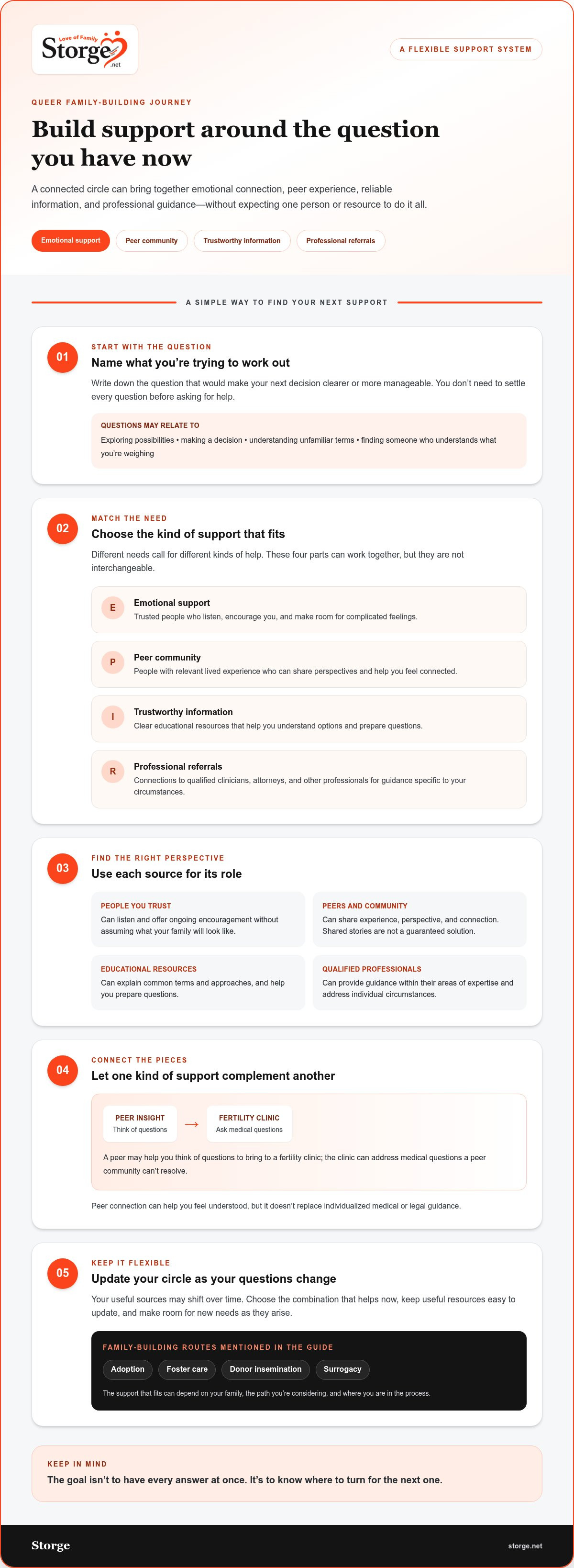
A useful support system isn’t one person expected to answer every question. It brings together different kinds of help, so you can turn to the right source for the need in front of you. Think of it as four connected parts: emotional support, peer community, trustworthy information, and professional referrals.
- Emotional support: Trusted people who can listen, encourage you, and make room for complicated feelings.
- Peer community: People with relevant lived experience who can share perspectives and help you feel connected.
- Trustworthy information: Clear educational resources that help you understand options and prepare questions.
- Professional referrals: Connections to qualified clinicians, attorneys, and other professionals for guidance specific to your circumstances.
These parts can reinforce one another, but they don’t replace one another. A peer may help you think of questions to bring to a fertility clinic; a clinic can address medical questions a peer community can’t resolve. Queer family creation journey support works best when each resource has a clear role.
Emotional and community support: feeling understood along the way
A trusted friend might offer a listening ear, while a peer space can connect you with people who understand some of the decisions you’re considering. Shared stories can open up possibilities, but every family’s circumstances are different. Choose spaces where your identity, relationships, and family structure are respected. Community can offer connection and perspective, not a guaranteed solution to emotional or practical challenges.
For example, someone exploring donor conception may value both personal conversations and focused educational material. Storge’s guide to LGBTQ donor community resources can help readers learn about that part of family building. Peer insight may help you feel less alone, while decisions about your own plans can still call for individual advice.
Online support can make connection easier when your immediate circle has limited experience with queer family building. RESOLVE: The National Infertility Association offers an LGBTQ+ family-building support group for people exploring paths to parenthood. A group can provide shared understanding without becoming your only source of support.
Information and professional support: knowing where expertise fits
Educational resources can explain common terms, approaches, and questions to consider. They provide a starting point, not a personalized recommendation. Medical decisions belong with qualified clinicians, and legal questions belong with qualified attorneys. Referrals can help you find relevant expertise, while the professionals you connect with can advise on your particular situation.
If a fertility clinic is part of your plans, prepare questions about communication, care, and the aspects of treatment you want to understand. Storge’s guide to questions for an LGBTQ-friendly fertility clinic offers a focused starting point. Hospital and attorney referrals can also connect logistical and legal needs to appropriate expertise.
To bring community and vetted resources together, explore Storge’s family-building resources as one part of your wider support system, alongside trusted relationships and professional care.
Match queer family journey support to what you need right now
There’s no required order for seeking support. You might look for community before deciding on a path, or seek a professional referral as soon as a specific question comes up. Let the question you’re facing guide your next step, then revisit your choices if your circumstances, information, or preferences change.
Useful support is the support that fits your current need. Use this quick comparison as a starting point, not a checklist you have to complete from top to bottom.
| Your current need | Support that may help | A practical next step |
|---|---|---|
| Orientation | Inclusive educational resources | Write down what you want to understand and what remains unclear. |
| Connection | Peer community or trusted personal relationships | Look for a space where your identity and family structure are respected. |
| Professional guidance | A relevant clinical, legal, or hospital referral | Identify the question that needs individualized expertise. |
| Ongoing family support | People and resources that can adapt as needs evolve | Revisit your support plan when a new decision or circumstance arises. |
When you are exploring possibilities or gathering information
Start with clear, inclusive educational material and give yourself room to consider what matters to you. Before making an appointment or seeking a referral, note unanswered questions, such as which options you want to learn about or what practical factors may shape your decision. If you’re exploring surrogacy with a gestational carrier, surrogacy guidance for gay couples may offer relevant context.
When you want connection, referrals, or help coordinating next steps
Peer community can be valuable when you want perspectives from people with related experiences or simply feel less alone. A professional referral is more appropriate for questions requiring clinical assessment, legal advice, or guidance about hospital resources. Use both, or neither, depending on what would help now. No route or source of support is right for everyone.
Queer family creation journey support can shift as a plan takes shape. Information that helped you compare possibilities may lead to a more specific question for a professional. A conversation with a peer may help you recognize that you’re ready to explore a different option. Changing direction doesn’t mean earlier choices were wrong; it can reflect new understanding.
Before seeking help, ask yourself: “What am I trying to figure out, and what kind of response would be useful?” If you need context, seek education. If you want shared perspective, look for connection. If the question calls for expertise, pursue an appropriate referral. That distinction can make the next step clearer without turning your journey into a rigid sequence.
Create a flexible support plan for your family-building journey
A support plan doesn’t need to predict every decision ahead. Think of it as a small, revisable tool for finding help with the question you have today. Queer family creation journey support can feel more manageable when you can see what you’re trying to understand, who might help, and what one next step could look like.
Try this simple sequence whenever a new question comes up:
- Name the current question. Write it in plain language, even if it feels unfinished.
- Choose a support type. Consider whether you need a listening ear, peer perspective, educational information, or professional expertise.
- Identify one next step. For example, save a resource, talk with someone you trust, or prepare a question for a clinician or attorney.
- Revisit later. Check whether the answer helped or whether new information has brought up another question.
Keep questions, notes, and useful resources in one private place that’s easy to update, such as a password-protected document or a notebook you keep at home. Organize it by topic or simply add notes as they come up. The point isn’t to create more admin; it’s to make information easier to find when you need it.
Turn an overwhelming question into a manageable next step
For any question that feels hard to untangle, make three quick notes: what you already know, what you need to find out, and what still feels unclear. Then match the open question to the right kind of support. Community information may help you understand how others think about a topic; a question about your own medical care or legal circumstances calls for relevant professional expertise.
Choose one realistic action, not a complete plan for every decision ahead. You might set aside time to read one reliable resource or write down questions before an appointment. A small next step counts.
Make room for changing needs and boundaries
You decide who to involve and what to share. A trusted person may be able to listen, help with a practical task, or accompany you to an appointment, but you can be specific about what would feel supportive. For instance, you might say, “I’d like you to listen without offering advice,” or “I’m ready to talk about this, but please keep it private.”
Every so often, ask yourself whether the support you’re receiving still feels useful and affirming. Your comfort, privacy needs, and questions may change. It’s okay to pause a conversation, seek a different perspective, or invite someone new into your circle. A flexible plan should make room for your boundaries, not pressure you to maintain connections that no longer feel right.
For connected community and family-building resources alongside your personal support network, explore Storge’s family-building resources.
Find connected, affirming resources with Storge
Family-building questions can touch several parts of life at once. You may want community, clear information, and a connection to professional expertise, but those needs don’t always come from the same place. Storge is an online resource platform for LGBTQ+ people and couples building families, bringing relevant resources and referrals together to support your next steps.
Storge PLUS membership connects members with a trusted community, vetted networks of egg donors, sperm donors, and gestational carriers, verified resources, and referrals for fertility clinics, attorneys, and hospitals. Which resources are relevant depends on your plans. Donor and gestational-carrier networks, for example, may be useful if you’re exploring those paths, but they aren’t a required part of every family-building journey.
These connections can help you find information and identify whom to approach with your questions. They don’t replace personal relationships or professional care. Medical decisions belong with qualified clinicians, and legal advice should come from an attorney who can address your circumstances.
How a connected community and resource platform can help
Finding the right kind of support can take energy, especially when each question points toward a different resource. A connected platform can make it easier to explore community, verified information, and relevant referrals as parts of one broader journey. You can look for peer connection while also identifying whether a question needs clinical, legal, or logistical expertise.
Use what fits and leave the rest aside. If donor or gestational-carrier resources relate to your plans, they may help you explore that area; they aren’t a recommendation to choose a particular route. A platform can offer useful connections, but it can’t promise an outcome, match, or timeline. Your decisions remain your own.
Choose the next resource that fits your question
Start with the question you most want answered. If it’s about legal concerns, an attorney referral can connect you with legal representation. If it’s clinical, a fertility clinic referral can point you toward relevant medical expertise. Hospital search resources may help with planning, while community and verified information can support broader exploration.
- For connection: Explore community and shared resources.
- For clinical questions: Consider a fertility clinic referral and discuss your situation with a qualified clinician.
- For legal concerns: Consider an attorney referral for guidance from qualified legal counsel.
- For planning: Explore hospital search resources if they’re relevant to your next steps.
You don’t have to use every resource or know every answer before reaching out. Asking for support is a practical step, not a sign that you’re uncertain about building a family. Explore Storge and its family-building resources to find resources that fit your question and your path.
Take your next step with support around you
You don’t need to have every part of your family-building path settled before you seek support. Start with the question that matters most today, and let the answer guide what you explore next. Queer family creation journey support can grow alongside your plans, changing as your questions and priorities do.
If you’re ready to explore connected resources, Storge can be one part of your wider support system. Storge PLUS membership connects members with a trusted community and vetted resources, while Storge provides referrals for fertility clinics, legal representation, and hospital searches. These connections can help you find relevant resources as you make your own decisions, alongside guidance from qualified professionals and support from people you trust.
Explore Storge’s community and family-building resources to find a resource that fits the question you’re carrying now. One thoughtful next step is enough to begin. You deserve support that respects your family, your choices, and the pace that feels right for you.
Frequently Asked Questions
Is it normal to feel overwhelmed while creating a queer family?
Yes, feeling overwhelmed can be a normal response to unfamiliar decisions, competing priorities, or waiting for information. It doesn’t mean you’re making the wrong choice or that you need to have everything figured out. Try identifying the one question that feels most pressing and setting aside the rest for now. If stress is affecting your daily life, talking with a supportive professional may help you find additional care.
Can friends and family be part of a queer family-building support system?
Yes, friends and family can be meaningful supporters, even if they haven’t experienced your exact path. Let them know what would help: listening without trying to solve the problem, helping organize paperwork, or joining you for an appointment. You can also explain what you’d prefer they not share with others. Clear requests give loved ones a practical way to show care while respecting your privacy.
How do I find affirming support if I do not know anyone who has built a queer family?
You can begin with online LGBTQ+ family-building groups, community organizations, or peer spaces focused on the questions you’re facing. Search for groups that welcome your identity and family structure, and notice whether their discussions feel respectful and relevant. Queer family creation journey support doesn’t depend on already knowing someone with the same experience. A single helpful conversation or resource can be a starting point for building connection.
What kind of support can an LGBTQ+ family-building community provide?
A community can offer a place to hear how others approached conversations, handled uncertainty, or prepared for appointments. Members may share questions to consider or point you toward educational resources. Treat personal stories as perspectives, not instructions: someone else’s experience may not match your circumstances. A community can help you feel connected and informed, while decisions specific to your health or legal situation still call for qualified professional guidance.
Do I need a therapist during the family creation journey?
No, therapy isn’t a requirement for building a family. Some people find it useful for processing uncertainty, communicating with a partner or loved ones, or managing stress during a period of change. You can seek support before you feel overwhelmed, or decide it isn’t something you need right now. If you choose therapy, you may want to look for a professional who respects LGBTQ+ identities and your family-building goals.
How can I support a queer friend who is trying to build a family?
Ask what kind of support they want before offering advice. You might say, “Would you like me to listen, help with a task, or give you space?” Follow their lead about what they share and with whom. Avoid assumptions about their relationship, route to parenthood, or timeline. A thoughtful check-in that doesn’t demand an update can show care while leaving your friend in control of the conversation.
Can a community resource platform replace medical or legal advice?
No. A community resource platform can help you find educational information or relevant professional connections, but it can’t provide individualized medical care or legal advice in place of qualified experts. Bring clinical questions to a licensed clinician and legal questions to an attorney who can consider your circumstances. Peer conversations can help you prepare or feel understood, but another person’s experience isn’t a substitute for professional guidance.


