
What if the most helpful support isn’t a single answer, but a community where your questions and family structure are understood? Searching for a Support group for queer parents to be can feel like one more decision in a journey already full of them, especially when a general parenting space may not reflect your experiences or plans.
Wanting both emotional connection and practical information makes sense. Peer conversations can help you feel less alone as you weigh family-building options, while reliable resources can clarify possible next steps. A useful community supports your choices without pressuring you toward someone else’s path.
This article covers what to look for in a welcoming community, how peer connection can support you through family building, and where Storge fits. Storge is an online community and resource platform, not a facilitated support group. Through Storge PLUS, members can connect with a broader family-building community and access resources, including donor and gestational-carrier searches and professional referrals.
Key Takeaways
- A Support group for queer parents to be can offer shared understanding and encouragement while you explore family-building decisions.
- Peer stories can broaden your perspective, but they reflect individual experiences rather than universal advice.
- Peer groups, mental-health professionals, and family-building referrals serve different needs.
- Consider your preferred format, boundaries, and accessibility needs when choosing a community.
- Storge PLUS brings community connections together with family-building resources and professional referrals.
Why a Support Group for Queer Parents-to-Be Can Matter
Family building can bring hope and uncertainty at the same time. You might be imagining the family you want while weighing unfamiliar choices, gathering information, or wondering whether others will understand your circumstances. Wanting a place to talk through those feelings is a reasonable part of preparing for a major life change.
A peer support group is a space where people with related experiences connect, share perspectives, and offer mutual encouragement. It isn’t a substitute for clinical mental-health care. Peers can listen and speak from lived experience, while a mental-health professional provides care within a professional relationship.
What can a peer support group offer during family building?
A group can make room for questions that may be hard to raise elsewhere, from how to talk about donor conception with loved ones to what it feels like to wait for the next step. Members may exchange reflections, practical questions, and personal stories. Hearing how someone approached a decision can give you a new perspective, but one person’s experience is not universal advice or a prediction of what will happen for you.
Shared understanding doesn’t require everyone to have the same identity or family plan. A group may include people with different gender identities, sexual orientations, partners, and routes to parenthood. Some may be considering adoption; others may be exploring fertility treatment, donor conception, or surrogacy. Look for a space that makes room for those differences rather than treating one family structure as the default.
Why can general parenting spaces feel different?
Many parenting spaces focus on pregnancy, newborn care, or life with children. If you’re still deciding how to build your family, you may want to discuss what comes before a child arrives: exploring options, managing uncertainty, or finding language to describe your future family. A support group for queer parents to be can focus on that earlier stage.
Affirming language and recognition of queer families can make it easier to participate without having to explain or defend who belongs in your family. General parenting groups are not automatically unwelcoming; some may be a good fit, while others may focus on different stages or concerns. Look for a space where your identity and family structure are treated as ordinary parts of the conversation.
For broader context on family structures and available research, see this overview of research on same-sex parenting. A peer group offers something different: a chance to connect with people thinking through the personal realities of becoming a family.
What Support Can Look Like Before You Become a Parent
Support before parenthood can take several forms: reassurance when the path feels uncertain, shared learning as you explore options, and the relief of talking with people who understand why this journey matters to you. Excitement and questions can exist side by side. You don’t have to resolve every concern before you deserve connection.
Emotional connection when the path feels uncertain
Sometimes support means being heard without being rushed toward a decision. A peer might recognize the strain of waiting, the vulnerability of sharing your plans with loved ones, or the complicated feelings that can accompany a change in direction. Listening and recognition can help create a sense of connection, though they aren’t therapy or a replacement for mental-health care.
You should be able to choose how much you participate. You might share openly, ask a specific question, or simply listen until you feel ready. A welcoming space respects different comfort levels instead of treating disclosure as a requirement. Family Acceptance Project resources from San Francisco State University offer a research-based perspective on family support and acceptance.
Practical perspective without pressure to follow one path
Peer conversations can help you think through questions that arise between major decisions. Someone might describe how they approached a conversation with a potential donor, what they wished they’d understood before exploring fertility care, or how they prepared for discussions about a gestational carrier. These reflections can suggest questions to consider, not prescribe what your family should do.
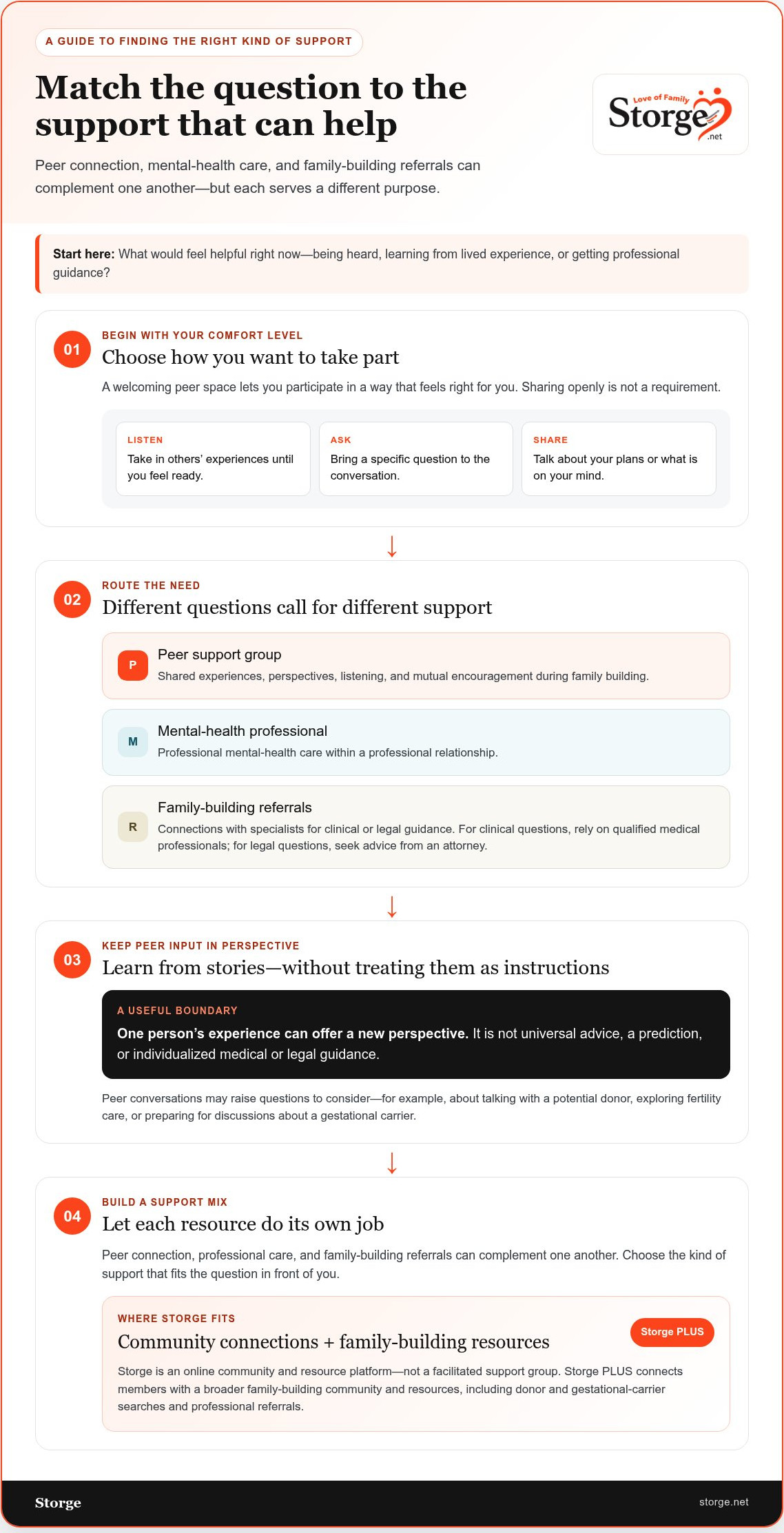
Peer stories offer perspective, not individualized medical or legal advice. For clinical questions, rely on qualified medical professionals; for legal questions, seek advice from an attorney. This distinction lets you learn from others while making decisions based on guidance suited to your circumstances.
Family-building journeys may involve donors, fertility care, gestational carriers, adoption, or other paths. No single route is the measure of commitment or belonging. If you’re exploring donor-related options, the LGBTQ+ donor community guide offers more context.
A Support group for queer parents to be can be one source of connection alongside practical resources. Storge brings LGBTQ+ people and couples together with family-building resources and community connections. Storge’s family-building community is one option to consider as part of your support network.
Peer Support, Therapy, and Professional Resources: What’s the Difference?
These forms of support can complement one another, but each serves a different purpose. Peer connection centers on shared experience. Therapy provides professional mental-health care. Family-building referrals connect you with specialists for clinical or legal guidance. Matching the kind of support to your question can make a next step clearer.
| Type of support | What it can offer | What it doesn’t replace |
|---|---|---|
| Peer group or community | Conversation, companionship, and perspectives from people with related experiences | Therapy or individualized medical and legal advice |
| Mental-health professional | Professional care for emotional well-being, including therapy | Medical fertility care or legal representation |
| Family-building referrals | Connections to fertility clinics or attorneys for specialized guidance | Services provided directly by a peer community |
When peer connection may be the support you are seeking
You may want a place to talk with people who understand the questions and transitions involved in family building, or simply to hear how others have approached their own journeys. A Support group for queer parents to be can offer shared conversation, though formats and group experiences differ. Peer support can sit alongside clinical care, but it does not replace it.
When professional guidance may be important
For questions about fertility care, speak with qualified medical professionals who can consider your individual circumstances. Legal questions call for guidance from an attorney familiar with the relevant family law. Peer stories can help you prepare questions, but they can’t determine which medical or legal advice applies to you. See this LGBTQ+ family law attorney guidance if you’re considering legal questions.
Community participation does not replace individualized medical or legal advice. Storge connects members with family-building resources, including referrals to fertility clinics and legal representation. Official directories can also help you explore support options, such as the LGBTQY Resource Database.
How to Find a Supportive Space That Fits Your Needs
The right community is not necessarily the largest or most active one. Look for a space whose purpose, pace, and expectations suit your stage of family building. Before joining, consider what you need and what would help you feel comfortable participating.
Questions to clarify before joining a group
Use these four steps to focus your search:
- Identify your needs. Are you looking for emotional connection, practical discussion, or a mix of both?
- Choose a preferred format. Would you rather meet in person, connect online, or take part through written conversations? Consider what fits your schedule and comfort level.
- Set your boundaries. Decide what you’re comfortable sharing, whether you want to speak or mostly listen, and which topics you’d prefer to keep private.
- Consider accessibility. Think about timing, location or online access, communication style, and any other factors that affect your ability to participate.
Check who the group is intended for, too. A space for people preparing to become parents may focus on different questions than a group that includes parents at many stages. Neither is automatically a better fit; the goal is to find a purpose that matches what you need now.
Signs a space may feel affirming and respectful
Look for language that recognizes varied identities, relationships, and family structures without assuming everyone will follow the same path. Clear expectations help as well. You should be able to understand the group’s purpose, how participation works, and what boundaries members are expected to respect.
Consider privacy carefully. Read any stated privacy guidelines, but don’t assume a group can guarantee confidentiality. Think about what personal details you’re comfortable sharing, especially online, and participate at your own pace. Notice whether questions are met with respect and whether members can pass without being pressured to disclose.
A Support group for queer parents to be should leave room for different experiences rather than prescribe a single “right” way to build a family. If a group’s format or focus doesn’t feel comfortable, it’s reasonable to keep looking. You deserve to choose a space that suits you.
As you consider what kind of connection and family-building resources would be useful, Storge’s family-building community is one resource to explore.
Finding Community and Family-Building Resources with Storge
Storge is an online platform for LGBTQ+ individuals and couples exploring family building. It brings community connections together with practical resources, so you can consider both the people and information that may support your next steps. You can explore donor or gestational-carrier searches, or look into professional referrals as you weigh your options.
Community alongside practical family-building connections
Storge PLUS membership connects members with a community that includes donors and gestational carriers, alongside family-building resources. It offers a way to bring community connection into a process that may also involve research, conversations, and decisions over time. Storge is a community and resource platform, not a facilitated therapy or peer-support group, medical provider, law firm, or full-service surrogacy agency.
Storge supports searches for egg and sperm donors, gestational carriers, and hospitals, and provides referrals to fertility clinics and legal representation. These referrals connect you with professionals for specialized guidance; they are distinct from medical care or legal services provided directly by Storge.
A Support group for queer parents to be and a family-building resource platform can serve different needs. Peer spaces may center shared conversation, while a platform like Storge connects community access with searches and referrals. You can use more than one kind of resource, and the support you need may change as your questions do.
A calm next step for your own journey
Start by naming what would be useful right now. Are you looking for community connection, exploring donor or carrier options, or seeking a referral to a fertility clinic or attorney? You don’t need to have every decision settled before exploring resources. Family-building paths differ, and your next step can be small and specific to where you are today.
Storge PLUS membership brings community connections and family-building resources together for members.
Take Your Next Step at Your Own Pace
Finding a Support group for queer parents to be can help you feel more connected as you explore becoming a parent. The right space should respect your identity, boundaries, and family-building path. Peer connection offers shared perspective, while therapy and professional guidance serve different needs. Medical and legal questions call for individualized advice from qualified professionals.
Community can also sit alongside practical resources. Storge connects LGBTQ+ individuals and couples with a family-building community, donor and gestational-carrier searches, and referrals to fertility clinics and legal representation. Storge PLUS provides membership access to community connections and family-building resources; it is not a facilitated therapy or peer-support group.
You don’t need every answer before exploring what could help. Consider the kind of connection or resource that would be useful now, and let your next step reflect your needs and timeline. Explore Storge PLUS and find community for your family-building journey.
Your path is your own, and you deserve support that meets you with understanding along the way.
Frequently Asked Questions
Is there a support group for queer parents-to-be?
Peer communities and support groups for LGBTQ+ people preparing for parenthood can offer shared conversation and encouragement. Their focus and format vary, so look for spaces that welcome prospective parents and recognize different identities and family-building paths. Storge is an online community and resource platform, not a facilitated or formal support group. Storge PLUS connects members with a broader family-building community and related resources.
What can I expect from a support group for LGBTQ+ prospective parents?
You can generally expect opportunities to connect with people considering or pursuing parenthood and exchange questions, reflections, or personal experiences. A group may focus on emotional connection, practical discussion, or both. Members’ experiences can offer perspective, but they aren’t universal advice. You can decide how much to share, and seek qualified professionals for individualized medical or legal guidance.
Can a peer support group replace therapy or fertility counseling?
No. Peer support centers on shared experience and mutual encouragement, while therapy provides professional mental-health care. Fertility counseling or medical guidance should come from qualified fertility-care professionals. A group can complement these forms of support by giving you a place to connect with others, but it can’t assess your individual health needs or provide clinical care. Choose the kind of support that matches the question you’re facing.
How do I find an affirming support group for queer family building?
Look for a group whose purpose includes prospective parents and family building, rather than only parenting after a child arrives. Review its language and guidelines for recognition of diverse identities, relationships, and routes to parenthood. Consider whether the format, participation expectations, and privacy information feel comfortable. No group can promise confidentiality, so share only what feels right for you.
Are online support groups helpful for LGBTQ+ parents-to-be?
Online groups can make it easier to connect with people beyond your immediate community and may offer flexibility in how you participate. Whether one feels helpful depends on your needs, the group’s focus, and how comfortable you are communicating online. Review participation and privacy expectations, and take time to decide what personal information you want to share. Online peer connection doesn’t replace professional care or advice.
What is the difference between a support group and a family-building community?
A support group usually centers peer conversation, shared experience, and mutual encouragement. A family-building community may connect people with one another while also offering educational resources, searches, or professional referrals. These roles can complement each other, but they aren’t interchangeable. Storge is an online family-building community and resource platform. Storge PLUS provides membership access to community connections and family-building resources, not facilitated therapy or a structured peer-support group.
Can I find donors, gestational carriers, and professional referrals through Storge?
Yes. Through Storge, members can access egg and sperm donor searches and gestational-carrier searches, along with referrals to fertility clinics and legal representation. The platform also supports hospital searches and connects members with family-building resources. Referrals connect you with professionals for specialized guidance; Storge doesn’t provide medical procedures or in-house legal services. These resources can sit alongside peer connection as you consider your next steps.


