
What if the donor option that seems simplest at first isn’t the one that best fits your family’s hopes for connection, identity, or future openness? Sperm donor options for queer individuals include sperm bank donors and known or directed donors, but choosing between them involves more than logistics. It’s understandable to want clear information about screening, donor identity, and possible contact over time, especially when many resources don’t reflect the diversity of queer families.
This guide compares the main donor pathways and helps you consider how each may align with your circumstances, values, and family plans. We’ll look at sperm bank donors, including different identity-release policies, as well as known donors and community-based searches. You’ll also find practical questions to raise about screening, relationship expectations, and future communication, plus guidance on where clinical and legal professionals fit into the process. There’s no single right path. The goal is to make a thoughtful, informed choice grounded in your family’s needs.
Key Takeaways
- Sperm donor options for queer individuals include different routes, each with distinct considerations around clinical coordination, relationships, and future contact.
- Compare sperm bank, known-donor, and community-based searches by looking beyond profiles to the connection and communication you hope for.
- Screening can inform decisions and reduce some risks, but it can’t guarantee a child won’t have health conditions.
- Write down your priorities and open questions before reviewing donors, then discuss clinical steps with a fertility professional and legal questions with a qualified attorney.
- Storge connects LGBTQ+ individuals and couples with a donor community, while Storge PLUS membership provides access to that community.
What sperm donor options can queer individuals consider?
Donor sperm is sperm provided by a donor and used to help achieve conception, often with fertility care. It’s one possible source of sperm for building a family, not a fertility treatment in itself. Choosing a donor and choosing how to pursue conception are connected, but they’re separate decisions. Sperm Donation Overview offers general background on donation, including screening and legal considerations.
Sperm donor options for queer individuals can fit many kinds of family-building plans. A single person, a couple, or a family with more than two intended parents may consider donor sperm. Gender identity, relationship status, and body do not determine one required path. The people involved can discuss who hopes to parent, who may carry a pregnancy, and what clinical support could be relevant, without assuming those roles must follow a particular pattern.
Which queer family-building paths may involve donor sperm?
Donor sperm may be used with fertility care, but it doesn’t determine who will carry a pregnancy or which treatment may be considered. Depending on a family’s circumstances and plans, the path might involve insemination or IVF. Some plans may also involve an egg donor or a gestational carrier. These are distinct parts of a family-building plan, and not every family will need each one.
A fertility clinician can explain which approaches may fit an individual’s medical circumstances and discuss the clinical steps involved. For example, a couple might explore whether one partner could provide eggs and another carry a pregnancy, while a single intended parent could consider a different arrangement. These examples aren’t prescriptions. They show how family roles and treatment choices can vary. A clinician can help clarify the possibilities without making assumptions about someone’s body or family structure.
What should you know before comparing donor choices?
Start by separating the donor-source decision from the decisions that may follow. First, consider where sperm might come from, such as a sperm bank, a known donor, or a community-based search. Separately, consider treatment, pregnancy roles, and the relationships each person hopes to have with the donor. Keeping these questions distinct makes a complex process easier to work through.
Several kinds of considerations deserve attention in their own right:
- Medical: What screening information is available, and what clinical guidance would help you understand it?
- Emotional: How might each person feel about the donor’s role and a child’s future questions?
- Identity: What matters to your family about donor background, identity, or possible future communication?
- Legal: What agreements or parentage questions should you discuss with an attorney familiar with the relevant circumstances?
These considerations can overlap, but addressing one doesn’t automatically resolve the others. A donor profile or personal connection may feel meaningful, while clinical and legal questions still need their own attention. Queer families are not all alike, and there’s no required sequence of roles or relationships. Naming what matters to you is a useful starting point for comparing the options that follow.
How do sperm donor sources and fertility pathways differ?
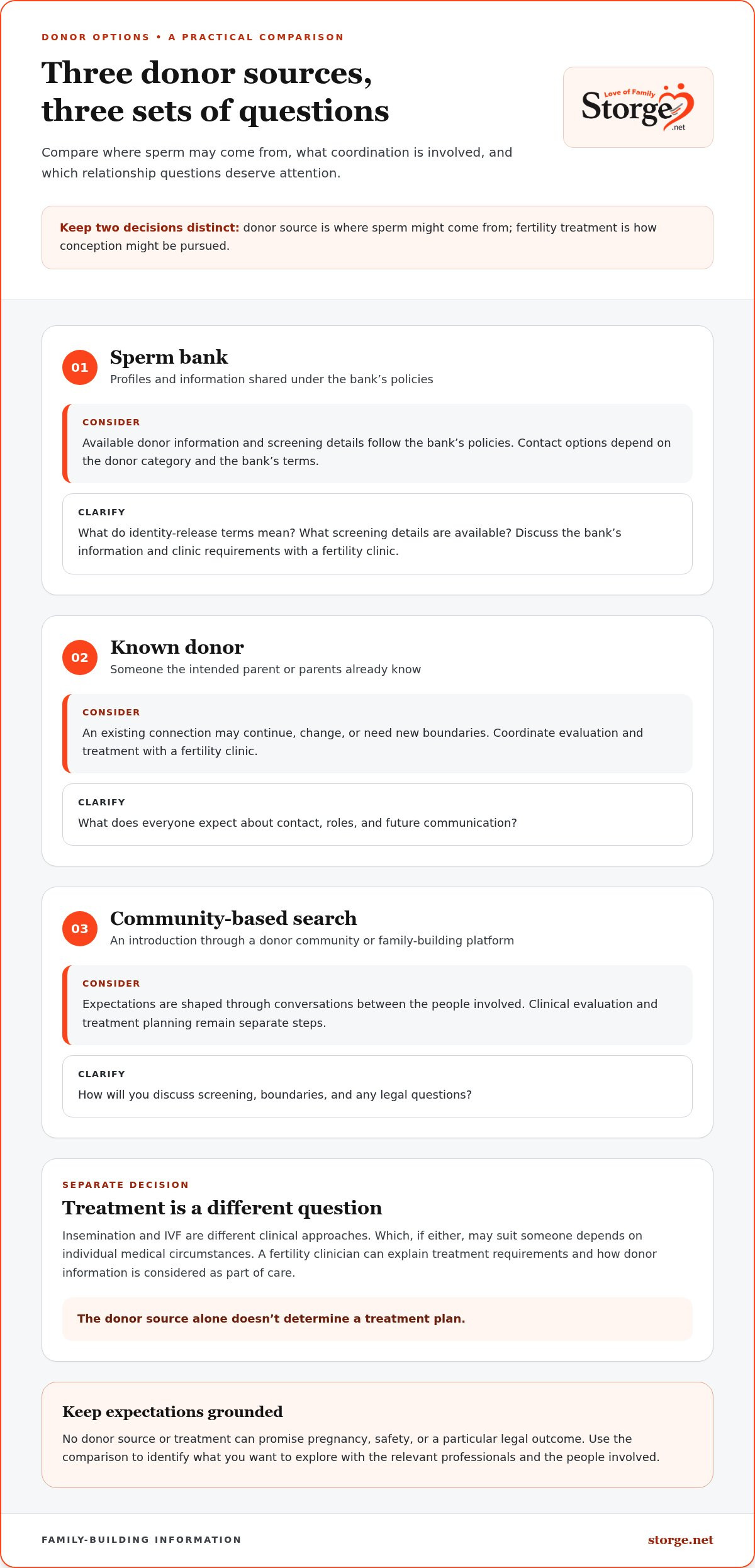
A donor source answers one question: where might the sperm come from? Fertility treatment answers another: how might conception be pursued? Sperm bank donors, known donors, and community-based searches can involve different information, relationships, and coordination. None determines whether insemination or IVF is appropriate, and no source or treatment can promise pregnancy, safety, or a particular legal outcome. Use the comparison below to identify what you’ll want to explore.
| Donor source | Typical source | Clinical coordination | Relationship expectations | Questions to explore |
|---|---|---|---|---|
| Sperm bank | Donor profiles and information shared under the bank’s policies | Discuss the bank’s information and clinic requirements with a fertility clinic | Contact options depend on the donor category and the bank’s terms | What do identity-release terms mean? What screening details are available? |
| Known donor | Someone the intended parent or parents already know | Coordinate evaluation and treatment with a fertility clinic | An existing connection may continue, change, or need new boundaries | What does everyone expect about contact, roles, and future communication? |
| Community-based search | An introduction through a donor community or family-building platform | Clinical evaluation and treatment planning remain separate steps | Expectations are shaped through conversations between the people involved | How will you discuss screening, boundaries, and any legal questions? |
Once you’ve considered the source, discuss treatment separately. Insemination and IVF are different clinical approaches. Which, if either, may suit someone depends on individual medical circumstances. A fertility clinician can explain treatment requirements and how donor information is considered as part of care. The donor source alone doesn’t determine a treatment plan.
What is different about a sperm-bank donor search?
Banks may offer donor profiles and screening information according to their own policies. Terms such as “identity-release” or “non-identity-release” can also vary, so read the specific terms rather than assuming every bank uses them in the same way. Ask a fertility clinic about available screening information and any clinic requirements. That conversation can help clarify what the details mean for your care.
What changes when considering a known donor or community search?
With a known donor, the relationship already exists, which can make shared expectations especially important. Discuss boundaries, future communication, and what each person understands their role to be. A community introduction may offer a starting point for connection, but it doesn’t replace clinical evaluation or legal guidance. Those steps address different needs and deserve attention independently.
Storge connects LGBTQ+ individuals and couples with a community that includes sperm donors, egg donors, and gestational carriers. This connection can support your search while you pursue clinical and legal guidance separately. If a community-based search feels worth exploring, Storge’s donor community can be one place to begin.
How can you compare donor options beyond a profile?
A donor profile can offer useful details, but it can’t tell you how every part of the decision will feel over time. As you compare Sperm donor options for queer individuals, consider the available information alongside your hopes for identity, communication, and family life. A bank profile, a conversation with a known donor, and an introduction through a community may each offer different kinds of information and connection. None is inherently safer or better for every family.
Weigh these questions together rather than letting one appealing detail decide everything:
- Information: What medical, genetic, and personal-history details are available, and what remains unknown?
- Identity: How important are identifying details or the possibility of future contact to you and your family?
- Communication: What expectations exist now, and how might they change as your family grows?
- Values: Which qualities or circumstances matter most to you, and which preferences are flexible?
Your answers may bring trade-offs into focus. For instance, a profile may provide structured information but little personal connection, while a known donor may bring an existing relationship along with the need for clear boundaries. Neither description predicts the outcome. Your comfort, the donor’s terms, clinical guidance, and the needs of everyone involved all matter.
How do identity and future contact preferences affect the decision?
Think about what you want to know about a donor, how you might discuss that information with a child, and whether future contact feels welcome, uncertain, or unwanted. Policies and agreements differ, so understand the specific terms rather than relying on a label alone. Consider how your preferences could evolve and how open, age-appropriate conversations might help a child make sense of their story.
There’s no single family script. Some parents may feel ready to talk about donor conception from early childhood; others may still be finding language that feels right. You don’t need to predict every future conversation before making a choice. Ask whether the information and contact arrangements available leave room for your family’s questions to change over time.
Which medical and genetic details merit a careful conversation?
Review available health and screening information with a fertility professional who can explain its relevance to your circumstances. Testing and genetic matching options can vary by clinic and donor source. Avoid interpreting a result on your own. A clinician can explain what it does and doesn’t indicate, and whether additional discussion is appropriate.
Screening can identify or reduce some risks, but it can’t guarantee that a child will have no health conditions. Some conditions may not be included in screening, and health can’t be fully predicted from test results or family history. Treat screening as one important source of information, not a promise or a complete picture. Bring unanswered questions to your clinical team, and consider the information alongside your identity, communication, and family values.
What steps can help you make a thoughtful sperm donor decision?
A steady process can make a personal decision feel more manageable. Before opening profiles, write down what matters most, what you’re unsure about, and which questions need professional guidance. Sperm donor options for queer individuals can differ in information, relationships, and expectations, so a simple plan can help you compare paths without feeling you need to settle every question at once.
- Clarify your priorities. Note your non-negotiables and preferences, including the health information you hope to review, identity considerations, relationship context, and thoughts about future communication.
- Compare donor sources. Consider what you know about each route, what information it provides, and what expectations or questions it may raise.
- Talk with a fertility clinic. A clinician can discuss treatment options, donor-related clinical questions, and timing in light of your individual circumstances.
- Review agreements with qualified legal counsel. Donor agreements and parentage rules can vary, so get guidance relevant to your situation before relying on assumptions or signing documents.
How can you clarify your priorities before searching?
Give yourself room to sort priorities before comparing profiles. Rank what matters most, such as available medical information, identifying details, the donor relationship, or the possibility of future contact. Mark each item as a must-have, a preference, or an open question. If you’re making this decision with a partner, talk through where your priorities align and where they differ. A trusted support person may also help you reflect.
Some preferences may shift as you learn more, and that’s okay. A written list gives you a reference point rather than locking you into an early answer. It can also help you notice when an appealing profile doesn’t address a question that matters to your family. Keep your notes private and revisit them after conversations with clinical and legal professionals.
Which professionals can support the next stage?
A fertility clinic can help explain possible treatment approaches, clinical questions about donor information, and timing for your circumstances. Preparing questions in advance can make those discussions more focused. For example, ask what donor-related information is relevant to your care and what factors may affect treatment timing. Storge connects LGBTQ+ families with fertility clinic referrals as part of a broader family-building search.
For donor agreements or parentage questions, seek guidance from a qualified attorney familiar with the relevant circumstances. The rules that apply can depend on the situation, so general information shouldn’t be treated as a legal conclusion. Storge offers attorney representation referrals as a resource, connecting members with independent legal professionals. Taking these steps in sequence can help you move forward thoughtfully, with space for both practical questions and the relationships your family hopes to build.
How can Storge support your search for a sperm donor?
Choosing a donor is personal, and it can help to have a community resource alongside clinical and legal guidance. Storge is an online LGBTQ+ family-building platform that connects individuals and couples with a community that includes sperm donors, egg donors, and gestational carriers. It offers a place to explore connections and resources as you consider which path feels right for your family.
Sperm donor options for queer individuals involve more than identifying a possible donor. You may also be thinking about family structure, future communication, and the professional support you’ll need as plans take shape. Storge PLUS membership provides access to Storge’s donor and carrier community. Community access is one part of the process, not a promise of a particular connection, screening result, or family-building outcome.
What can an LGBTQ+ donor community add to the search?
A community can give you a way to explore potential connections in a setting focused on LGBTQ+ family-building needs. It may also help you feel less alone as you consider questions about donor relationships and the kind of family story you hope to create. An introduction is a starting point for conversation, not a substitute for clinical evaluation or a decision about treatment.
As you learn more, a guide to understanding the LGBTQ+ donor community can help you reflect on what community-based searching may involve. Keep your own priorities in view as you explore. Your questions about available information, communication, and expectations are specific to your family. Membership doesn’t guarantee a donor match or any particular screening outcome. Discuss clinical questions with a fertility professional.
How can you explore Storge PLUS at your own pace?
Storge PLUS is a membership that provides access to Storge’s community of donors and carriers. It can be one resource to consider while you continue your own decision-making. Community access and professional guidance serve different purposes and can complement one another.
Storge offers referrals to fertility clinics and attorney representation, connecting members with independent professional support. Clinics can discuss treatment and donor-related clinical questions, while an attorney can provide guidance on agreements and parentage considerations relevant to your circumstances.
If you’d like to understand how membership fits into the wider search, an article about Storge PLUS membership can offer another perspective. Take the time you need to consider whether community access feels useful at this stage. When you’re ready, explore Storge PLUS as one resource for your family-building journey.
Take your next step at your own pace
Your family-building path doesn’t need to be mapped all at once. Let the questions that matter most to you guide the next conversation, and give yourself permission to revisit preferences as you learn. Sperm donor options for queer individuals are personal choices. A thoughtful next step makes room for your family’s values, relationships, and hopes for the future.
If a supportive community would be helpful as you explore, explore the Storge PLUS community for your family-building journey. Membership provides access to a trusted LGBTQ+ community of donors and carriers. Storge also offers referrals to fertility clinics and attorney representation, connecting you with independent professionals for clinical and legal questions. Explore these resources as they feel relevant, without needing to have every decision settled first. Your family’s journey is your own, and each considered step can bring you closer to a path that feels right.
Frequently Asked Questions
Can a queer single person use donor sperm?
Yes, a queer single person may consider donor sperm as part of a family-building plan. For example, someone planning to carry a pregnancy may discuss one set of clinical options, while someone planning to use a gestational carrier may need to consider a different arrangement. A fertility professional can help clarify what may fit your medical circumstances and goals. Qualified legal guidance can address donor agreements and parentage questions relevant to your plans.
Is a sperm bank or known donor better for queer individuals?
Neither option is universally better. The right fit depends on your priorities and circumstances. Sperm donor options for queer individuals can vary in the information available, the existing relationship with a donor, and expectations about future communication. Compare how each route handles donor information, what your clinic needs, and how comfortable you feel with the relationship dynamic. Discuss clinical questions with a fertility professional and legal questions with a qualified attorney.
What is the difference between an identity-release and anonymous sperm donor?
The terms describe different policies around access to a donor’s identifying information, but their meaning can vary by bank and jurisdiction. Some arrangements may allow information to be requested under defined conditions, while others restrict release. Read the specific terms instead of relying on a label. You might also consider how you’d answer a child’s questions about donor origins and what information your family may want to preserve for future conversations.
Does sperm donor screening guarantee a healthy child?
No, screening can’t guarantee that a child will have no health conditions. Tests may identify some risks, but no screening process can assess every possible condition or predict a child’s overall health. If a donor profile includes medical or genetic information, ask a fertility professional to explain what was assessed and what the results can’t tell you. This can help you understand the information without mistaking a screening result for a promise.
Do queer individuals need IVF to use donor sperm?
No, using donor sperm doesn’t automatically mean IVF is needed. Possible treatment routes depend on individual medical factors, reproductive goals, and a clinic’s assessment. For instance, the options discussed with someone who hopes to carry a pregnancy may differ from those involved when a gestational carrier is part of the plan. A fertility professional can explain the benefits, limitations, and practical considerations of available approaches for your circumstances.
Can donor-conceived children contact their sperm donor later?
Future contact may depend on the donor arrangement, applicable policies, and individual circumstances, so it shouldn’t be assumed or promised. Before choosing a route, understand what the terms say about identifying information and communication. It may also help to think about how you’ll keep relevant donor information accessible and talk about donor conception as a child grows. Your approach can develop over time as your child’s questions and understanding change.
What legal issues should queer individuals consider when using donor sperm?
Legal questions may include how a donor agreement relates to parentage and each person’s intended role, but rules and processes vary by jurisdiction and family circumstances. Don’t assume an agreement alone resolves every issue. Seek advice from a qualified attorney familiar with LGBTQ+ family building in the relevant jurisdiction. Storge connects members with attorney representation referrals; legal advice comes from the attorney.


