
What if the right egg donor match is about more than a list of preferences? Finding an LGBTQ-friendly egg donor also means finding a process that respects your family structure, identity, and hopes for the future. Transparency and shared expectations matter, especially because donor profiles and screening information can only tell you part of the story.
It’s understandable to want a search that feels affirming while making room for medical guidance, personal priorities, and conversations your future child may have about their origins. You don’t have to resolve every question at once, and your family’s path doesn’t need to fit someone else’s assumptions.
This guide can help you define what an affirming donor match means for your family, compare common search pathways, and decide what to consider when reviewing donor information. We’ll also look at how clinic guidance, specialized legal referrals, and supportive LGBTQ+ family-building communities can complement one another. With a clearer framework, you can move forward at your own pace and make considered decisions that feel right for your family.
Key Takeaways
- Define what respect, transparency, and inclusive communication look like for your family before beginning your donor search.
- When Finding an LGBTQ-friendly egg donor, separate medical questions for your fertility team from personal preferences about donor information.
- Compare fresh-donor and frozen-egg pathways by considering coordination and process, then discuss medical implications with your clinic.
- Use clear checkpoints for privacy, communication, screening information, and everyone’s role in the process.
- Explore how donor resources, community connection, fertility clinic referrals, and specialized legal referrals can support different parts of your next step.
What Makes an Egg Donor Search LGBTQ-Friendly?
Inclusion matters in a personal decision like choosing an egg donor. You deserve communication that recognizes your family as it is, without asking you to explain or defend your identity, relationship, or route to parenthood. Finding an LGBTQ-friendly egg donor is not only about reviewing profiles. It also means noticing whether the search process treats your questions and choices with respect.
An LGBTQ-friendly donor search is a respectful, transparent process that responds to each family’s language, identities, relationships, and needs without assuming there is only one way to become a parent. A welcoming label alone can’t guarantee an affirming experience. Pay attention to the day-to-day interactions: Is information explained clearly? Are your questions welcomed? Are you treated as an active participant in decisions?
Families may pursue egg donation for different reasons and have different hopes for genetic connection, pregnancy, and the donor’s role in their child’s story. Egg donation involves medical, ethical, and personal considerations, so make space for practical questions as well as your family’s values.
What respectful donor-search communication looks like
Inclusive communication begins before anyone discusses a donor profile. Intake questions and conversations should let people describe their relationships and roles in their own words. For example, a form that asks who will be involved in decisions, rather than assuming there is a husband and wife, gives families a clearer way to share what matters.
It’s reasonable to clarify how each person wishes to be addressed and who should receive information or take part in conversations. A single intended parent, two partners, or a family with other trusted decision-makers may have different preferences. Respectful questions focus on what’s relevant, explain why information is requested, and avoid treating someone’s identity as a curiosity.
Privacy is part of trust, too. You should be able to understand how personal details are used and who is included in discussions. Clear explanations help you distinguish what’s known from what still needs an answer, making it easier to raise concerns without feeling rushed or dismissed.
Why the search can feel different for LGBTQ+ families
There isn’t one standard LGBTQ+ family-building path. One family may be considering reciprocal IVF, another may be planning for a gestational carrier, and another may have a different arrangement for pregnancy and genetic connection. The people involved, their relationships, and the meaning they attach to donor information can vary, too.
It can feel vulnerable to wonder whether others will understand your family or make assumptions about who is genetically related to a future child. That concern deserves care, but it doesn’t mean every professional or process will be unwelcoming. Look for signs of respect in how people listen, use your language, and explain the steps ahead.
There’s no single ideal family structure or set of preferences. Your priorities are yours. A search that makes room for them can help you consider donor information and family-building decisions with greater confidence.
How to Define Your Priorities When Finding an LGBTQ-Friendly Egg Donor
Before opening donor profiles, decide what information will help you make a thoughtful choice. Finding an LGBTQ-friendly egg donor can bring medical questions, personal hopes, and conversations between intended parents together. Separating those threads first makes it easier to compare options without treating every profile detail as equally important.
A useful priority checklist covers medical guidance, family-history questions, personal preferences, identity-release considerations, and open questions. These are areas to consider, not required profile fields. Programs differ in what they share and how they describe it, so a missing detail doesn’t automatically tell you what it means.
Which donor-profile details may matter to your family?
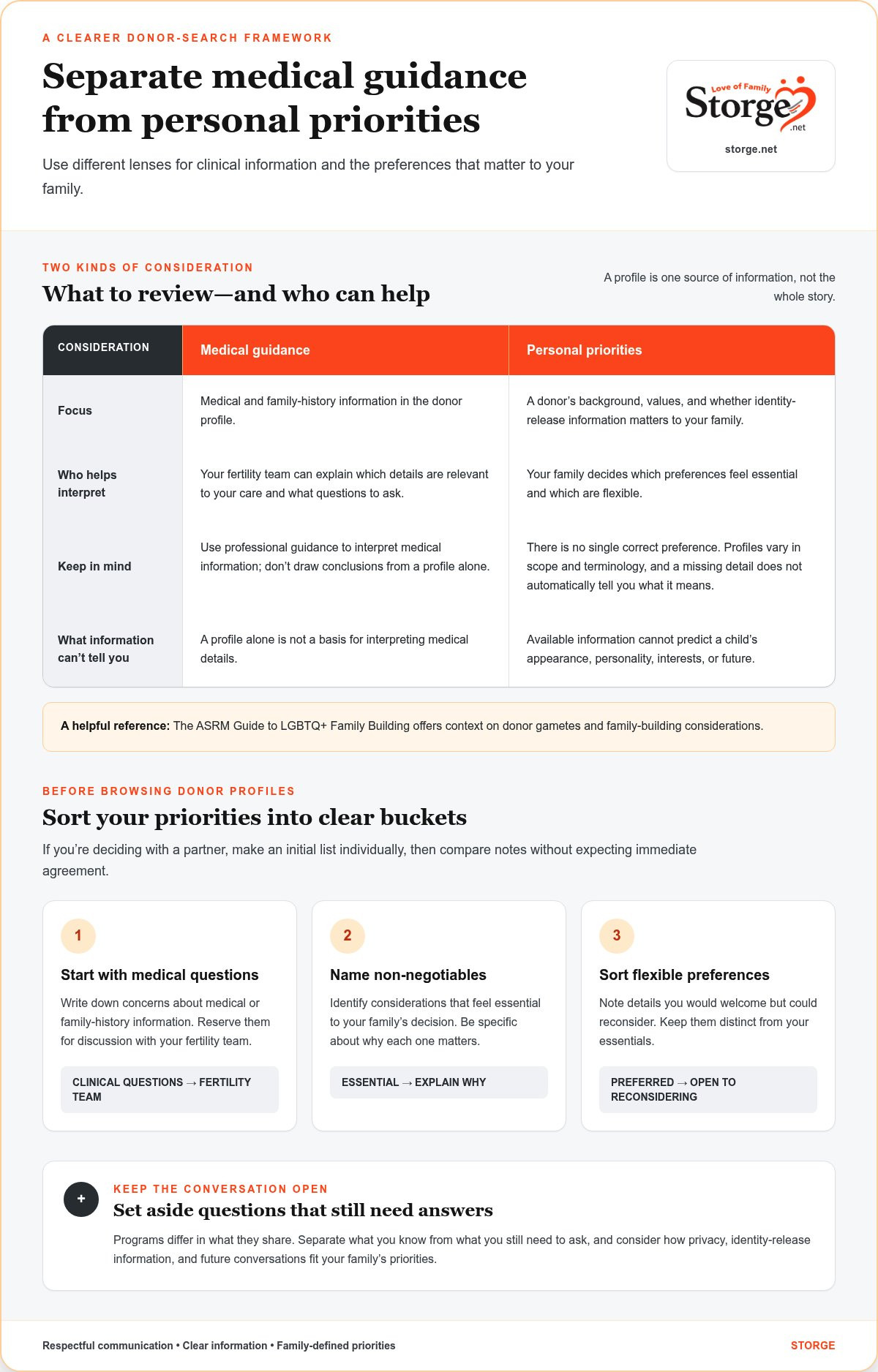
Review medical and family-history information with your fertility team. Your clinician can help explain which details are relevant to your care and what questions to ask about the information provided. The ASRM Guide to LGBTQ+ Family Building offers context on donor gametes and family-building considerations. Use professional guidance to interpret medical information rather than drawing conclusions from a profile alone.
Other considerations are personal. You may want to think about a donor’s background, values, or the availability of identity-release information, which can matter to some families considering future conversations with their child. There isn’t one correct preference. Profiles vary in scope and terminology, and the information available can’t predict a child’s appearance, personality, interests, or future.
How to separate must-haves from preferences
Try this process before browsing. If you’re making the decision with a partner, complete the first pass individually, then compare notes without expecting immediate agreement.
- Start with medical questions. Write down concerns about medical or family-history information and reserve them for discussion with your fertility team.
- Name your non-negotiables. Identify any considerations that feel essential to your family’s decision. Be specific about why each one matters.
- Sort flexible preferences. Note details you’d welcome but could reconsider. This distinction can keep one appealing profile feature from outweighing more important considerations.
- Record what remains unknown. Keep a running list of questions for your clinic or another relevant professional, including questions about terminology or the limits of available information.
Shared priorities can make conversations more manageable. If you and a partner differ, discuss the value behind each preference. Perhaps one person is focused on health information while the other is thinking about a child’s future questions. Understanding that underlying concern can help you decide whether something is essential, flexible, or still unresolved.
Use your notes as a guide, not a rigid scorecard. Profiles can support discussion, but they can’t offer certainty about who a child will become. If connection and LGBTQ+-focused family-building resources would help as you explore, Storge’s donor-search resources can complement clinic guidance as one part of your process.
Compare Egg Donor Search Pathways Without Losing Sight of Your Needs
Donor-search pathways can differ in how eggs are sourced, how the process is coordinated, and what decisions come next. Comparing those practical differences can help you connect your family’s priorities with a path to discuss with your fertility clinic. Finding an LGBTQ-friendly egg donor doesn’t mean choosing one universally preferred option. The right pathway is the one that fits your family’s needs, clinical plan, and expectations.
This high-level comparison can help you prepare questions. Program details and clinical plans vary, so the table isn’t a substitute for medical guidance.
| Pathway | Process and coordination | Considerations to discuss |
|---|---|---|
| Fresh-donor arrangement | Eggs are obtained through an arrangement involving a donor’s planned donation and coordination with the fertility clinic. | Ask your clinic how the plan, timing, and coordination fit your treatment needs and the program’s process. |
| Frozen donor eggs | Eggs have already been retrieved and frozen, with next steps coordinated with the clinic and program. | Discuss how the eggs and their information fit your clinical plan, and what steps the clinic recommends. |
Fresh donor arrangements and frozen donor eggs
A fresh arrangement involves coordinating a donor’s donation with the intended parents’ treatment plan. Your clinic can explain which medical steps and scheduling considerations apply to your circumstances. Frozen donor eggs have already been retrieved and stored; your clinic can explain how they would fit into your plan. Neither description alone tells you which option is medically appropriate or what outcome to expect.
Useful questions include: What does the clinic need to coordinate for this pathway? Which medical details are relevant to our situation? What steps depend on the program’s process? Coordination depends on the program and clinical plan, so discuss the implications with your fertility team before deciding.
Known, identity-release, and anonymous arrangements
These terms describe different expectations around donor identity and potential information or contact. A known donor is someone whose identity is known to the intended parent or parents. In an identity-release arrangement, identifying information may be available under circumstances defined by the program. “Anonymous” may describe limited identifying information or contact, but programs can use these terms differently. Clarify what each label means in the specific arrangement rather than relying on the word alone.
Consider what you hope to share with your future child, what information may be available later, and what contact expectations everyone understands. These are family conversations, not a test with one correct answer. A known arrangement isn’t automatically more affirming, just as an anonymous or identity-release arrangement isn’t automatically less so. Focus on the expectations, clarity, and support that feel right for your family.
Evaluate an Egg Donor Search With These LGBTQ-Affirming Checkpoints
A thoughtful evaluation looks beyond a welcoming label. As you consider finding an LGBTQ-friendly egg donor, notice how information is shared, whose questions are welcomed, and whether the process makes room for your family’s language and roles. These checkpoints can help you assess communication without assuming every program follows the same standards.
- Transparency: Can you find clear written explanations of the steps, the information provided, and who is responsible for each part? If a point is unclear, note what needs clarification rather than filling in the gaps yourself.
- Privacy: Is it clear how your personal information is handled and who may access it? Consider whether the process gives you a comfortable way to share sensitive details.
- Inclusive communication: Do forms and conversations avoid assumptions about gender, pronouns, relationship structure, or who will be a parent? You should be able to share names, pronouns, and family roles in the language that feels right to you.
- Role clarity: Is it clear which questions belong with the fertility clinic, the donor-search program, or an independent attorney? Knowing who handles what can help you direct questions to the right professional.
Questions about screening, privacy, and information-sharing
Donor screening can involve medical and genetic information, but qualified fertility professionals should explain the scope and meaning of that information. Screening cannot eliminate every health risk, and a profile or test result shouldn’t be treated as a guarantee about a future child’s health. Your clinical team can explain what testing was conducted, what the results mean for your circumstances, and what choices remain.
You might ask how medical and genetic information is communicated, who can access it, and how questions about results are handled. Look for written program information that describes the process, then discuss clinical interpretation and testing decisions with your fertility team. Practices and terminology may differ, so focus on whether the explanation is understandable and relevant to your care.
Questions about communication and coordination
Notice what happens when you share your family’s needs. For example, explain who should be included in updates, how each intended parent wants to be addressed, or which family terms matter to you. A clear response should help you understand how communication will work, rather than leave you unsure about whose role is recognized.
Specialized medical questions belong with the fertility clinic. Discuss questions about legal parentage, agreements, or rights with an independent attorney experienced in assisted reproduction. You can prepare for clinic conversations with a focused list of questions about inclusive communication and coordination.
If you’d like donor-search resources alongside fertility and specialized legal referrals, explore Storge’s LGBTQ+ family-building resources as you consider your next step.
Find Community and Take Your Next Step With Storge
You’ve considered what matters to your family, compared pathways, and identified questions for professionals. The next step doesn’t have to be a major decision. It could be choosing one question to resolve or finding a community that understands why this process can hold personal meaning as well as practical complexity.
How community support can complement professional guidance
Connecting with people familiar with LGBTQ+ family-building journeys can offer recognition and shared understanding. A community may help you feel less alone as you think through donor information, family conversations, and the decisions ahead. It can also offer a place to learn about others’ experiences without assuming their choices need to be yours.
Community connection is different from medical care or legal representation. Your fertility clinic is the resource for clinical recommendations and interpreting medical information. An independent attorney can advise on legal questions. Donor resources and community can complement that guidance, helping you find information and connection while professionals address questions within their expertise. A guide to the LGBTQ donor community can be another way to explore the value of shared experience.
Storge is an LGBTQ+ family-building platform that connects individuals and couples with a community that includes egg donors, sperm donors, and gestational carriers. Storge also offers fertility clinic and specialized legal representation referrals. These resources can work alongside one another, so you can seek community connection while keeping clinical and legal guidance with the appropriate professionals.
A manageable next step for your donor search
Start with the priorities you wrote down earlier. Choose one open question, then decide who is best placed to address it. For example, bring a question about medical information to your fertility team, or record a legal concern to discuss with an independent attorney. If your next need is connection, explore donor and community resources. One clear next step is enough for now.
Storge PLUS provides access to Storge’s trusted community and verified resources. Explore the Storge PLUS membership guide to learn more about the membership, then decide whether it fits what you need at this stage. Taking time to understand a resource before choosing it is a thoughtful part of the process.
Finding an LGBTQ-friendly egg donor is a personal journey, and you’re allowed to move at a pace that feels right for your family. If you’re ready to explore a community created around LGBTQ+ family building, join Storge PLUS for access to its donor community and verified resources. Bring clinical questions to your fertility team, and let your own priorities guide the way forward.
Let Your Next Step Reflect the Family You’re Building
You don’t need to have every part of your donor search figured out before moving forward. Choose one useful next step: write down a question, talk through a decision with someone you trust, or seek a resource that understands LGBTQ+ family building. Finding an LGBTQ-friendly egg donor is a personal process, and you’re allowed to shape it around your family rather than follow someone else’s timeline.
Storge is a specialized platform for LGBTQ+ family building. Through Storge PLUS, you can access a community that includes donors and gestational carriers, along with verified resources. Fertility clinic and legal-professional referrals can help connect you with guidance for questions that call for medical or legal expertise.
If community and resource access would help as you consider what comes next, explore Storge PLUS and find LGBTQ+ family-building community. Take the time you need, and trust that each thoughtful step can bring your family’s path into clearer focus.
Frequently Asked Questions
Can LGBTQ+ individuals and couples use an egg donor to build a family?
Yes. LGBTQ+ individuals and couples may use donor eggs as part of a family-building plan, with the specific approach depending on their circumstances and clinical needs. For example, someone may need donor eggs for fertility treatment, while some families may also need a gestational carrier to carry a pregnancy. A fertility clinic can explain which options fit your situation. There’s no single route that every LGBTQ+ family needs to follow.
What does LGBTQ-friendly mean when choosing an egg donor resource?
An LGBTQ-friendly resource respects your identity and family structure in its everyday interactions, not just its promotional language. Notice whether staff or materials use your names and terms correctly, recognize who you identify as a parent, and explain processes without relying on assumptions. Finding an LGBTQ-friendly egg donor resource can also mean having information presented clearly, so you can make decisions without feeling pressured to educate others about your family.
How do I know whether a donor profile has enough information?
A profile may have enough information to help you decide whether you want to learn more, but it may not answer every question your family has. Identify any gaps that could affect your decision, such as an unclear term or a detail you want your fertility team to interpret. Keep those questions together rather than guessing what missing information means. Profiles offer a snapshot, not a complete picture of a donor or a prediction of your child’s future.
Is a known egg donor better than an anonymous or identity-release donor?
No arrangement is automatically best for every family. A known donor may already be part of your life, while other arrangements can set different expectations about identifying information or future contact. Before choosing, discuss what everyone understands about communication, privacy, and possible future questions from a child. If you’re considering someone you know, an independent attorney can explain legal agreements and help clarify expectations before the arrangement proceeds.
Can an LGBTQ-friendly community replace a fertility clinic or attorney?
No. Community resources can offer connection and family-building information, but they don’t replace medical care or legal advice. A fertility clinic should guide treatment decisions and explain clinical information. An attorney can advise on legal questions specific to your circumstances. Storge connects LGBTQ+ individuals and couples with community resources, including donor and carrier connections, and offers fertility clinic and legal-professional referrals to help members find relevant support.
How should intended parents talk with a child about donor conception?
Many parents find it helpful to think about donor conception as part of their child’s family story, using simple, truthful language that can grow with the child’s understanding. You might begin with a clear explanation that a donor helped your family have a child, then welcome questions over time. Parents can discuss together what language feels natural and consider seeking guidance from a counselor experienced in donor-conceived families if they want additional support.
What should I ask about donor screening before moving forward?
Ask the fertility team what medical or genetic screening was performed, what the results can and can’t tell you, and whether any additional review is relevant to your circumstances. You can also ask who will explain results and where related records or follow-up questions should be directed. Screening doesn’t remove every possible health risk, so avoid treating a profile or test result as a guarantee. Your clinical team can interpret the information for your care.


