
What if the right online community could offer both a sense of belonging and a clearer path to your next family-building decision? An online community for LGBTQ family planning can connect you with people who understand the questions you’re facing, whether you’re exploring donors, a gestational carrier, fertility care, or another route to parenthood. The challenge is knowing which conversations offer peer perspective and which resources need closer scrutiny.
If you’ve felt alone in the process, or unsure how much to share, that hesitation makes sense. Community support can be meaningful without replacing advice from qualified medical or legal professionals. You should also be able to choose what you disclose as you get to know a space.
This article explains how to assess whether an online community feels affirming, how peer connection can complement professional guidance, and what to check before taking a next step. It also covers Storge PLUS as one option for accessing an LGBTQ+-focused family-building community, alongside referrals and search resources for people considering donors, carriers, clinics, attorneys, or hospitals.
Key Takeaways
- An online community for LGBTQ family planning can support connection and resource discovery, but the right starting point depends on what you need now.
- Compare peer groups, directories, referrals, and integrated platforms to find the kind of support that fits your current stage.
- Before sharing personal details or relying on recommendations, check a community’s privacy practices, moderation, transparency, and approach to verification.
- Donor, carrier, clinic, attorney, and hospital searches may become relevant at different points in a family-building journey.
- Storge PLUS provides access to a community of donors and gestational carriers, alongside other family-building resource options.
What an Online Community for LGBTQ Family Planning Can Offer
There’s no single correct starting point for building a family. You might be exploring donor options, considering fertility care or surrogacy, weighing adoption, or simply making space to imagine what parenthood could look like. Your plans may change as you learn more, and you don’t need to choose a path before finding support.
A family-planning community is a digital space where people connect, share experiences, and discover resources. It can offer perspective and help you prepare, but it can’t replace individualized professional advice. Some communities focus mainly on peer conversation. Others include resource directories or referral pathways. A directory can help you find or compare providers, while a qualified clinician or attorney can offer guidance specific to your medical or legal circumstances. These functions may appear in one place, but they aren’t interchangeable.
Family-building can take many forms. For a broad overview of LGBT parenting options, including adoption, surrogacy, and assisted reproductive technology, see Wikipedia’s summary. It can help you learn the language around different paths before exploring what fits your own goals.
Who can use an LGBTQ family-planning community?
An online community for LGBTQ family planning can be relevant at many stages, whether you’re gathering early information or actively exploring donors, fertility care, or a gestational carrier. It may also help people considering adoption or other routes find shared experiences and questions to explore. You don’t need to have a partner, set a timeline, or know which option you’ll pursue to take part.
Look for spaces that welcome LGBTQ+ people across identities and relationship structures, including single intended parents and families with different goals. You should be able to decide how much to share. Reading quietly or asking general questions can be a useful first step.
Community support versus professional guidance
Peers can describe what they found confusing, what helped them prepare, or what they wish they’d asked earlier. Their stories may help you feel less alone and turn a broad concern into a focused question for a professional. They’re personal experiences, though, and don’t guarantee that your situation will unfold the same way.
Medical decisions belong with qualified healthcare professionals, legal questions with an attorney familiar with your circumstances, and mental-health concerns with an appropriate mental-health professional. A community can help you discover resources and prepare for those conversations, but it can’t assess your individual needs or provide professional advice. For a broader overview of family-building resources, read this LGBTQ family-building guide.
How LGBTQ Online Communities Connect Support with Family-Building Resources
An online community can be more than a place to talk. Depending on the platform, it may bring together peer connection, shared experience, resource discovery, and referrals. You might hear how someone approached an early conversation with a clinic, find questions to ask while exploring donor options, or realize that you need legal guidance before making a decision.
The next steps depend on your goals. Someone considering donor eggs or sperm may want to learn from others with similar experiences. A person exploring a gestational carrier may be gathering information about clinics, attorneys, and hospitals. Someone exploring fertility care may want to identify providers and prepare for an initial conversation. For an overview of LGBTQ+ family-building options, RESOLVE: The National Infertility Association offers information to help you explore possible paths.
A referral or directory can help you find a professional; it isn’t medical treatment, legal representation, or a guarantee that a provider is right for you. Services vary by platform. Confirm what it currently offers, how referrals work, and what you’ll need to assess for yourself.
Finding peers and learning from shared experiences
Community connections can make unfamiliar steps easier to discuss. A moderated discussion, where available, or a conversation with someone who has considered a similar path may help you identify practical questions. Experiences are individual, though, and another person’s timeline or outcome may not apply to yours. If you’re exploring donor-related connections, the LGBTQ donor community guide offers a starting point for understanding this part of family-building.
Connecting with qualified family-building professionals
Referrals can narrow your search, but take time to check credentials and ask prospective professionals about their experience supporting LGBTQ+ people and families like yours. Ask how they approach your specific needs, what their role includes, and what questions you should resolve before moving forward. A referral is a lead to explore, not an endorsement or promise of fit.
For clinic conversations, use this resource on questions for an LGBTQ-friendly fertility clinic to prepare. Storge connects LGBTQ+ individuals and couples with family-building resources, including referrals to fertility clinics, attorneys, and hospitals, as well as donor and gestational-carrier searches. To explore those resource options, visit Storge’s family-building platform.
How to Evaluate Whether an LGBTQ Family-Planning Community Is Trustworthy
An affirming tone matters, but it isn’t enough on its own. An online community for LGBTQ family planning may discuss deeply personal information and connect you with consequential resources, so understand how the space works before relying on its claims or sharing details. A useful principle: verify claims independently, and share only information you’re comfortable disclosing.
Use this checklist to guide your questions:
- Look for transparency. Can you tell who operates the platform, what it offers, and how referrals or resource listings work? Ask for clear explanations rather than relying on broad terms such as “trusted” or “verified.”
- Review privacy and account controls. Check what information is visible to other members, how the platform says it handles data, what account controls are available, and how to report a concern. Don’t assume a particular privacy or data-retention practice unless the platform confirms it in current documentation.
- Understand community standards. Find out how members interact, whether discussion guidelines are available, and how to report harmful, misleading, or unwanted behavior. Ask how concerns are handled rather than assuming a specific level of moderation.
- Ask what verification means. Find out which details about members or resources are checked, who checks them, and what the process does not confirm. Verification may have limits, so clarify them before treating a listing or claim as proof of suitability.
- Check professional boundaries. A community or referral platform should make clear whether it helps with discovery or provides professional care. Confirm that medical questions go to qualified healthcare professionals and legal questions to an attorney.
Questions to ask about privacy and community standards
Before joining or posting, ask who can see your profile and contributions, whether you can control or remove account information, and how to report a concern. If those details aren’t easy to find, contact the platform and request its current policies. You can also begin by observing the space, if that option is available, and decide what feels comfortable to share.
How to assess donor, carrier, and professional listings
For a donor, gestational carrier, clinic, attorney, or hospital listing, ask what information has been checked and whether that check confirms identity, credentials, experience, or something else. These are different things. Independently verify professional credentials and speak directly with providers before making consequential decisions. A listing or referral can help you discover an option, but it doesn’t guarantee credibility or fit.
If you’re considering a gestational carrier, the gay surrogacy guide offers additional context to help you identify questions for your own research and professional conversations.
How to Choose an Online Community That Fits Your Family-Planning Needs
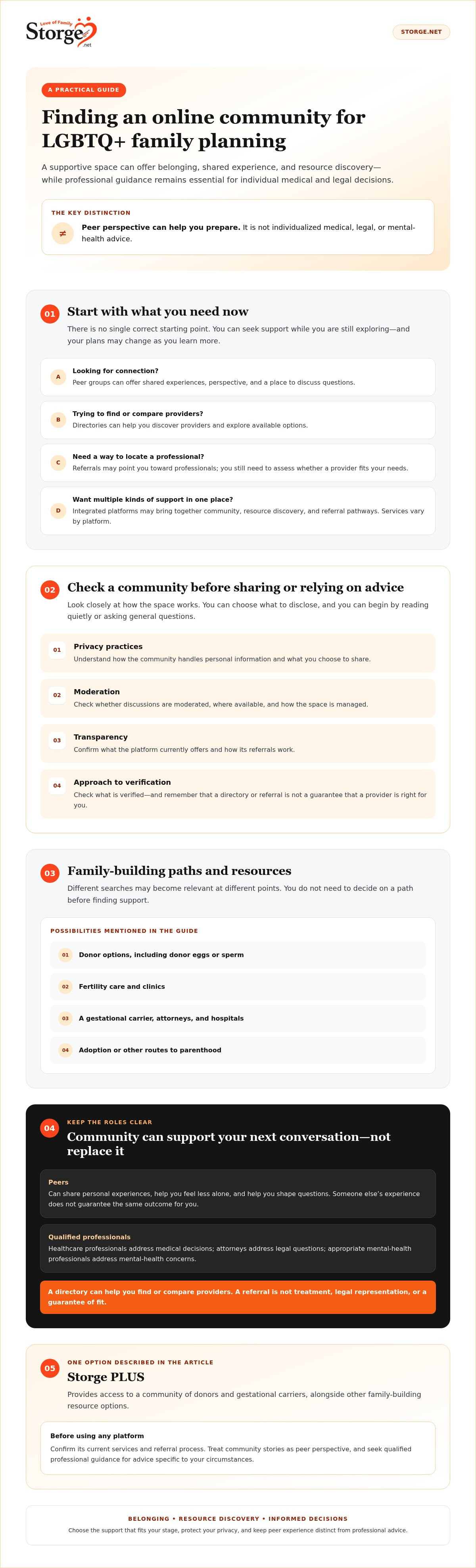
The best fit depends on what would help you now, not on which platform makes the biggest promises. An online community for LGBTQ family planning might help you connect with peers, discover resources, or find referral pathways. Use the comparison below to identify what to look for, not to rank every platform. Features and availability vary, so confirm details directly.
| Community type | May suit you if you want to… | What to check |
|---|---|---|
| Peer group | Share experiences, hear different perspectives, and feel less alone. | Community guidelines, how members interact, and whether the space feels respectful to you. |
| Resource directory | Explore categories of donors, carriers, clinics, attorneys, or hospitals. | How listings are maintained, what information is checked, and whether details are current. |
| Professional referrals | Find potential clinics, attorneys, or hospitals to contact. | What a referral means, which details you should verify, and whether the professional fits your needs. |
| Integrated platform | Explore community connections alongside family-building resource options. | Which features are included, any access limits, and the current membership terms. |
Which community features matter at each stage?
If you’re just exploring, look for welcoming information and perspectives on different ways to build a family. During active planning, focus on resources related to the path you’re considering, such as donor or gestational-carrier searches, clinic referrals, or attorney referrals. Later, hospital information may become relevant. At each stage, confirm that the specific resource is currently available and appropriate for your situation.
Recognizing a good personal fit
Notice how the platform speaks about LGBTQ+ people and families, whether its expectations feel comfortable, and whether its resources match your priorities. Clear explanations of membership terms, access limits, and cancellation details can help you make an informed choice. You don’t need to join a paid community to begin exploring, and you don’t have to share private details or decide immediately.
A low-pressure first step is to review the policies, write down your questions, and ask the platform for clarification before creating an account or sharing more. Take time to compare options. A good fit should support your pace and goals, not make you feel rushed.
To explore an LGBTQ+-focused platform with community access and family-building resource options, visit Storge’s family-building platform.
How Storge Supports an Online Community for LGBTQ Family Planning
Storge is a national online platform that connects LGBTQ+ individuals and couples with family-building community and resource options. For people seeking an online community for LGBTQ family planning, it offers a place to explore possible connections and practical next steps while keeping the limits of each resource clear.
What Storge can help members explore
Storge PLUS provides access to a community of donors and gestational carriers. Storge also offers egg donor, sperm donor, and gestational-carrier searches, along with referrals to fertility clinics, attorneys, and hospitals. These options can help you discover possible next steps, but they don’t guarantee a match or establish that a provider is right for your individual circumstances.
A referral is a starting point for your own research. Storge doesn’t perform medical procedures, provide legal representation in-house, or operate as a full-service surrogacy agency. For care or legal advice, speak directly with qualified professionals and confirm their credentials, experience, services, and suitability for your needs.
A low-pressure next step for your family-building journey
You can review the available community and resource options at your own pace, without deciding on a family-building path right away. Before joining or using a resource, consider asking:
- What information about donors, gestational carriers, or professionals is checked, and what does that check confirm?
- How does the platform describe privacy, account controls, and the visibility of information I share?
- What does Storge PLUS membership currently include, and are there access limits or other terms I should understand?
- What does a referral involve, and what should I verify with the provider directly?
These questions can help you decide whether the platform’s resources align with your goals and what you feel comfortable sharing. Membership details, access, and verification practices can change, so confirm current information directly rather than assuming how a service works.
If you’d like to learn more, explore the Storge PLUS membership and review its current details as you consider what feels right for your family-building journey.
Take Your Next Step at Your Own Pace
The right online community for LGBTQ family planning can offer connection and help you discover useful resources while leaving room for your priorities and comfort level. Before relying on a listing or recommendation, ask how information is checked, review privacy and membership terms, and seek professional medical and legal advice from qualified providers.
Storge PLUS provides access to a community of egg donors, sperm donors, and gestational carriers. Storge also offers referrals to fertility clinics, attorneys, and hospitals, helping you explore possible next steps without replacing those professionals’ services. Confirm current membership details and resource practices as you consider what may fit.
If you’re ready to explore, explore the Storge PLUS community and review the options at a pace that feels right. You don’t need to have every answer today. Each thoughtful question can help you move toward a family-building path that reflects your hopes.
Frequently Asked Questions
What is an online community for LGBTQ family planning?
An online community for LGBTQ family planning is a digital space where LGBTQ+ people can connect, share experiences, and discover family-building resources. Depending on the platform, members might discuss questions about donors or fertility care, or find information about clinics and other providers. Peer conversations can offer perspective and help you prepare questions, but they aren’t individualized medical, legal, or mental-health advice from a qualified professional.
How can I find an LGBTQ-friendly family-planning community?
Look for a community that clearly welcomes LGBTQ+ people and families with different identities, relationships, and goals. Before joining, review its privacy information, including what other members may see, and check whether its resources match your interests, such as donor searches or clinic referrals. Read the community standards and learn how to raise concerns. If anything is unclear, ask the platform directly before sharing personal details.
Are online LGBTQ family-planning communities safe to use?
Safety varies by platform, so review its current privacy and community policies before participating. Check what information may be visible, what account controls are available, and how to report harmful or misleading behavior. Don’t assume that every member or resource has been verified in the same way. Start with general questions if that feels more comfortable, and share personal or sensitive information only when you’re ready.
Can an online community help me find an egg donor or gestational carrier?
Some platforms offer donor or gestational-carrier searches, community connections, or both, but available options and verification processes vary. Storge offers egg donor, sperm donor, and gestational-carrier searches, and Storge PLUS provides access to a community of donors and gestational carriers. These resources don’t guarantee a match. Ask what information is checked, confirm current availability, and discuss medical and legal considerations with qualified professionals.
Do online family-planning communities provide medical or legal advice?
Peer communities generally share personal experiences and help members discover resources, while referrals point people toward professionals. Neither a member’s story nor a referral is a substitute for advice tailored to your circumstances. For medical decisions, speak with a qualified healthcare professional; for legal questions, consult an attorney. Ask each platform to explain its role so you know whether it offers peer connection, resource discovery, or professional services.
How do I know whether a donor or carrier resource is verified?
Ask the platform what information it checks, who conducts the check, and what the process confirms. Verification may refer to different details, such as identity or professional credentials, and it may have limits. Don’t treat a listing or profile as proof that someone is suitable for your situation. Independently confirm relevant information, speak directly with the people or professionals involved, and seek qualified medical or legal guidance before consequential decisions.
Is Storge a surrogacy agency or fertility clinic?
No. Storge is an online platform connecting LGBTQ+ individuals and couples with family-building resources. It offers fertility clinic, attorney, and hospital referrals, as well as egg donor, sperm donor, and gestational-carrier searches. Storge PLUS provides access to a community of donors and gestational carriers. Storge doesn’t perform medical procedures, provide in-house legal services, or operate as a full-service surrogacy agency. Confirm current membership details and resource practices directly.


